My Submission to the Standing Committee on Finance, 2026

The House of Commons Standing Committee on Finance has been taking pre-budget submissions from whoever wants to contribute. I chose, unsurprisingly, to focus on funding child care, especially child care in Ontario. Here’s what I wrote:

RECOMMENDATIONS

  1. Expansion is the key priority for this next 5 year period. Provinces who are not yet at $10 a day should be allowed to get to $10 a day more slowly than originally planned to focus scarce funds on expansion. 
  2. The federal government should increase its annual amount of CWELCC funding sufficiently to allow child care capacity to continue to grow in all provinces and territories. Equally important, the federal government needs to credibly commit to maintaining and expanding the child care program.   Across Canada, an extra $4 billion to $6 billion annually would allow for maintaining the program and increasing capacity.  A clear commitment to maintaining and expanding the program can substantially reduce expansion risks for non-profit child care providers.
  3. In Budget 2024, the $1 billion Child Care Expansion Loan Program for non-profit child care was announced.  This program should now be implemented in its original or amended form. Non-profit child care operators have little access to capital funding to expand.  This would be of great assistance, especially to multi-site non-profit operators.
  4. The Child Care Infrastructure Fund of $625 million to support expansion is being sunsetted.  This has been a good model, with money distributed through provincial/territorial authorities.  It should be repeated and expanded, perhaps with some tweaks to funding rules.

TOPICS

  • The benefits of universal child care
  • How much more child care does Ontario need?
  • How is Ontario doing on expansion?
  • Why is child care expensive to provide?
  • What is the average operational cost of a child care space?
  • What could Ontario do with additional federal funding?
  • Should Ontario lower its fee to $10 a day?
  • Would income-testing help?

The benefits of universal child care

Much has been written about the benefits of universal child care.  Two recent papers are especially important.  

The first is by economists Michael Baker, Johnathan Gruber and Kevin Milligan.[1] They analyze universal child care in Quebec to show that:

  • Mothers’ employment in Québec rose by a lot and stayed permanently higher through those mothers’ lives (+12 percentage points by age 50).
  • Mothers’ incomes grew very substantially over their lifetimes as a result of maintaining attachment to the labour force and not losing skills when their children were young (+27% by age 50).
  • There was a substantial drop in the level of family poverty, particularly during childbearing years. The program was particularly important for those without a university education – the policy had a consistently strong effect on mothers with levels of education below university
  • Based on analysis of Canadian tax records over a long period, Quebec’s $5 a day child care reforms generated enough government tax revenues and reduced social benefit payments to pay for the costs of the program.  

The second paper, again analyzing universal child care in Quebec, is by economists Montpetit, Carrer and Beauregard.[2]  They uncover two important results:

  • In addition to the important gains in employment and earnings for mothers, they measure substantial additional benefits that we might describe as work-family balance.  Universal child care makes all the tasks associated with caring for children less stressful and onerous for the family.
  • This point is obvious but generally overlooked.  All of the benefits of universal child care – employment, earnings, work-family balance, etc – depend on increasing the supply (availability) of child care even more than on improvements in affordability.  The benefits depend on making more spaces available to families.

Our takeaways from these studies: Not only does early learning and child care deliver very substantial economic benefits to mothers and families, it also delivers very substantial fiscal benefits to governments.  These benefits depend on continuing to grow the child care system, making it available to all families.

How much more child care does Ontario need?

The federal government has set 59% of children 0-5 years of age as a target.  This is a reasonable definition of “universality” given that Ontario already has full-day early learning for children 4 and 5 and maternity/parental benefits and leave for children up to 12 or 18 months of age.  To reach 59%, Ontario would need to have 515,430 child care spaces for children 0-5.[3]  As of the end of December 2026, Ontario plans to have 375,111 spaces.[4] 

After December 2026, Ontario would reach the federal target if it had 140,319 additional spaces inside CWELCC and all of them were operational. 

How is Ontario doing on expansion?

In Québec’s successful child care rollout, growth happened quickly – was planned and organized.  Québec started with 18% coverage of 0-4 year old children in 1997.  By 3 years later, it had added another 11 percentage points of coverage.  By 8 years after the program started, it had added another 23 percentage points of coverage and provided enough child care for 52% of all children 0-4 by 2005.  This strong commitment to expansion of the program greatly aided its acceptance and ultimate success.

In the first 3 years, from 2022 to 2025,  Ontario’s centres grew from about 34% coverage of children 0-5 to about 39%, an increased coverage of only about 5 percentage points.  Ontario’s child care system is growing much more slowly than Québec’s did.   Without this growth, families and governments will not reap the benefits of a universal affordable child care program.

Why is child care expensive to provide?

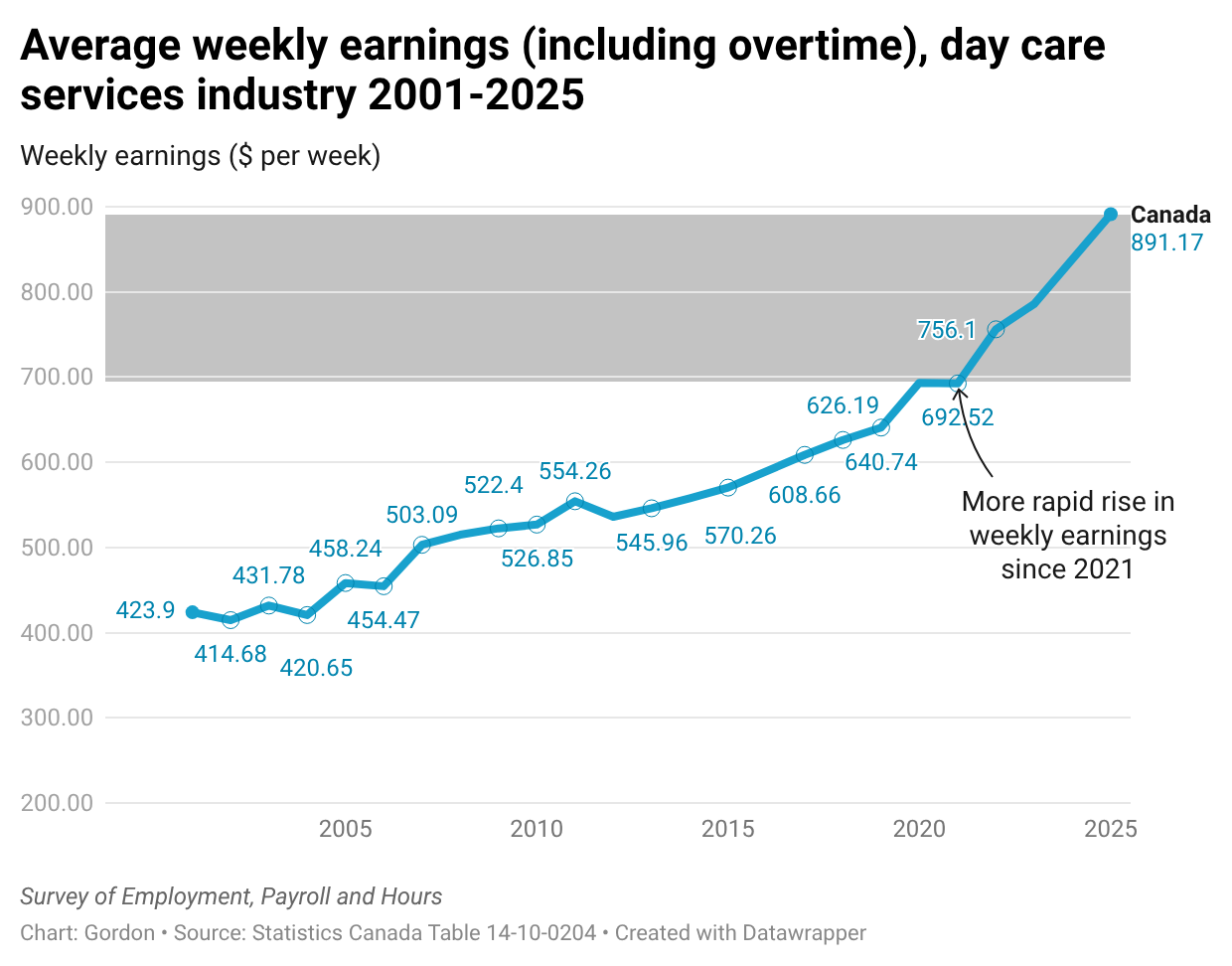
It’s not a surprise that child care is expensive; it requires a lot of skilled labour.    Registered Early Childhood Educators (RECEs) in Ontario now earn about $27 an hour on average and Educator Assistants earn about $22 an hour. 

As an example, how much in staff salaries does it cost to provide care for toddlers in Ontario?  According to regulations, one RECE and two Assistants can look after 15 toddlers and the child care centre is open for perhaps 10 or 11 hours per day.  If these ratios need to be maintained all day, you can calculate these salary costs on a 10 hour day and add 20% for benefits (not generous).  Then the staffing costs per toddler amount to nearly $57 per day per child.

That’s without adding in the cost of food and food preparation, supplies, the costs of leasing the centre and playground, the cost of replacement staff for holidays and a share of the costs of the supervisory and administrative staff.   Or the cost of providing an allowance for profit.  So, the provision of child care can be expensive, even on the relatively low salaries and benefits that are currently paid. 

What is the average operational cost of a child care space?

Ontario has a funding formula that they developed based on evidence that the Ministry of Education collected about the cost of providing child care.  We can reverse engineer this funding formula to give us estimates of the typical operational costs of providing child care – program staff, supervisory staff, operations and accommodation.

In Ontario, this estimate based on the 2026 funding formula is $130 per day for infants, $85 per day for toddlers, $65 per day for preschoolers and $35 a day for kindergarten children.   A single cost estimate per space, irrespective of child age, is meaningless; costs vary depending on the ages of children using child care.  Note that costs in Ontario are higher than in many other provinces, for good reasons.  Typically, the quality-related regulations are stronger and better enforced in Ontario.  That’s good for children.

What could Ontario do with additional federal funding?

Many of Ontario’s child care spaces – about 80,500 – are licensed but non-operational.  The Auditor General of Ontario advises that “many of these centres operate below their capacity because of staffing shortages, including RECEs” (Auditor General of Ontario, 2025, p. 42). 

To solve staffing shortages, compensation of early childhood educators will have to rise.  Currently the average educator wage for program staff appears to be about $27 per hour and for staff without these qualifications about $22 per hour.  A rise of about 25% in compensation (wage and benefit improvements) has been called for to aid recruitment and retention of staff.[5]  

If Ontario had an extra $1 billion of operating funding, I estimate it could fund nearly 70,000 of these already licensed but non-operational spaces at rates allowing for a 25% compensation increase for educators.

Alternatively, $1 billion of new operational funding could support services in about 57,000 NEW spaces with a 25% compensation increase for educators. New spaces receive a growth supplement to operational funding in Ontario and therefore cost more. 

Ontario needs at least $2 billion additional funding in order to stay on track for building an affordable universal child care system.  Since, Ontario is about 38% of Canada’s population, an extra $2 billion annual funding for Ontario would imply about $5.3 billion annual funding for all provinces and territories combined. 

More one-time-only funding is also needed for capital grants to support expansion.  Overall, the federal commitment needs to rise by between $4 billion and $6 billion annually.  That would allow building of adequately staffed and stable child care services serving over 100,000 more children in Ontario than was true in 2025.

Should Ontario lower its fee to $10 a day?

No.  Not right now.  The parent fee of a maximum $22/day (actual average $19/day) brings in significant revenue which is needed given Canada’s current economic situation.  Ontario has had a good child care subsidy system targeted at lower income families and vulnerable children.  It subsidizes many families that cannot afford $22/day and should subsidize more.  This subsidy system should be made more accessible; it is important to retain and improve access to child care subsidies.

Would income-testing make child care more affordable for governments?

The existing child care subsidy system is a form of income-testing, helping those who cannot afford $22 a day ($5,742 per child for a full year).  Maintaining this subsidy system or improving it is very important.  However, this is not what most people mean when they advocate income-testing.

There are two other types of proposals for income-testing.  One would mimic the funding system used in Québec for several years (2015-2019) under Premier Philippe Couillard.  In Québec, everyone using a fixed-fee provider paid the provider $7.30 per day.  Then, at tax time, the family would be assessed for how much child care they had used and would pay an income-tested extra amount to the Québec government.

The scheme became unpopular very quickly.  Families were “surprised” when they had to pay a few thousand extra dollars at tax time.  And, it didn’t raise that much additional revenue for governments.  So, the incoming CAQ government cancelled income-tested fees and returned to a fixed fee, rising over time with inflation.

The other kind of income-testing is like that used by the Australian Government.[6] The trouble with this kind of scheme is that it is entirely market-based.  There are no controls on provider fees and fees tend to rise constantly.  The average total fee charged by providers in Australia, irrespective of child age, is over $130 per day. And there is no financial accountability by providers for the subsidy money they received on behalf of parents.  This results in an unaffordable and unaccountable set of funding arrangements.

Both of these income-testing alternatives take a considerable amount of administration.  Unless governments are willing to have some parents pay much higher fees, they don’t raise that much revenue from parents.  On the other hand, a fixed fee model provides certainty to parents and, arguably, is a large part of the reason why the labour force impacts of Québec’s child care program have been so large over time.

Staying at $22/day with a well-functioning subsidy system is a better alternative than dropping the fixed-fee to $10 a day and layering income-testing on top of it.


[1] Baker, M., Gruber, J. & Milligan, K. (2026) Investing in Mothers? The Long-Run Impact of a Universal Child Care Program on Maternal Work and Income.  Working Paper.  https://drive.google.com/file/d/1PqKGMyrqKMMvUEXiahcx5jbQ4JhbLsYo/view

[2] Montpetit, S., Carrer, L., & Beauregard, P-L (2026) A Welfare Analysis of Universal Childcare Lessons from a Canadian Reform.  Working Paper. https://sebastienmontpetit.github.io/WebsiteSM/MCB_QCchildcare.pdf

[3] Ontario has 873,610 children 0-5 years of age as of July 1st, 2025 (Statistics Canada table 17100005).  

[4] Auditor General of Ontario (2025) Performance Audit: Canada-Wide Early Learning and Child Care Program.  Special Report 2025.  Office of the Auditor General of Ontario, p. 15.  But also see Moran, H. (2025) Updates to 2025 Ontario Child Care and Early Years Funding Guidelines. Memo to SSMs. https://efis.fma.csc.gov.on.ca/faab/Memos/CC2025/EYCC01_EN.pdf. This memo suggests capacity at end December 2026 will be 400,881 licensed spaces.  This may include spaces outside CWELCC.

[5] A. Shariati (2024) Addressing the Early Childhood Educators Labour Shortage in Canada: Challenges, Solutions and Impacts.  Centre for the Study of Living Standards Report prepared for YMCA Canada.

[6] Cleveland (March 2025) Does Tax Credit Funding Work for Child Care: Lessons from Australia.  https://childcarepolicy.net/does-tax-credit-funding-work-for-child-care-lessons-from-australia/

Child Care Investments Really Do Pay Off

Economists Michael Baker, Johnathan Gruber and Kevin Milligan have just produced a remarkably important research study

We all know about the studies (here, here and here) that show that Quebec’s $5 a day child care had really significant positive impacts on women’s labour force participation.   The employment rate of Quebec women went from substantially below the rest of Canada to substantially above.  The fixed, predictable parent fee removed a major barrier to mothers’ employment.

And Pierre Fortin and his colleagues (here) have given us good reason to believe that these increases in women’s employment generated by predictable parent fees brought in enough additional tax revenue to more than pay for the costs of the child care program.

But this paper by Baker, Gruber and Milligan goes farther and deeper than that.  This paper uses Labour Force Survey data and anonymized tax records to:

  • Show that the short term rise of about 9% in mothers’ employment generated by the Quebec program stayed at a permanently higher level, rather than being temporary.  Most of this employment was full-time
  • Show that over time mothers who were affected by the child care program had incomes that grew much faster than they otherwise would have, as a result of their attachment to the labour force and not losing skills when their children were young
  • Show that there is a substantial fall in family poverty in the childbearing years
  • Show that the program was particularly important for those without a university education – the policy did not provide a significant employment boost to those with university degrees but had a consistently strong effect on mothers with lower levels of education.
  • Confirm that even if we only consider income taxes and social benefit savings, Quebec’s $5 a day child care reforms generated enough government tax revenues to pay for the costs of the program (or very close).  Earlier work had calculated that the short run fiscal return to governments was nearly 40% of the program cost.  These new results show that the fiscal return over the lifetime of those mothers affected by the program is approximately enough to cover the total cost (between 75% and 117% of the total cost depending on what discount rate is used in the calculations).

Our Carney government needs to hear this message.    Most provincial and territorial governments are telling him now that the current federal commitment of money to this program – about $8 billion per year – is too small to keep it alive for the next five years.  Some are talking about leaving the program altogether or changing it dramatically to make parents pay more.  It makes no sense to ditch a social program that helps hundreds of thousands of Canadian families, raises employment, raises women’s earnings, and increases tax revenues sufficiently to pay for the program.

But there is more in this study that the federal government should hear.  One way of viewing the results of this study is to focus on the message – “Universal child care can pay for itself!”.

But, a second way of viewing these results is that there is strong evidence here that universal child care dramatically improves women’s lives for the better. 

As many of us know, having children tends to have strong negative effects on women’s labour market outcomes, but not on men’s.  This has come to be called the “motherhood penalty”, or sometimes the “child” penalty.  For example, Canadian economists have found that, even ten years after a birth, mothers’ earnings  are typically 34.3 percent lower than they were before birth, and on average nearly 15 percent fewer of these mothers are employed.  That’s a huge motherhood penalty.

But, the research in Baker-Gruber-Milligan paper shows that Quebec mothers who benefited from its universal $5 a day child care program in the early 2000s had much higher earnings later in life as a result.  This earnings impact was progressive, reaching an average of 27% by the time these mothers reached age 50. 

So, not only did Quebec’s child care program more or less pay for itself, it also dramatically reduced the motherhood penalty that Quebec women faced throughout their lives.  If that’s not a good news story, I don’t know what is.

And what it means for our government is that the investments they make right now in child care will make mothers’ lives better and family incomes higher for years and years to come.  It sounds to me like the Canada-Wide Early Learning and Child Care program is just the kind of Major Project that Prime Minister Carney should be investing in.  And while many of the Major Projects being discussed appear to be somewhat male-oriented, this one dramatically helps women to overcome the barriers that hold them back in the workforce.

How is CWELCC Doing? A Response to Peter Jon Mitchell

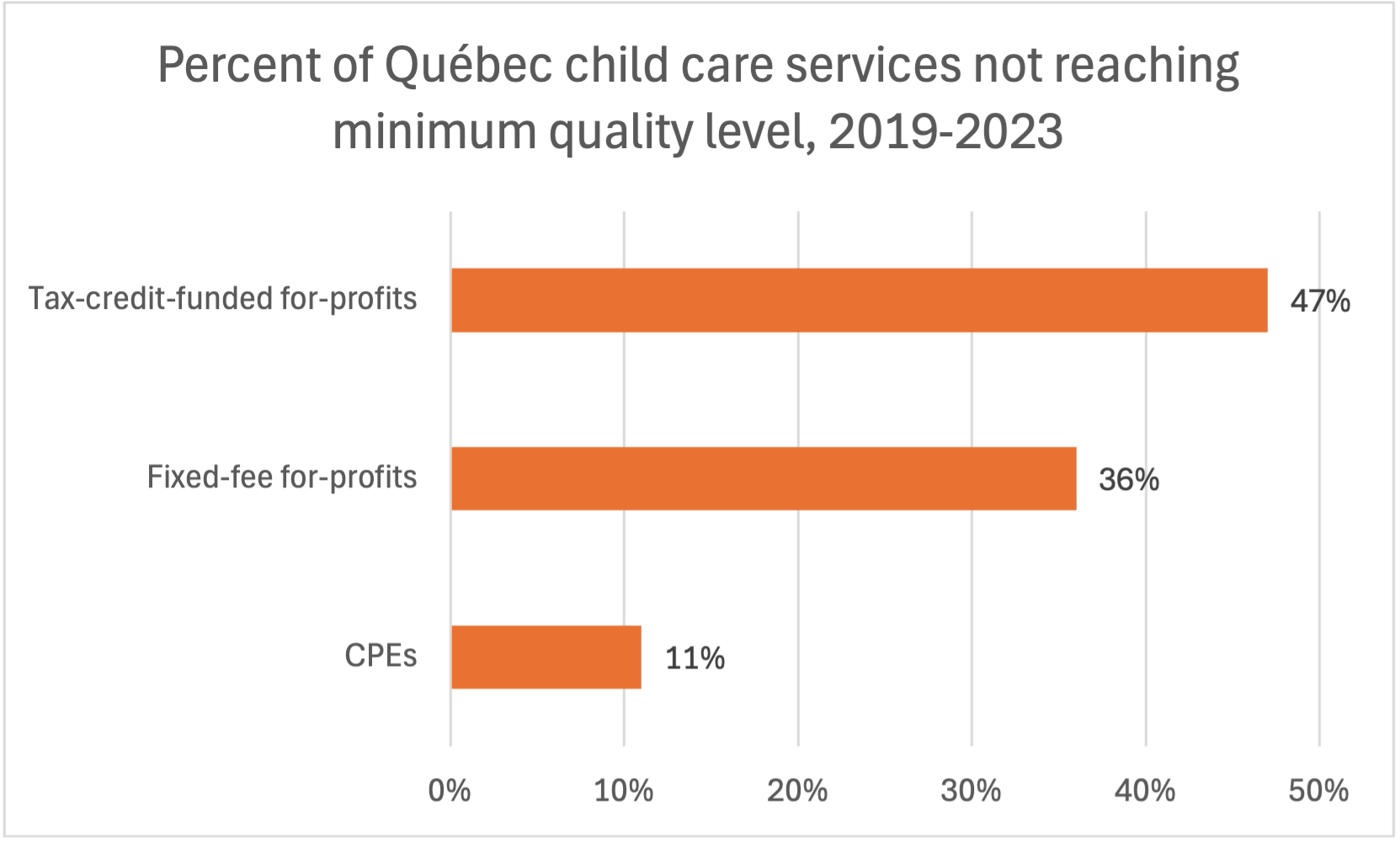
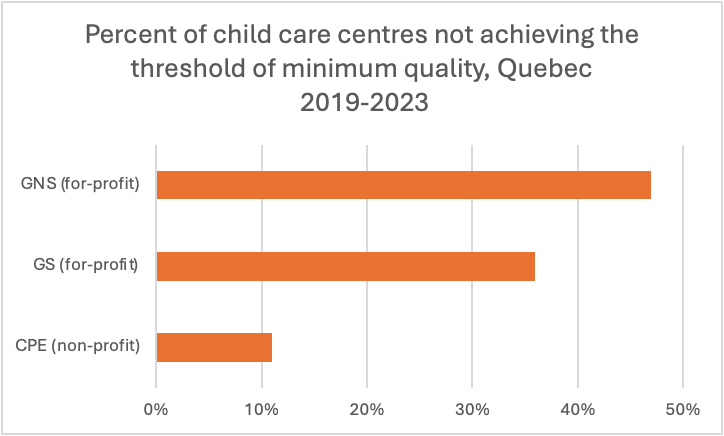
This week in the Hill Times, Peter Jon Mitchell says he wants to get rid of the $10 a day federal child care program.  But too many families now love it and depend on the increased child care affordability that has made their lives better.  So instead Peter Jon argues that the Canada Child Benefit or the Child Care Expense Deduction should be amended to provide child care assistance to those who can’t find child care.  But neither solution would be much help.  The Canada Child Benefit goes to nearly every family independent of whether they want to use any form of child care so this would be a very expensive way to deliver assistance.  And the type of tax credit that Peter Jon would use to replace the Expense Deduction has been an unmitigated disaster for child care quality in Quebec, as the charts below show.

Peter Jon hopes to convince us that the federal child care funding program is a complete failure and shambles, so he throws as much mud as possible at the wall to see if any of it will stick.  He has these complaints about the program:

  1. Space creation is difficult because the child care agreements favour expansion predominantly in the not-for-profit/public/family child care sector
  2. Many existing licensed spaces are empty or not operating
  3. Most children under six years of age don’t benefit from the program
  4. Only 71% of centres are in CWELCC – the federally funded program
  5. The program breeds inequality. Child care enrolment by low-income families is declining – by 31% in Ontario.
  1. Not-for-profit

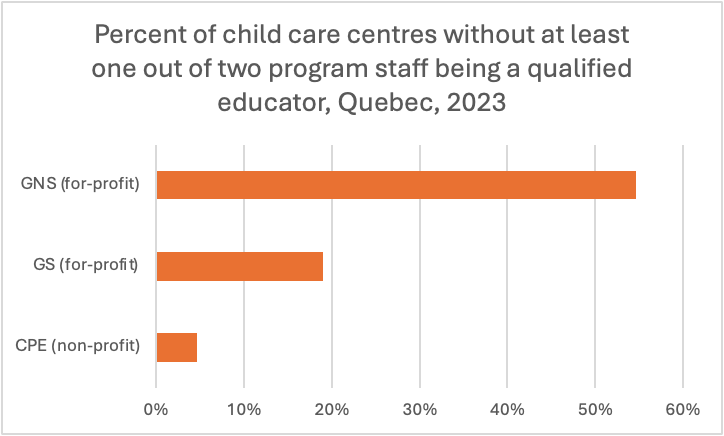
The not-for-profit issue has been tested in practice.  As Peter Jon reminds us  “Quebec’s daycare program, upon which the CWELCC is modelled, has long depended on private, for-profit childcare businesses.”  It’s true that since about 2010, Quebec has relied on a tax-credit-funded expansion of for-profit child care operators.  There are three types of centres in Quebec. There are the CPEs which are not-for-profit community-based centres that charge a flat fee less than $10 a day.  There are the funded for-profit child care centres (shown as GS on the charts) that also charge the low flat fee. There are the tax-credit-funded child care centres that grew since about 2010, shown as GNS on the charts.

It might surprise Mr. Mitchell to hear that Quebec Families Minister Mathieu Lacombe told the Globe and Mail in 2022 that “allowing for the expansion of private daycares was the biggest mistake that the Quebec government committed in the last 25 years.”   And the Quebec Auditor General has shown us why in her 2023-24 report, reflected in the charts below. 

The first chart shows us the results for on-site quality evaluations by the Ministry.  The other shows us the percent of centres that fail to meet the current requirements for fully-qualified staff (which is one out of every two staff).  Together they indicate that for-profit child care, which seems to be Peter Jon’s preference for the rest of Canada, is much lower in quality and cuts costs by avoiding hiring the required numbers of qualified staff, compared to the not-for-profit CPEs. 

So, yes, there are good reasons to want space creation to take place predominantly in the not-for-profit and public sectors.  Relying on for-profit expansion may seem faster and cheaper in the short run, but at what cost for our children’s future?

  1. Enrolment

It’s true that there are too many existing licensed spaces that are empty or not operating.  The Auditor General of Ontario found this was true of 27% of the funded spaces in Ontario, but it is also true elsewhere.  The substantial majority of this is due to staffing shortages.  Early Childhood Educators in most of Canada require a college education to be a fully-qualified educator, but they earn wages that are surprisingly low.  As a result about half of all new hires in child care do not stick around for very long.  Recruitment and retention of staff both fall well behind what is needed. 

However, empty spaces suggest a solution different from Peter Jon’s – raise educator wages and benefits closer to the average wage in the province or territory.  I’m sure that many trained educators currently working in retail and elsewhere will come flooding back to allow the spaces to open.  Families would be happy, educators would be happy and the child care system would be more stable.  The number of parents having difficulty finding child care would drop fast.

  • How many children benefit?

Peter Jon says that most children in Canada don’t benefit from CWELCC.  CWELCC is intended to be a universal program, but that doesn’t mean that everyone will want to use child care from their child’s birth through until school.  Many families take a year or more off after a child’s birth using maternity and parental leave to spend time with their infant.  Many families live in jurisdictions with full-day kindergarten, sometimes for both four and five year olds and don’t need additional child care beyond that.  Some parents want to stay home with their young child and do not need child care. 

If we looked only at families where the main caregiving parent was employed, was not on maternity/parental leave, and whose child was not in kindergarten, then already in 2023, 62% of Canadian children were enrolled in and attending some form of licensed child care across Canada, most of it receiving federal funding.  We still have a way to go to serve all children who need or want good quality affordable child care, but we’re much farther forward than Peter Jon says we are.

  • Is it true that nearly 30% of centres are not in CWELCC?

In fact, there are very few eligible centres not enrolled in the CWELCC program.  Mr. Mitchell should be more careful with his “facts”. 

The source he cites looks at centres serving children 0-12. This data source says that only 71% of centres said they were enrolled in CWELCC.  But many of these centres serve only school-age children and these centres are not eligible to get federal funding, which is only for children 0-5. 

Ontario is the province (outside Quebec) with the largest number of centres that are not part of CWELCC and as of March 31, 2025, 91.8% of all centres serving children 0-5 in Ontario were enrolled in the CWELCC program.

  • Child care enrolment by low-income families

This is a serious issue, but Peter Jon misunderstands it.  It is true that the Auditor General of Ontario recently found that the number of children receiving child care subsidies in that province has declined by 31%.  But that is compared to 2019 before CWELCC started, and the decline in subsidies before Ontario signed onto CWELCC was more rapid than since that time.  

 There is a legitimate worry that not enough low-income families will be able to access newly available spaces.  The Auditor General cited favourably a program in one region where a percent of spaces in each centre are reserved for children receiving child care subsidies.  This might be a useful reform that I hope Peter Jon would support.  Already, there has been a strong prioritization for child care expansion in Ontario to favour underserved areas with more vulnerable populations.

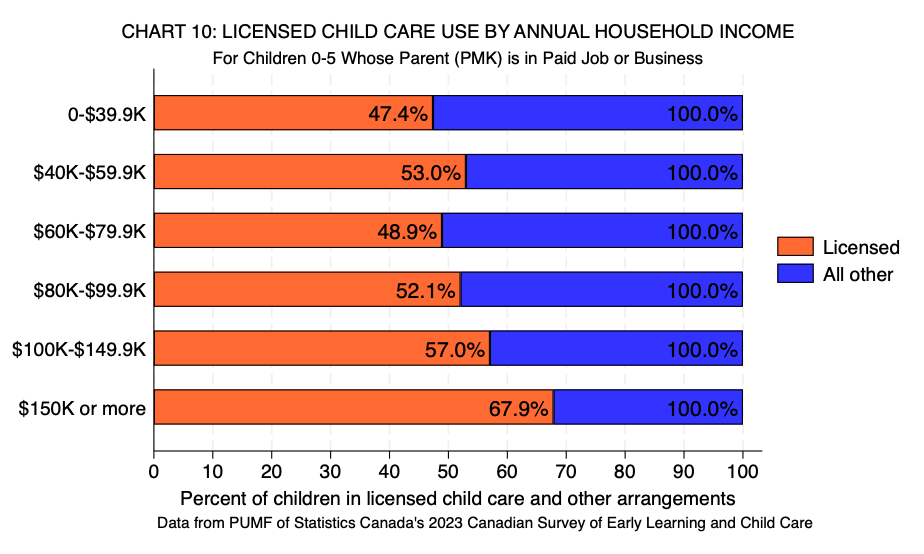
However, rather than look only at subsidies, there is more comprehensive data on child care use by family income that comes from a 2023 parent survey done by Statistics Canada.  Here’s what it shows:

The data suggests, yes, that access to licensed child care by lower income families is not as high as for the more affluent.  But the differences are probably smaller than you thought they were.  I don’t mean to minimize the issue.  Most studies show that children from lower-income or vulnerable families are especially likely to benefit from quality child care.  So working on this issue is a high priority.  However, the sky is not falling.  It is just a persistent problem that provincial and territorial  child care systems need to address.  In fact, it is a persistent problem in child care systems, no matter how they are funded, often less so the more universal the service is.

Instead of trashing the $10 a day child care program, maybe Peter Jon Mitchell should spend his time lobbying the Alberta Government to re-instate the child care subsidy system that they completely eliminated  this year!  This will definitely hurt lower and middle income families in Alberta.  The Alberta Minister complained at the time that federal funding regulations did not allow him to fund a targeted program like child care subsidy.  However, he had a subsidy system receiving federal funding ever since signing the CWELCC agreement with Ottawa, and nearly all other provinces have child care subsidy systems, so that excuse is untrue.  Alberta should re-instate its subsidy system as part of its CWELCC funding. 

What is to be done?

The $10 a day child care program is only partly developed and is far from perfect.   Much more affordable licensed child care is now wanted by many more parents.  Of course.  And expansion of services is too slow. There is little capital funding and too little planning for expansion of not-for-profit child care.  Also, crucially, child care wages in most provinces are too low to attract qualified educators. 

Making child care more accessible is central to the health of the program.  I hope Mark Carney recognizes that in the upcoming budget.  After all, isn’t a universal child care system a pillar of the new economy that families with children need – the kind of nation-building project that will make Canada stronger, fairer, and more affordable?

    8 things to know about $10-a-day child care

By Martha Friendly, Executive Director, Childcare Resource and Research Unit, and

Gordon Cleveland, Associate Professor of Economics Emeritus, University of Toronto Scarborough

  • Many more children are in licensed child care (especially centres) now than before the $10-a-day program

In 2023, 177,900 more 0-5 year olds were reported by Statistics Canada to be in child care centres than at the end of 2020 just before the $10-a-day program began. 

  • Nearly a million Canadian 0-5 year olds already benefit from low-fee licensed child care

938,000 children are using licensed child care that is eligible for the $10 a day program, according to 2023 Statistics Canada. If we add four and five year olds in kindergarten, and children at home with parents on parental leave, a total of 1.5 million young children are benefitting from public programs that support the care of young children as well as mothers’ employment and family incomes.

  • There is considerably more licensed child care than ever before

Between 2015 and 2023, the number of child care spaces for children 0-12 grew by 426,203 to a total of more than 1.6 million licensed spaces, despite the negative effects of the pandemic on child care services and mothers’ employment.

  • For the first time ever, child care has been made affordable for parents across the  income spectrum

In eight provinces and territories (including Quebec), parents now pay $10-a-day or less for licensed child care. In the other jurisdictions, fees have been substantially reduced by provincial/territorial fee reduction or are provincially set. The fee changes mean that parent fees are between one-sixth to one-third of the fees before the $10-a-day program, depending on the province/territory.  In addition, all provinces and territories except Alberta have fee subsidy programs to lower child care fees further for parents with particularly low incomes.

  • Waitlists for licensed child care were always long but have grown
    Although nearly a million Canadian children are benefiting from low-fee child care, there are too few licensed spaces and many families are still on waiting lists. Nearly 50% of child care users reported difficulty finding a space in 2023— about 10% more than the nearly 40% reporting difficulty finding care in 2020 before the CWELCC program began. 

Many employed families who use other child care arrangements can claim financial  assistance from the Child Care Expense Deduction, and most families with young children also receive the Canada Child Benefit – income support to help families with child rearing costs.

There is good agreement that provinces and territories must speed up expansion of spaces and hiring of qualified staff to reduce waitlists. To support this, federal government has made $625 million for child care infrastructure available to provinces and territories and allocated $1 billion of low-interest loans and grants for child care expansion to be distributed by the Canada Mortgage and Housing Corporation.

  • The $10-a-day child care program is very popular with parents, so demand for licensed child care, especially centres, is high.

Already in 2023, three-quarters of children in any form of non-parental child care were in licensed child care. On top of this, a majority of those not currently using any non-parental child care said they would like to use it too. Of these, 62% would prefer to use a child care centre.

  • For-profit providers are not being driven out of business

Mr. Poilievre claims that for-profit child care providers are being driven out of business. Agreements signed between the federal government and the provinces and territories included all existing child care providers willing to lower parent fees and provide accountability in exchange for very substantial, reliable public funding.

For-profit providers unwilling to participate in the low-fee program may set their own fees instead of relying on government funding.  The agreements with provinces and territories specify that new spaces should be primarily in not-for-profit or public centres or in licensed family child care homes. This protective provision is intended to ensure that higher profits should not be the predominant rationale of a system of publicly funded services for children and families.

  • Pierre Poilievre’s “freedom and flexibility” child care policy would raise child care fees

Opponents of publicly funded universal child care claim that the $10-a-day plan is a bad idea—“a massive top-down bureaucratic system”, “one-size-fits-all”, and “worse today than when the Liberals took office”, arguing instead for payments to parents. Pierre Poilievre’s alternative is “more flexibility and freedom for parents, provinces, and providers”.

In other words, Mr. Poilievre’s alternative would allow provinces to eliminate the $10 a day program. Instead, providers will have the flexibility and freedom to set their own parent fees, and provinces will have the flexibility and freedom to use federal funds to support unregulated child care or favour for-profit operations. Slashing red tape will mean child care providers will no longer need to account for how they spend billions of dollars of funding.

Mr. Poilievre’s alternative is to go back to the previous scarce-space, high-fee, market-model child care. This didn’t work during the nine years in which the Harper government (of which Mr. Poilievre was a member) tried out its market model, and it won’t work now. 

April 14, 2025

Does Tax Credit Funding Work for Child Care?:  Lessons from Australia

Many Canadians do not seem to realize that funding child care with tax credits would mean having no control over child care fees.  Plus, there would be no financial accountability by operators for the public money they receive.  Right now, child care fees are controlled in Canada – in eight of Canada’s thirteen jurisdictions, the fee is $10 a day.  By April 2026, parent fees will be limited to $10 a day across the country.  If we switched to tax credits (as the Conservative Party recommended in the last election), there would be no limitation on parent fees and no financial accountability for billions of dollars of public money.  Child care operators could charge whatever the market would bear.  And so, for many families, child care would be unaffordable once again.

I’m in Australia right now.  It’s a gorgeous, sunny country with great restaurants, stimulating and dependable coffee, and very friendly people.  But they have problems with their child care system that we can learn from.

You can give money to parents to fund their spending on child care; mostly, that’s what Australia does.  Or you can fund the services to ensure that they will be available and affordable; mostly, that’s what Canada now does.  The first is called demand-side funding.  The second is called supply-side funding. 

Demand-side funding comes under different names – a tax credit or a voucher or a parent subsidy; it amounts to the same thing.  Australia has a Child Care Subsidy; there are bigger subsidies for low-income families and smaller subsidies for high-income families.  The payments are made to the family’s chosen child care provider (from amongst approved child care providers), based on the amount of child care used.  The parents have to pay whatever child care fees are not covered by the subsidy.

Australia has a market-based child care system.  There are standard regulations on employee qualifications, staff-child ratios, health and safety, and so on.  But, there are no effective government controls on the fees that are charged by providers and centres can be established wherever they choose – usually where it is most profitable.  The majority of providers in the system are for-profit corporations and entrepreneurs. 

Australia gives Canadians a chance to see how demand-side funding works in practice.  And, I would argue, Australia gives a “best case” scenario for this approach.  Australians have tried very hard over the years to make this subsidy/tax credit approach work equitably and efficiently for all families and they have done a lot to promote higher quality in child care services.  I would argue that if Australia can’t make a demand-side funding system work effectively to make child care affordable, accessible and of high quality, then no one can.

In this context, the November 2024 report by Dr. Angela Jackson, Lead Economist for Impact Economics and Policy is well worth a read.  The report – Time to Stop Throwing Good Money After Bad – was commissioned by the Minderoo Foundation, a charitable organization founded by Dr. Andrew Forrest (former CEO of the Fortescue Metals Group) and Nicola Forrest.  The report provides an assessment of Australia’s child care funding and management system.

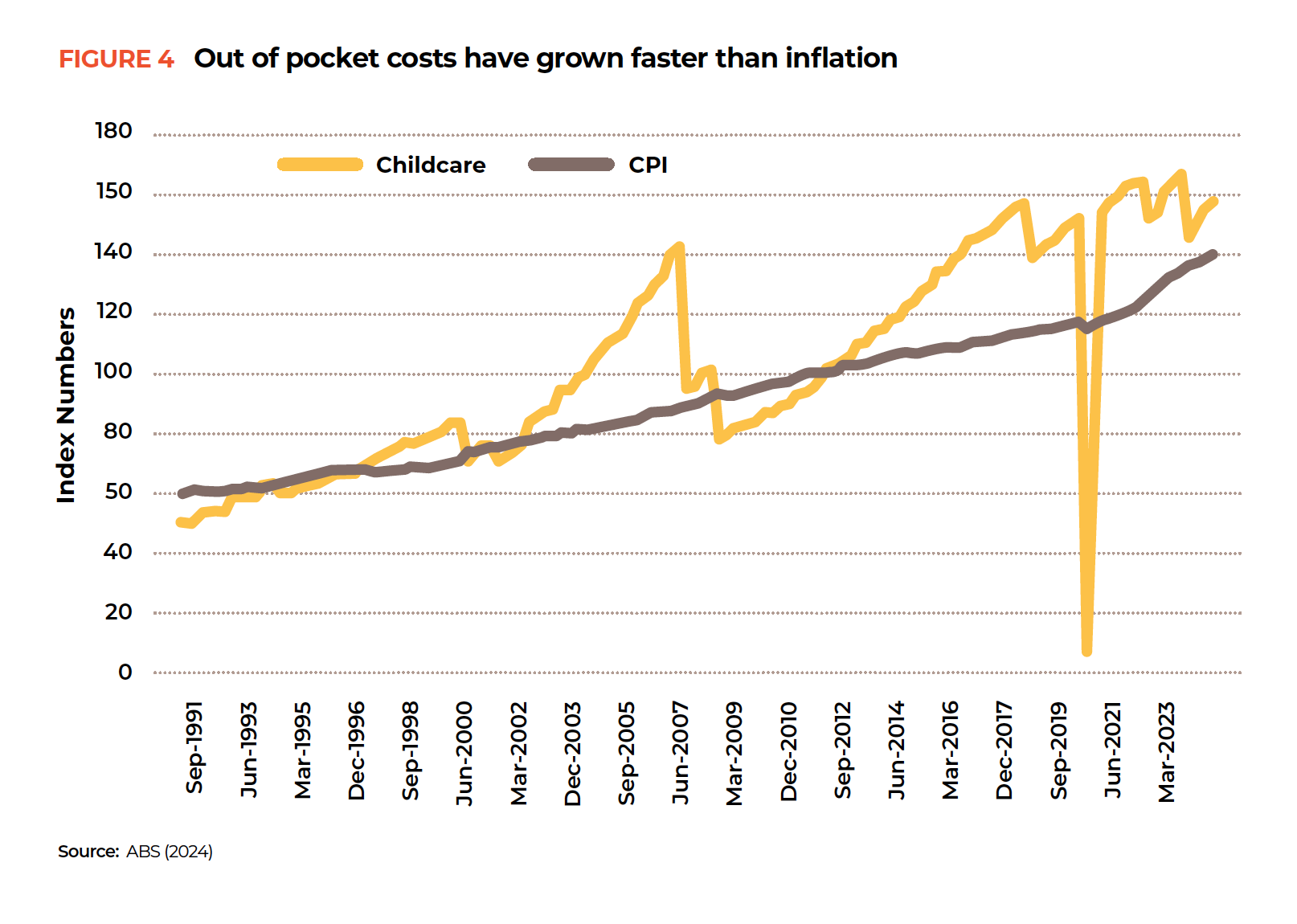
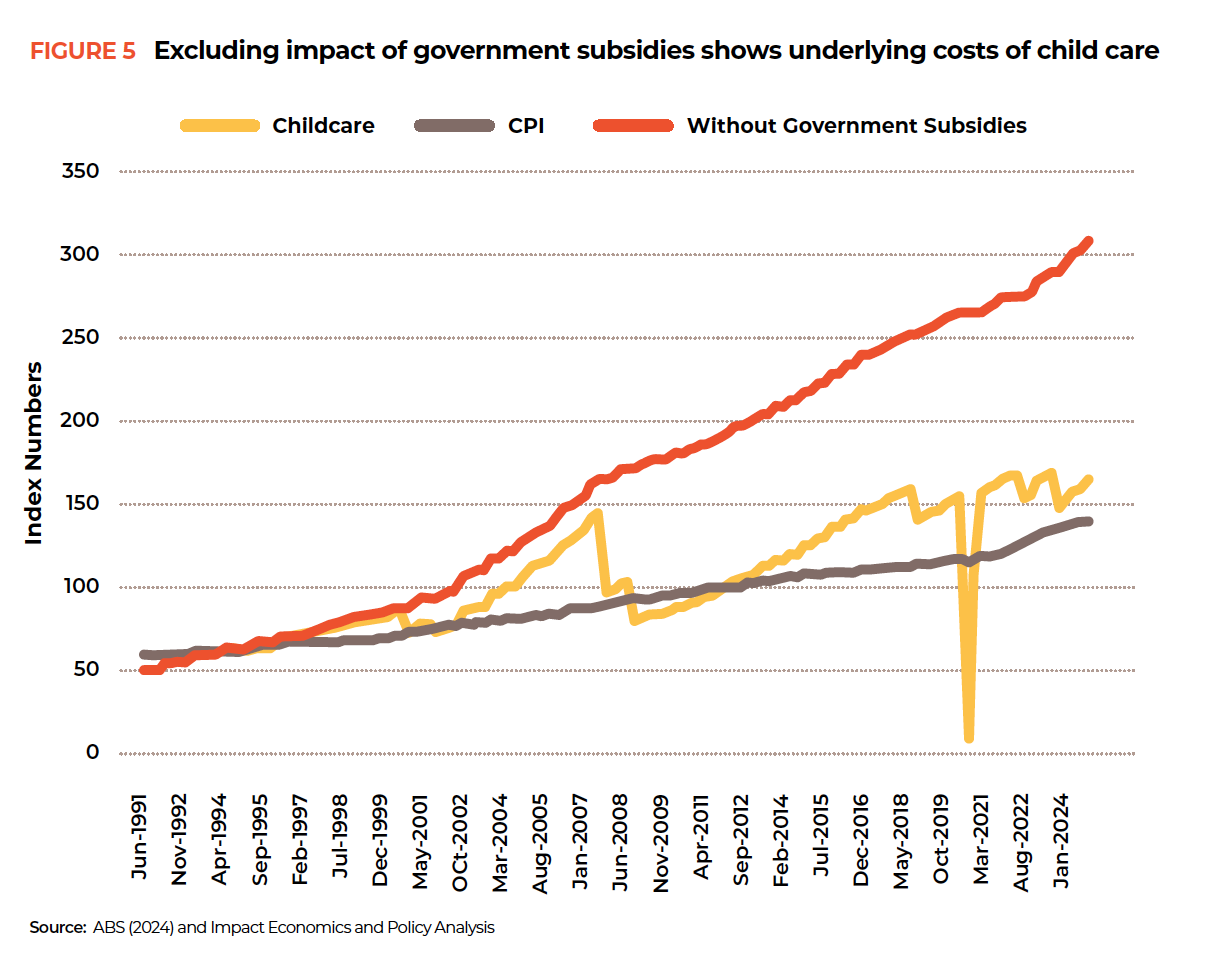
I think the best place to start is to look at two charts that Dr. Jackson features in the report. 

Figures 4 and 5 are copied from her report.  Figure 4 covers the period from 1991 until 2023.  What you see are two lines.  One is relatively straight, showing how the Consumer Price Index has risen pretty steadily over this period of 32 years.  The fiscal year 2011-12 is the base year and gets an index value of 100.  Compared to that, the average price level in the economy has risen from 50 back in 1991 to 140 now.

The second (yellow) line is very jagged. It goes up, then falls, then rises rapidly, then falls.  Again and again.  This line shows the “out of pocket costs” of child care.  Out of pocket costs are the amounts that parents actually pay for child care after accounting for the child care subsidy they receive.  When government increases the subsidy, the out of pocket costs go down.  When fees charged by child care operators rise but the subsidy stays the same, then out of pocket costs rise. 

In the battle between rising child care fees and increasing levels of subsidy, child care fees have been winning.  Overall, the amounts paid by parents have been rising faster than inflation despite subsidy increases. 

In Australia, there were major infusions of funding and reform of child care policy in 2000, 2007, 2008, 2018 and 2023.  In 2020, during the pandemic, child care services became free for those continuing to use them.  We can see each of these events on the chart as a sudden drop in the yellow line.   

But none of these funding infusions have stopped the upward march of child care fees. Out of pocket costs of child care have increased quite a bit faster than inflation over this 32 year period DESPITE many government attempts to improve tax credit/parent subsidy funding arrangements to make child care more affordable.  Child care has become, on balance, less affordable, not more affordable.  In 2023, after Child Care Subsidy is accounted for, the average out of pocket cost of child care for parents in Australia was $44.42 per day (or over $11,500 per full year).

By how much have child care fees risen over this time period?  Figure 5 provides this information.  It includes the two lines from the previous figure but adds a new one.  This third (red) line, rising above the other two shows the amount by which the cost of child care to parents would have risen had there been no improvements in child care subsidization. The underlying costs of child care have risen by 499.9% over this period – much much faster than the rise in consumer prices!  In 2023, before subsidy, the average child care fee for full-day care in Australia was $133.96 (or nearly $35,000 for a full year).

This pattern continues to this day.  As Dr. Jackson notes, over the last 12 months child care fees have increased by 10.6%, which has eroded the benefits of the new $5 billion child care expenditure program begun in July 2023.

The Australian Competition and Consumer Commission, which held an inquiry into costs and prices of child care providers in 2023, described this repeating pattern accurately:

 “when government subsidies increase, out of pocket expenses decline sharply in the immediate term, but then quickly revert to levels preceding the subsidy change.”

Is this pattern a glitch?  Or is it a feature that we should expect to observe if Canada were to adopt a tax credit system for funding child care?  Those who support tax credits emphasize parent choice and flexibility.  What they do not tell you is that tax credit systems mean that there is NO CONTROL over the fees charged by child care providers.  There is no regulation of the decisions that corporations and entrepreneurs make about where to locate their services.  And further, there is no requirement that child care providers account for the ways in which they spend the billions of dollars of government money they will be receiving when subsidized children attend their facilities.

With a tax credit system, additional government spending largely benefits providers, not families.  True enough, this very generous funding system has encouraged providers to expand.  There were enough centre-based spaces for only 7% of Australia’s children 0-4 years of age back in 1991 and there is now coverage for 42% in 2022.

Since there is little control over where providers locate, access to child care is concentrated in wealthier areas where providers can charge higher fees.  24% of Australia’s households with children are located in child care deserts.

The large majority of providers in Australia are for-profit enterprises.  And for-profit providers have been found, in Australia as elsewhere around the world, to provide lower quality child care on average.  Australia has put a lot of resources into measuring quality of services.  Their quality rating system has five result categories: Significant Improvement Required, Working Towards National Quality Standard (NQS), Meeting NQS, Exceeding NQS,  and Excellent.  35.4% of not-for-profit providers are rated as Exceeding NQS or Excellent.  Only 12% of for-profit providers reach the same levels.  Further, for-profit providers have been found to be half as likely to increase their quality ratings over time as the not-for-providers are.

Viewing the Australian experience with a Canadian lens, the tax credit approach has many weaknesses.  In a tax credit system, the only way to make child care affordable for parents is through substantial infusions of government funding.  However, if substantial government funding is combined with providers having the freedom to set and change their own fee levels, then the result will be rapidly rising fee levels and reduced affordability. On top of that, there is no requirement for child care operators to account for how public money is spent.

In theory, competition among providers is supposed to bring fees down and force providers to offer better quality of care.  In practice, competition is very imperfect, partly because child care markets are very localized, so few providers compete directly with each other.  Competition is also imperfect because parents can only perceive and evaluate child care quality imperfectly. 

So a tax credit or voucher system pushes up child care costs, profits and fees but delivers child care that is expensive for governments, unaffordable for many families and very uneven in quality.  Governments get into a cycle of additional spending to bring out of pocket costs down, then watching as provider fees rise to make child care unaffordable once again.  Whatever its growing pains, $10 a day child care is a much better bet than tax credits to provide affordable, accessible, quality child care.

*********************************************************************************

However, Supplementary Subsidy Funding Plays A Positive Role
Most Canadian provinces and territories have child care subsidy systems that are supplementary to their main way of funding child care.  The effect of this is positive.  The main funding is on the supply side – funding to operators in exchange for child care services made available to families.  On top of that, most provinces and territories have a subsidy system that can lower the parent fee from $10 a day (or, currently, a higher fee in five Canadian jurisdictions) for low-income or multiple-child families that cannot afford $10 a day.  Most of these subsidy systems are imperfect, but they serve the very important purpose of ensuring affordability for all families, even those who cannot afford current reduced fees.

Is Minister Jones Going To Take Away Your Affordable Child Care?

It’s Family Day in Alberta today (February 17th).  And Matt Jones, Minister responsible for child care in Alberta,  apparently wants to celebrate by making plans to leave the child care agreement  that will bring $15 a day child care to the province on April 1st.  And he wants to blame the federal government while he does it.  But the truth is, most decisions about child care in Alberta are entirely in the hands of the provincial government.

Take the cancellation January 30th of Alberta’s child care subsidy program that helps low-income families.  Matt Jones cancelled it, as part of the move to a flat child care fee of $15 a day.  He didn’t have to do that.  Every other province and territory outside Quebec has a child care subsidy program targeted at low-income and otherwise vulnerable families as part of their move to $10 a day. Alberta’s agreement with Ottawa committed to an “average fee of $15 a day” in 2024-25, not a flat fee of $15.   Why did Alberta have to cancel the subsidy payments?  No reason at all. 

And then Minister Jones had the gall to say that Alberta might have to withdraw from the $10 a day program because the federal government doesn’t allow him to target support to parents that need it the most. In an interview with LakelandTODAY.ca, the Minister said:  “The current federal agreement is not flexible to allow us to income test, say households earning under a certain amount of income.”  Which is plainly untrue.

In a Facebook post, Minister Jones cited other reasons for planning to withdraw child care support from Alberta families.  He said that the program is underfunded by Ottawa, by more than $4 billion over the next few years and that the child care agreement that Alberta voluntarily signed back in November 2021 is “unfair to the majority of child care providers”.

This week the federal government offered Alberta and other provinces the chance to extend existing child care agreements for another 5 years and receive more money to do so.  But, Mr. Jones wants even more money and he wants flexibility.  And if he doesn’t get it, Alberta will pull out of the $10 a day child care program.  As he puts it in government-speak, Alberta “will be forced to transition out of what is, and will be, an unsustainable program.” 

In 2025-26, Alberta will be getting nearly $1.1 billion through this agreement to support low-fee child care.  In its agreement with Ottawa, Alberta calculated that it could lower fees to $10 a day for 134,691 children for a cost of much less than that – for $829.93 million.  What changed? Unless Alberta child care costs are completely out of control, there should be enough money right now.  So, why not sign on to continue the program? 

Minister Jones real reason for being willing to take away your low-fee child care comes down to “flexibility”.  “Flexibility” is a code word.  In 2021, Alberta agreed to expand home child care and not-for-profit child care spaces by 42,500 and for-profit child care spaces by only 26,200.  Two-thirds of Alberta’s child care spaces are commercial now, so extra expansion of non-profit facilities would provide some balance and choice for families.  Minister Jones wants to wiggle out of that agreement.  That would be called “flexibility”.  Apparently, the evidence that non-profit child care services are stronger promoters of high quality is unimportant to Minister Jones. 

Frankly, Minister Jones reasons for not signing on to continue the $10 a day child care plan are flimsy.  I think he is in the pocket of that portion of commercial operators who want to be able to charge whatever fee they want, and earn whatever profit amount they can get away with.  He might call that giving money to parents in the form of a tax credit.  But we know that it means no more limits on parent fees – no more $15 a day child care or $10 a day child care.  And that would mean unaffordability for parents.  Not a good plan.

The purpose of the $10 a day agreements between provinces and territories and the federal government is to ensure that low-fee child care services are available to families and children when and where they want them.  Not every family wants to use child care throughout a child’s early years.  But most Alberta families use child care for some time as their children grow.  For instance, 61% of Alberta’s children who are 4-5 years of age and not yet in kindergarten use licensed child care.   Many more want an expansion of low-fee child care services.  In my opinion, Minister Jones should sign on to continue the $10 a day child care funding for Alberta parents and children.

A Fact-Based Response to Cardus’ Odd Assertions

Since its beginning, Canada’s plan to build a system of child early learning and child care – the “$10 a day plan” –  has been panned by a handful of players. These include spokespeople for some political parties, some child care centre owners, right-wing “pundits”, and social and economic conservatives, all with their own agendas. Relying on misrepresentation of research literature, misinterpretation of public opinion polls and Statistics Canada surveys, the common agenda is to paint the $10 a day plan as a “failure” and “disaster” rather than the first largely successful phase of a Canada-wide project to build a workable child care system for all families and children over time.  (Really, it is the second phase because back in 1997, Quebec began to build a largely successful and largely universal low fee child care system of their own).

This blog comments on a policy brief published  by Cardus in November 2024.  Cardus advertises itself as a non-partisan Christian think-tank; it takes a socially conservative approach and promotes ways of thinking that pre-date the Royal Commission on the Status of Women that reported in 1970.

Cardus would have you believe that very few Canadian children and families benefit from low fee licensed child care.  Cardus’ staff members Mitchell and Mrozek have written that: “…most Canadian families receive no benefit from the billions spent – only 29% of children aged 0-12 had access to a licensed space in 2021.”  (November 2024).  It’s a pity that Mitchell and Mrozak inappropriately use data on children 0-12 years to reach this conclusion.  Most of these children (the 6-12 year olds) are not even covered by the new funding programs to make child care universally affordable for families.  Cardus should instead have informed themselves with the latest Statistics Canada data (the parent survey in 2023 that looks at children 0-5 years of age).  It’s called the Canadian Survey on Early Learning and Child Care.  Or, Cardus could have read the report entitled Giving Parents Money Doesn’t Solve Child Care Problems published by the Prosperity Project in September 2024.  It provided much of the same data we include in this blog.

Many families already benefit from low fee child care

If Cardus had consulted the appropriate data, they would find out that the truth is somewhat different from their biased conclusion.  The latest data are from 2023, two years after the beginning of the $10 a day program and about 25 years since Quebec began phasing in universal child care.  There are about 2.2 million children 0-5 years of age in Canada and close to a million of them (938,000 children or 42% of all children) are already using licensed child care

Families prefer to use licensed child care

In fact, 75% of the children 0-5 years of age who use any kind of non-parental child care in Canada now use licensed child care.  About 1.25 million children 0-5 regularly use some form of non-parental child care and 938,000 of them are using licensed child care.

Licensed child care provides strong support of parental employment

A major reason why governments in Canada are spending billions of dollars to provide low fee child care is to support parental employment.  And this support of parental employment is happening.  According to the recent Statistics Canada parent survey, 59% of parents (mostly mothers) whose main activity is working at a paid job or business already use licensed child care for their young children.  Many others – another 115,000 who are on a waiting list – would like to use licensed child care and will happily do so when more supply becomes available.

Child age and availability of kindergarten explain patterns of use of licensed child care

The demand for licensed child care is strongly related to the child’s age.  Parents with  children less than two years are less likely to use licensed child care, so satisfying the demand for licensed care does not mean having spaces for 100% of children.

When considering child care use, it’s important to take other family or education programs into account.  For many families with very young children, parent-only care during maternity or parental leave is their choice.  For many children who are already in full-school-day kindergarten at four or five years of age, they do not need or their parents do not want supplementary child care. 

Across Canada:

  • 24% of children younger than two years of age  are in licensed child care.  In this age bracket, 62% are in parent-only care, with many of these parents on maternity or parental leave. 
  • 55% of all children in Canada who are two or  three years of age currently use licensed care. 
  • 68% of all four- and five-year-olds who are not yet in kindergarten currently use licensed care. 
  • But, when those four- and five-year-olds reach kindergarten, the use of licensed child care drops to 33%.
Percent of Canadian Children Using Licensed Child Care by Age Group and Kindergarten Attendance, 2023

From the Public User Microdata File of the Canadian Survey on Early Learning and Child Care, 2023.

Licensed Child Care and Low-Income Families

The other main claim in Cardus’ brief is that low-income families do not get much access to child care services when child care is universally funded. The implication is that low-income families would be better served by a targeted child care program.  And that universal $10 a day child care will mostly serve affluent families rather than those who have low-incomes.

There are two problems with this.  First, the use of licensed child care by low-income families is already larger than you might imagine.  In Canada outside Quebec 36% of children with employed mothers from the lowest income group use licensed care.  And in Quebec, 68% of children with employed mothers from the lowest income group are in licensed child care.

 Second, Cardus has identified the wrong culprit for the important inequities that remain.  It is market-driven child care that disadvantages low-income families.  It is universal  child care that does a better job of welcoming the participation of low-income children to licensed child care. 

We can see this by comparing access to licensed child care for different income groups where the mother is employed in provinces outside Quebec to the same data from Quebec.  Two conclusions are obvious in the charts below.  First, in Quebec, a much greater percentage of children from these low-income families are able to access licensed child care than is the case in the rest of Canada’s provinces.  Second, the gap in access between the lowest and highest income groups is much smaller in Quebec than it is in the rest of Canada.  As before, this data is from Statistics Canada’s recent parent survey. 

What’s the explanation?  When child care fees were uncontrolled (as they were in Canada outside Quebec until 2021 or 2022) many families have found licensed child care to be completely unaffordable.  Most low-income families were squeezed out.  Targeted child care subsidies were not enough to reverse this trend.  Naturally, the majority of child care users were from more affluent families.  But this was a result of the mostly unrestricted operation of the free market in child care, not the result of a massive program to lower fees. 

Percent of Children in Licensed Child Care by Income Group in Canada outside Quebec when Mother is Employed

From the Public User Microdata File of the Canadian Survey on Early Learning and Child Care, 2023.

Note: * The vast majority of parents responding to the survey were mothers

Percent of Children in Licensed Child Care by Income Group in Quebec when Mother is Employed

From the Public User Microdata File of the Canadian Survey on Early Learning and Child Care, 2023.

Note: * The vast majority of parents responding to the survey were mothers

As Cardus would know if they had looked at the federal-provincial-territorial agreements that have brought us the $10 a day child care program, improved equity in access for children from different backgrounds is a key objective of the federal program.  There are substantial federal, provincial and territorial efforts to ensure that new child care capacity is directed towards underserved populations – low income children, vulnerable children, children from diverse communities, children with special needs, and Francophone and Indigenous children.  Still, there is too little access to licensed child care for low-income families – on this we agree with Cardus.  But eliminating funding support for child care services and instead paying money to families to stay at home is the opposite of a solution to this problem.

Cardus wants to make child care unaffordable again

Cardus does not really want financial support for licensed child care at all.  Instead, Cardus wants us to return to some version of Stephen Harper’s Universal Child Care Benefit.  They estimate that if the federal spending on the $10 a day child care program was divided equally amongst families instead of going directly to day care centres to lower fees, each family would receive $3,869 per child, per year.  But, right now, families using low fee child care are receiving $5,000 – $15,000 in child care fee reductions.  With the end of direct funding of child care, child care fees would soar and nearly a million families would be much worse off than they are currently. Child care would be unaffordable once again, and mothers would be squeezed out of employment by high fees.  How is that a sensible and affordable child care policy?  No wonder 75% of Canadians think that a Conservative government, if elected, shouldn’t end the $10 a day child care program.

There Is still a lot of work to do to build a $10 a day child care program for all the families that want to use it – especially in expanding the qualified workforce and the supply of services.  But already many Canadian children and families are much better off than they were in 2021.  The priority now is to finish the job of providing affordable, accessible, quality child

Affordable Child Care Services vs Money for Parents

Those who oppose the $10 a day program often argue that there is a simple and better program to replace it – give money directly to parents instead.  The logic is, at first glance, persuasive.  If you give parents money, it seems like they should be able to purchase exactly the child care they need.  And competition among different providers should, you might think, keep fees down.  Programs that directly fund child care services, like the $10 a day program, are said to be bureaucratic and inflexible and to create huge shortages and long waiting lists. 

There is some truth here, but much falsehood, and much deliberate ignoring of the evidence on the impact of a “family allowance” approach.  I have just written a report for The Prosperity Project that examines the likely impacts of giving parents money instead of funding and providing child care services that parents can use.  I unearth a lot of new data about families that are using child care in Canada and the number of parents who want access to affordable, accessible, high quality child care. 

The evidence shows that this type of “family allowance” fails as public policy because it:

(a) isn’t what most families want

(b) doesn’t address families’ needs for child care

(c) would be much more expensive than the $10 a day program

(d) would have negative effects on women’s employment and the economy, and would increase the gender-based child penalty that mothers pay with reduced earnings

(e) has been tried before and hasn’t solved child care issues, and

(f) ignores the very large child benefit programs that already provide money to parents.

You should read the report in full (19 pages), or at least its Executive Summary (3 pages).  Below, I provide a few tidbits to encourage you to dig deeper.

  • As of 2023, when Statistics Canada collected large amounts of data from parents about child care and employment, there are 938,000 Canadian children using licensed or accredited child care services – the kind of services supported by the federal government program.  In fact, over three-quarters of children using any kind of child care are in licensed care.   In 8 of Canada’s 13 jurisdictions, average fees for this child care is down to $10 a day or less.  Other jurisdictions have lowered fees by at least half relative to fee levels in 2019-20.  In other words, although the press scarcely covers it, a very large number of Canadian children and families are already benefiting from licensed child care that is subsidized to be affordable and more accessible.
    • Licensed child care is not the only part of the set of services and benefits that will make up a fully developed early learning and child care system.  Many children benefit from full-day or part-day kindergarten at ages 4 and 5 years.  Many children and families benefit from paid maternity and parental leave for up to 12 or even 18 months.  If we put these all together, it is already true that in 2023 over 1.5 million children currently benefit from Canada’s early learning and child care and leave arrangements.  That is about 2/3rds of all children 0-5 years of age.  
    • Some people think that the reason some parents don’t currently use child care is because they don’t want to.  But, outside Quebec, most families (58%) that currently do not use any child care would like to use some type of non-parental child care if they can find what they need and want.  And, of these, the lion’s share – 62% – would like to use licensed child care, largely as a means to join or rejoin the workforce. 
    • Some people argue that it is mostly affluent parents that benefit from universal child care programs and that marginalized families and those from diverse backgrounds are left behind.  That is certainly true of market-based child care systems when fees are not controlled; high parent fees are only affordable by affluent families and many vulnerable families do not qualify for income-based subsidies.  However in fixed-fee systems like the $10 a day program, families from all backgrounds gain access.  I show a series of charts from Quebec making this point.
    • A family allowance program would have to give parents an amount of money that was equivalent, on average, to what they gain by having $10 a day child care.  This family allowance program would cost the federal government just over $28.5 billion annually and its net cost would be three times as much as the cost of providing child care services.  
    • Women who have children suffer substantial losses in earnings after the birth of a child.  Economists have found that mothers’ earnings decrease by 49% in the year of a child’s birth.  Even ten years later, women suffer from an average earnings loss of 34% relative to their earnings before childbirth. Universal child care has been found to substantially reduce these “child penalties”.  In other words, accessible child care services make an important contribution to increasing gender equity.

    Please read the full report and executive summary

    Supply-Side or Demand-Side – A Contribution to the Australian Discussion

    John Cherry, from Goodstart Early Learning, has written an evaluation of child care in Quebec and New South Wales.  Apparently his purpose is to determine whether supply-side funded systems (like Quebec’s) are better or worse than demand-side funded systems (like in Australia). 

    To summarize briefly, John finds that Quebec does better on workforce participation and affordability, NSW does better on child care accessibility and quality.  So, John concludes that Australia’s system is pretty good.  His conclusion appears to be that Australia shouldn’t flirt with Quebec’s fixed-fee, supply-side-funded system. 

    It’s a problematic paper for several reasons.  First, some of the details about Quebec are wrong.  Second and more fundamentally, only part of Quebec’s child care system is supply-side funded and charges parents a fixed fee of approximately $10 a day.  The other part (about 20% of the total) is demand-side funded like in Australia.  In the demand-side-funded part, child care providers can set whatever parent fees the market will bear and some of this later gets reimbursed to parents.  So, some of John’s comparisons, particularly on affordability and quality, are actually comparing a mixed system (Quebec) to a demand-side-funded system (New South Wales).  These comparisons don’t tell us much about how a supply-side funded system would perform in Australia.  Third, John does not explain how a demand-side funded child care system can deliver what we want from a universal child care system – dependably low fees, financial accountability for public funds, and planned expansion of capacity according to need.  Let me explain.

    Much of John’s paper is captured in Table 1 – Summary of ECEC Indicators.  There’s a column for Quebec and one for New South Wales, comparing results on different indicators of ECEC health.  I reprint it below.

    Workforce Participation
    John agrees that Quebec does a better job than New South Wales in workforce participation.  Absolutely true.  85% labour force participation for Quebec mothers with young children vs 71% in Australia.  Add on top of that the fact that most Quebec mothers work full-time vs. Australian mothers mostly part-time and it does appear that a fixed low parent fee really does have a very substantial impact on mothers’ employment. 

    Affordability
    John then presents comparisons of affordability, but his numbers are too generous to New South Wales and not generous enough to Quebec.  The differences in parent fees between supply-side funding and demand-side funding are much bigger than he admits.  On NSW, John calculates that for a family with average income, the parent fee for a first child is $29.50 per day and for a second child it is $10.05 per day.  In fact, the Productivity Commission draft report says that the average per child out-of-pocket parent fee across Australia (and therefore likely in NSW) is just shy of $45 per day. That includes the extra charges for centres open more than 10 hours per day, where parents have to pay the full fee for these extra hours even though they don’t use them.

    And the Quebec numbers on parent fees are too high.  In the supply-side funded centres and family homes, the daily fee for every child in 2024 is CA $9.10 (or about AU $10).  The figure John quotes for Quebec of  CA $17.20 per day includes the children who pay $9.10 but it also includes the high parent fees paid by demand-side funded parents before the tax credit reimburses them.  In a fair comparison, Quebec’s child care is cheaper than in NSW by a considerable amount, not just by a little bit.  That helps us understand why mothers’ employment has been so responsive in Quebec.

    Accessibility
    Then there is accessibility.  According to John, NSW scores high on accessibility of child care.  But, he chooses a strange way of measuring it.  He chooses the growth in the number of centre-based child care spaces in the last 5 years.  NSW has added more child care spaces so therefore he concludes that accessibility is better in NSW.  

    A much better measure of accessibility would have been the coverage rate – what percent of the child population could be accommodated in approved services (licenced services in Canada).  John provides these numbers on page 6 of his paper, but not in Table1 and not in his conclusions about accessibility.  In fact, as he records, about 75% of  children 0-5 in Quebec are in early childhood services.  This compares to about 60% in New South Wales.  John makes a big deal about services growing in New South Wales and not growing in Quebec.  Of course, that’s what you would expect if accessibility was already better in Quebec; it wouldn’t need to grow its services as fast.  The current rate of growth of services is not a good measure of current accessibility.

    And if you compare the number of days of child care attended in Quebec and NSW, the accessibility in Quebec is even stronger.  Over 90% of the children in Quebec who attend ECEC do so on a  full-time basis, compared to about 30% in Australia (with another 25% in Australia attending 4 days a week).

    Quality
    Finally, we get to a part of the comparison between Quebec and NSW on which John and I agree.  The quality of child care in Quebec is lower than it should be, and probably is lower than it is in NSW.  The most obvious indicators of this are the child-staff ratios.  5 children to 1 staff member for very young infants in Quebec vs. 4 to 1 in NSW.  Personally, I think both of these ratios are too high for the very young, but I agree that a 5 to 1 ratio is shocking.  As is a ratio of 8 to 1 in Quebec after children turn 19 months of age. 

    Quebec is an outlier here in Canada too.  In Ontario, the required ratios are 10 children to 3 staff members for children 0-17 months, 5:1 for children 18 months to 35 months, and 8:1 for children 3 years to 6 years (except for before-and-after school care for kindergarten children).  NSW’s ratios are comparable to Ontario’s. 

    Similarly, the wage rates paid to educators in Quebec are worse than in New South Wales.  John is right on this.

    John overstates the differences in percent of educators required to be qualified.  He says it is 50% in Quebec and 100% in New South Wales.  The regulated percent in Quebec is really 66.6% or 2/3rds.  It was temporarily lower due to staff shortages during the pandemic. And the requirement in NSW is for 100% of front-line staff to be certified.  But this is a bit misleading because only 50% of the front-line staff in NSW must have an ECE Diploma or above.  The other 50% can have a Certificate III which is a qualification well below what is needed to provide good quality care for children on one’s own.

    However, the inadequate quality of Quebec’s child care system is not really evidence that supply-side funding does not work.  Instead it is evidence that Quebec services have not been adequately funded.  The history of Quebec’s system explains this.  Back in the 1990s, Quebec struck out on its own to build a universal child care system, without any funding from Canada’s federal government.  Relying only on its own funding, Quebec ended up cutting corners on quality.  If New South Wales were operating either a demand-side funded or a supply-side funded system with no Commonwealth funding – relying only on state funds – I am sure that quality would suffer too.  But Quebec’s history is not New South Wales’ inevitable destiny.  With strong Commonwealth commitment to spending on universal child care, New South Wales can have both supply-side funding and good quality care.  As you can see in John Cherry’s Table 1, public funding of child care in New South Wales is already 50% higher than in Quebec – AU $5.7 bn vs. AU $3.7 bn annually.

    What Conclusions Should We Draw From This Comparison?
    I understand John Cherry and Goodstart’s hesitation about a switch to supply-side funding.  It would be a big transformation of funding arrangements and would constrain the power of child care operators to set their own fee levels.  If it was done badly, it could have negative effects. 

    However, I think John and Goodstart need to explain how they will build a publicly-accountable universal low-fee high-quality child care system on Australia’s existing demand-side funding base.  In my opinion, they need to answer (at least) three questions.  How would they guarantee that the system will have low child care fees in the future?  How can they build financial accountability for public funds into the existing system?  And, what mechanisms of public planning for location of new services can ensure an equitable and efficient growth of new services in Australia?

    Australia has seen parent fees rise consistently as public funding has increased over the years.  The average parent fee per child is now about AU $135.00 per day.  Every time the Commonwealth government pours more money into the system, out-of-pocket child care fees fall temporarily.  After a short while, these out-of-pocket costs gradually rise back to previous levels.  Nothing has worked to keep fees down in the long term.  Supply-side funded systems guarantee low dependable out-of-pocket fees.  Until Australia’s demand-side-funded child care system can provide the same guarantee, it cannot be considered a good basis for a universal system.

    In a universal child care system, the vast majority of operator revenues come from governments.  It is unacceptable to continue to have no public accountability for these substantial amounts of public funds.  Currently, child care operators do not have to justify the fees they charge or show that public moneys are spent on legitimate costs of service provision.  Goodstart should explain how this will be remedied in their plans for a universal child care system built on the existing demand-side foundations.

    Finally, an equitable universal system of child care services needs to plan where new child care services will be located.  It cannot leave this to the whims of private investors who all want to crowd their new services into higher income areas.  How will this be accomplished within Australia’s demand-side funded system?  These are the tough questions that need to be answered by the champions of a continuation of demand-side funding for Australian child care. 

    The Fraser Institute’s Evaluation of the $10 a Day Child Care Reforms

    This is not his best work.  Phillip Cross has had a notable career at Statistics Canada.  He’s an expert in macroeconomic trends.  But, one thing that he knows very little about is child care.    Unfortunately, he has written a short paper for the Fraser Institute evaluating the success or failure of the Canada-Wide Early Learning and Child Care reforms so far. 

    It’s bad. Almost everything in the paper is either wrong or misleading.

    So what does Phillip Cross say?

    • He says that the Canada-Wide early learning and child care program had 3 goals:

    (1) providing more jobs in the child care industry,

    (2) enabling mothers to join the labour force, and

    (3) providing better care for young children. 

    His paper will look at the first two.

    • He looks at some evidence and concludes that there has been no change in the employment trends in child care staff.
    • Then, he looks at evidence about women’s labour force participation and concludes that it has hardly changed since 2015.
    • Having concluded that the Canada-Wide child care reforms are a failure, he goes on to take pot shots at Quebec’s child care system concluding that its universal child care system doesn’t really help low-income families, wasn’t really responsible for the boost in its labour force participation, has long waiting lists due to inadequate supply, and isn’t really universal.

    Phillip Cross is wrong on all counts, contributing yet more false information to child care discussions in Canada.  There are many problems with the rollout of the Canada-Wide program across the provinces and territories – particularly slow rates of growth in child care capacity.  However, the Fraser Institute paper does not grapple with real issues and propose real solutions.

    Phillip Cross, believe it or not, ignores improving the affordability of licensed child care in his list of goals of the Canada-Wide program.  This, of course, is the greatest success of the program so far.  Hundreds of thousands of children and families have benefited from less expensive child care.  Their very high child care costs have been cut by half or more.  These parents are very happy with the marvellous success of the program.


    Employment in the Child Care Industry

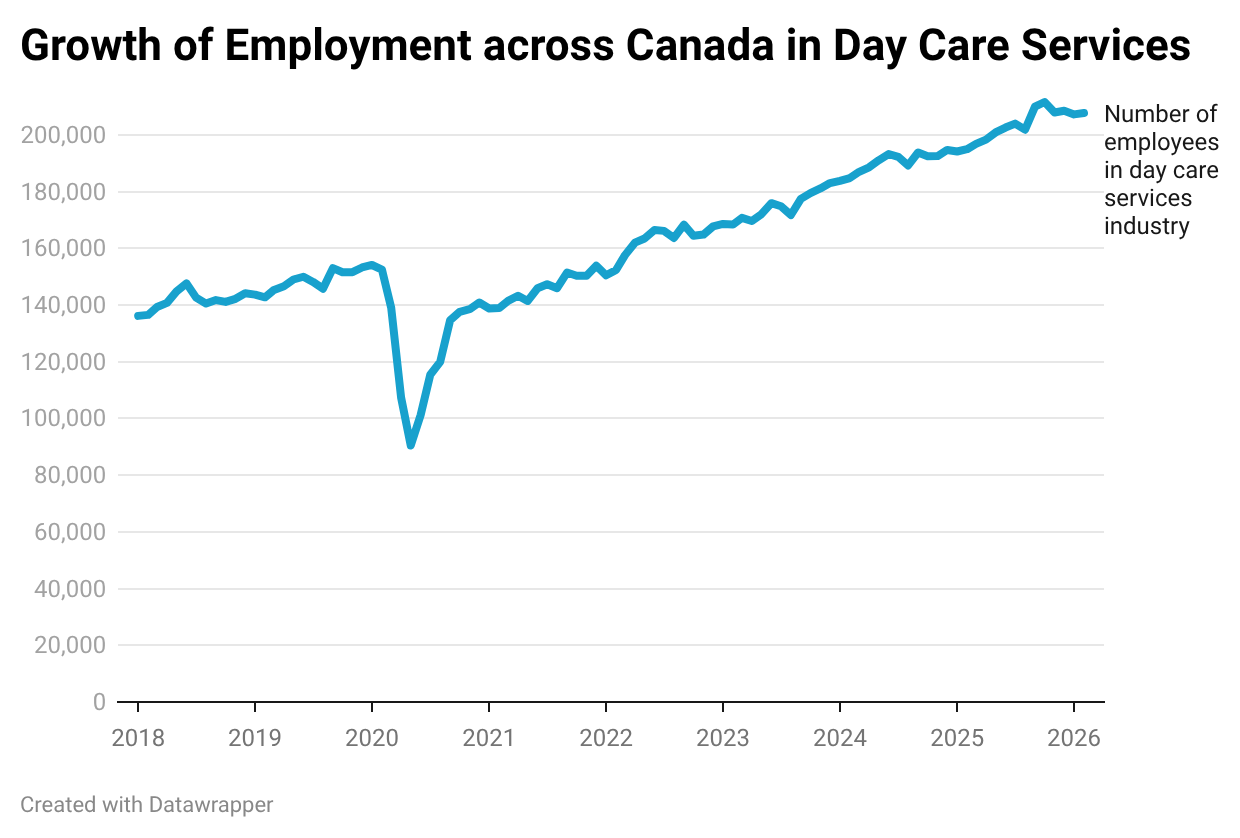
    There has been substantial growth in employment in the day care industry (NAICS Code 6244) since April 2021 when the Canada-Wide program was announced.  By my reckoning, the number of persons employed in Canada outside Quebec has risen by 36.9%, a total of 32,885 additional persons employed.  Phillip Cross hides this growth in two ways.  First, he looks at Canada including Quebec, which is inappropriate.  Quebec has a mature child care system and its employment of child care staff is not growing quickly.  The focus of growth in the Canada-Wide program is on the provinces and territories outside Quebec.

    Second, Phillip Cross ignores the collapse of child care employment during the pandemic and assumes that child care employment should have grown as if the pandemic did not happen.  In fact, child care employment in Canada outside Quebec collapsed from over 100,000 at the beginning of 2020 to less than half of that a few months later.  Employment did not climb above 100,000 until March of 2022.  So, the Canada-Wide program has helped the revival of employment in the child care industry and gone well beyond.  We should celebrate this, rather than hiding it.  This evidence can be found in Statistics Canada CANSIM Table 14100201.


    Mothers in the Labour Force

    Phillip Cross concludes that the Canada-Wide program has also shown no progress in supporting mothers to enter the labour market.  According to him, labour force participation hit its peak in 2015 and even after all this money spent on child care, it has only just about reached the same level.  As he notes, the participation rate was 61.7% in 2015 and now it is just 61.5%.

    But, Cross is not looking at the right statistics.  He is looking at the labour force participation of all women 25-54 years of age.  However, most women do not currently have a child 0-5 years of age.  Women without young children would not have their labour force participation affected by the Canada-Wide child care program.

    The Fraser Institute report should instead be looking at labour force participation of mothers with children 0-5 who are the target of the program.  Here, participation rates are up by several percentage points from April 2021 to now (from 76.9% to 79.9%) even though expansion of child care has been slower than it should be.  And compared to 2015, which the Fraser Institute cites as the high water mark, the labour force participation of mothers with children 0-5 is over 6 percentage points higher now than it was then.  So this evidence of “failure” is false news and should not be left to become conventional wisdom.  This data can be found in Statistics Canada CANSIM Table 14100397.


    Quebec’s Universal Child Care System

    Phillip Cross would presumably be very surprised to hear that Quebec’s child care system is very popular with parents and with the Quebec government.  He believes that low-income families have been squeezed out of access to child care.  In fact, there is good evidence that a much higher percentage of low-income families in Quebec have been able to access child care than was true for low-income families in the rest of Canada in the period before the Canada-wide system[1]. The universal system of child care in Quebec encouraged many more low income mothers into the labour force and into using child care.  It is true, and a problem, that on average low-income families are more likely to have their children in the lower-quality for-profit child care services.  The Quebec government is expanding not-for-profit centres as a partial remedy.

    Cross claims that Quebec’s child care system is not universal.  His evidence for this seems to be that there are 51,000 families on a waiting list for child care services.  Here his lack of child care knowledge is really showing.  This is a waiting list to get into one part of their child care system – the preferred part with a fixed fee and many better quality services. 

    There is no overall shortage of child care spaces in Quebec; in fact there are many empty spaces in the for-profit child care services funded by a tax credit.  But parents don’t prefer these for-profit spaces where there is no guaranteed parent fee.  These services have been shown to be much poorer quality than the not-for-profit spaces in CPEs (early childhood centres).  So, yes, there are 51,000 children on a waiting list to get out of these tax-credit-funded spaces and into the fixed-fee services that they prefer.

    Finally, Phillip Cross tries to deny that the universal child care system in Quebec has been responsible for dramatic increases in labour force participation of mothers.  He writes that “proponents attribute the increase in female participation in Quebec to its childcare program” and “Clearly, some determinants of female labour force participation are not understood by researchers, who nevertheless loudly endorse Quebec’s initiative.”  This is a bit strange, because if there is one thing that all economic studies of the Quebec child care program are agreed upon, it is that there was a substantial boost to mothers’ labour force participation and hours of work as a result of universal child care.

    A summary of the results of one of the many studies goes like this:  “Lefebvre and Merrigan[2] (2008) use Statistics Canada’s Survey of Labour and Income Dynamics (SLID) annual data from 1993 to 2002. Using the sample of all Canadian mothers with at least one child aged 1 to 5, they find that the policy had substantial effects on a diversity of labour supply indicators (participation, labour earnings, annual weeks and hours worked). In 2002, the effects on participation, earnings, annual hours and weeks worked of the childcare policy are respectively between 8.1 and 12 percentage points, $5,000 to $6,000 (2001 dollars), 231 to 270 annual hours at work, and 5 to 6 annual weeks of work.“   

    The Fraser Institute is not noted for the complete accuracy of its studies, but this is a bit ridiculous.  As an evaluation of the success or failure of the Canada-Wide Early Learning and Child Care program, the Fraser Institute study is worse than useless. It is, perhaps deliberately, misleading. 

    Instead, we should conclude that:

    • Hundreds of thousands of children and families have benefited from more affordable licensed child care
    • There are now nearly 33,000 more persons working in the day care industry than there were when the program was announced in April 2021 – an increase of nearly 37%.  Many more qualified educators are needed, but this is a good start.
    • Even though the growth in the number of child care spaces has been too slow, there has still been a rise of 3 percentage points in the labour force participation rate of mothers with children 0-5 since April 2021.  Again, only a start, but definitely a start.
    • Quebec does have a universal child care program and many families access child care for less than $10 a day.  It is a very popular program with families.  There is no overall shortage of child care spaces in Quebec, but many families want to get into the fixed-fee part of the child care system, especially the better-quality not-for-profit CPEs.  Many of these families are on a waiting list.  A large number of low-income families have benefited from the universal child care program in Quebec, a much larger percentage than benefited from Canada’s targeted child care assistance.  There is still important work to do to ensure that low-income families also benefit equally from better quality in child care services.

    [1] Cleveland, G. (2017) “What is the Role of Early Childhood Education and Care in an Equality Agenda?” pp. 75-98 in Robert J. Brym ed. Income Inequality and the Future of Canadian Society ISBN-13:978-1-77244-044-7 Oakville, ON: Rock’s Mills Press. Proceedings of the inaugural S.D.Clark memorial symposium.  That study found that:” In Quebec, 61.8 percent of children 1-5 years with an employed or studying mother with a high school education or less use licensed child care. Including children with a mother who is not employed, 43.1 percent of Quebec children whose mother has a high school education or less are using licensed child care — about 30 percentage points higher than the comparable figure in the rest of Canada.“

    [2] Lefebvre, P., Merrigan, P. (2008). Childcare policy and the labor supply of mothers with young children: a natural experiment from Canada. Journal of Labor Economics 23, 519–548.