Some commentators believe that Canada cannot benefit from a substantial boost in labour supply when we make child care much more affordable and available. Labour force participation of mothers is already high in Canada they say. There’s not much room for increase.
But these judgements are wrong. In fact, it is reasonable to believe that more than 200,000 additional mothers of young children will be in the labour force annually when child care in the rest of Canada becomes as affordable and available as in Québec. And most of this new employment would be full-time.
Right now, labour force participation of mothers in the rest of Canada is much lower than inside Québec. Affordable and available child care in Québec has boosted labour supply and earnings for mothers of children 0-5 but also for mothers of older children who stay in the labour force as children get older. This can and should be replicated in the rest of Canada.
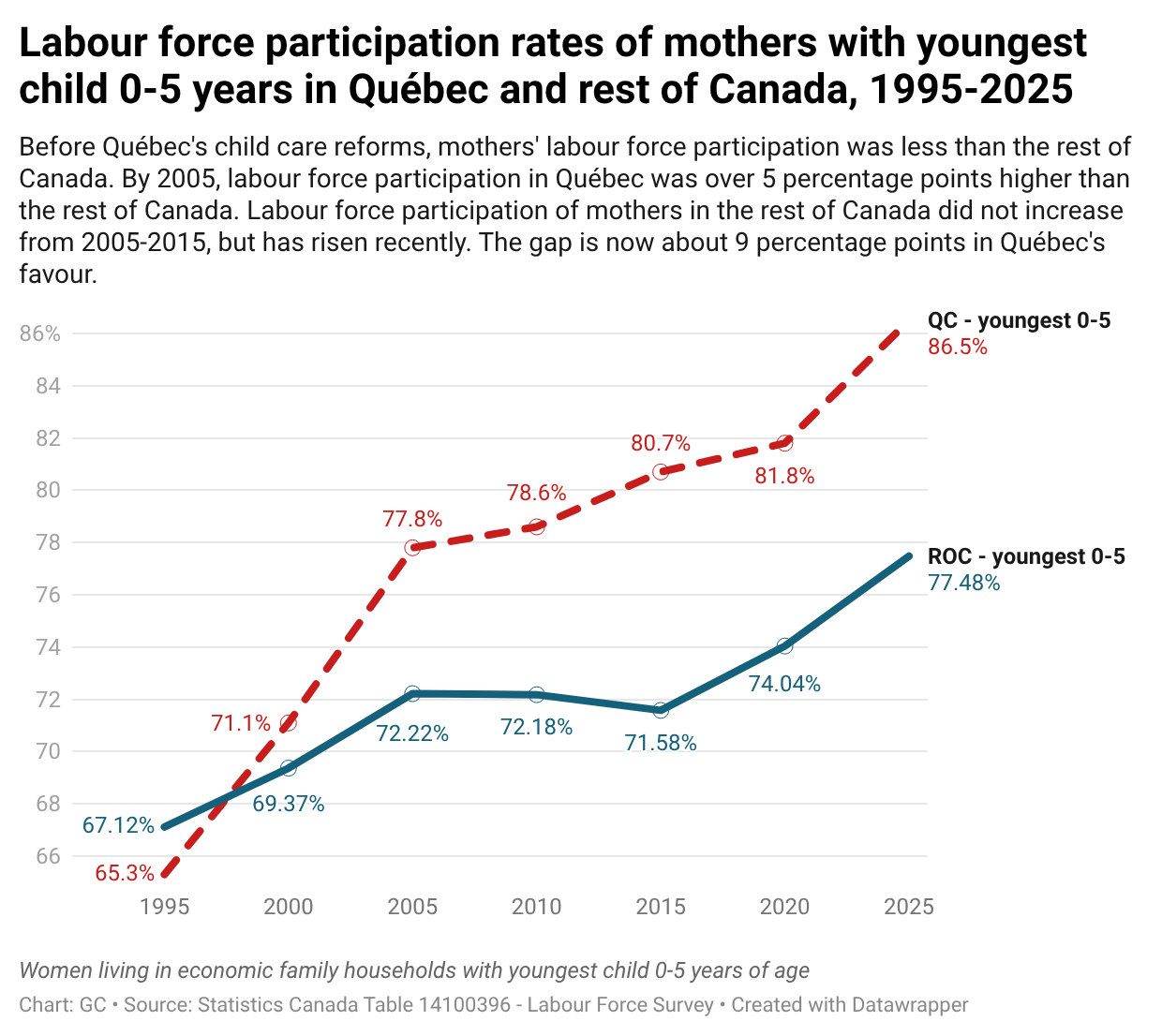
Have a good look at the three charts below. Every five years, they show labour force participation from 1995 (before the Québec child care reforms) to 2025. The first chart shows the rapid and continuing rise for mothers whose youngest child is 0-5 years of age in Québec (red dotted line). In the rest of Canada (blue line), labour force participation has risen, but much more slowly.
The big conclusion from the first chart is that there is lots of room for mothers in the rest of Canada who have children 0-5 to increase labour force participation – there’s a 9 percentage point gap. If the rest of Canada matches Québec’s participation, there would be 105,000 additional mothers with children 0-5 in Canada’s labour force.
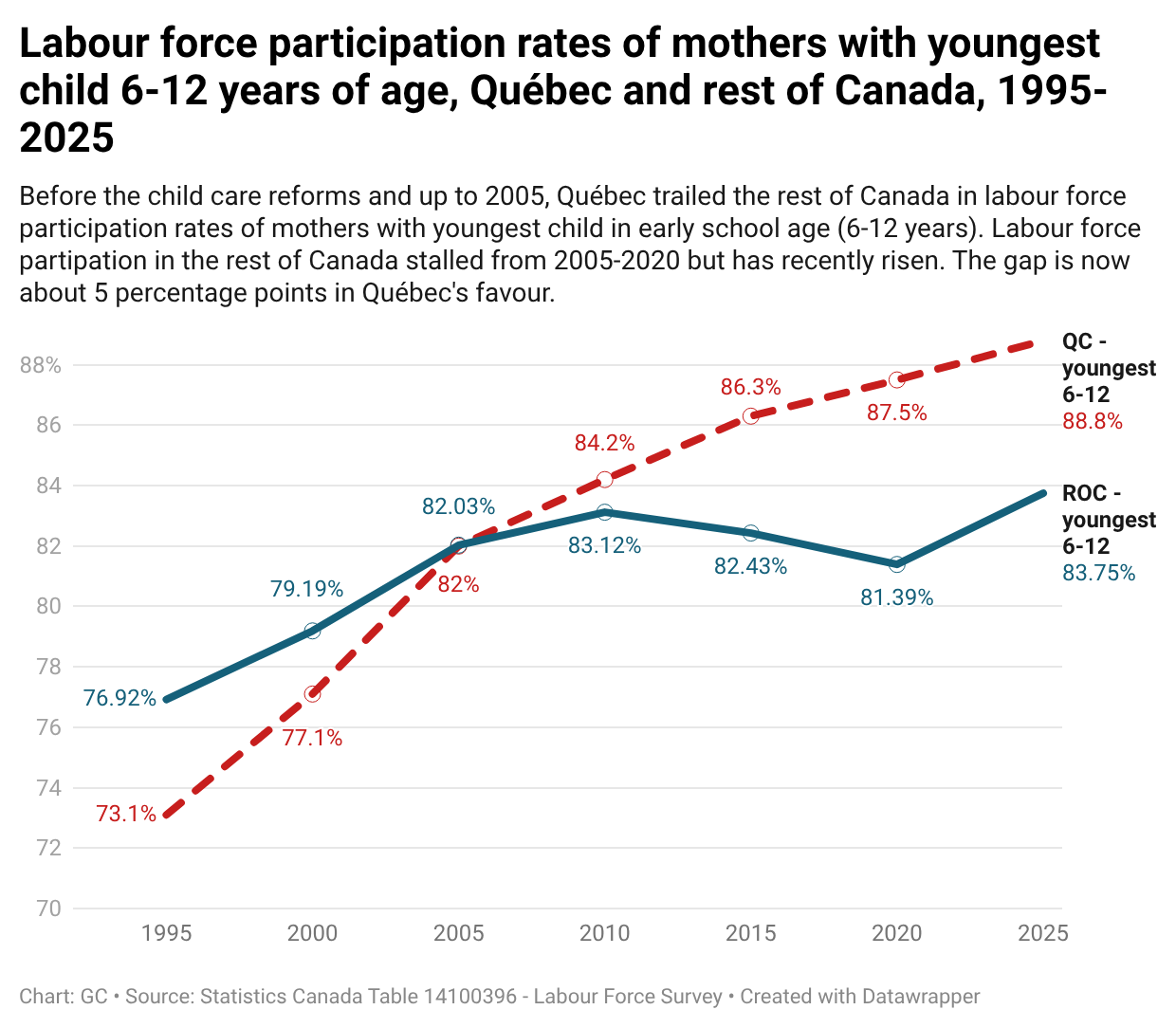
But, that’s not all. As the recent Baker, Gruber and Milligan study (2026) and others have shown, mothers affected by $5 a day child care tended to stay in the labour force for the long haul. We can see these effects in the next chart. It shows labour force participation in Québec and the rest of Canada again, but this time for mothers whose youngest child is 6-12 years of age.
In Québec, mothers who were exposed to affordable child care when their children were young stayed in the labour force, and each successive generation was more and more likely to remain attached to employment even when children were 6-12 years of age. In contrast, labour force attachment in the rest of Canada rose more slowly and not continuously. If behaviour in the rest of Canada matched Québec, there would be 54,000 additional mothers with youngest child 6-12 in the labour force.
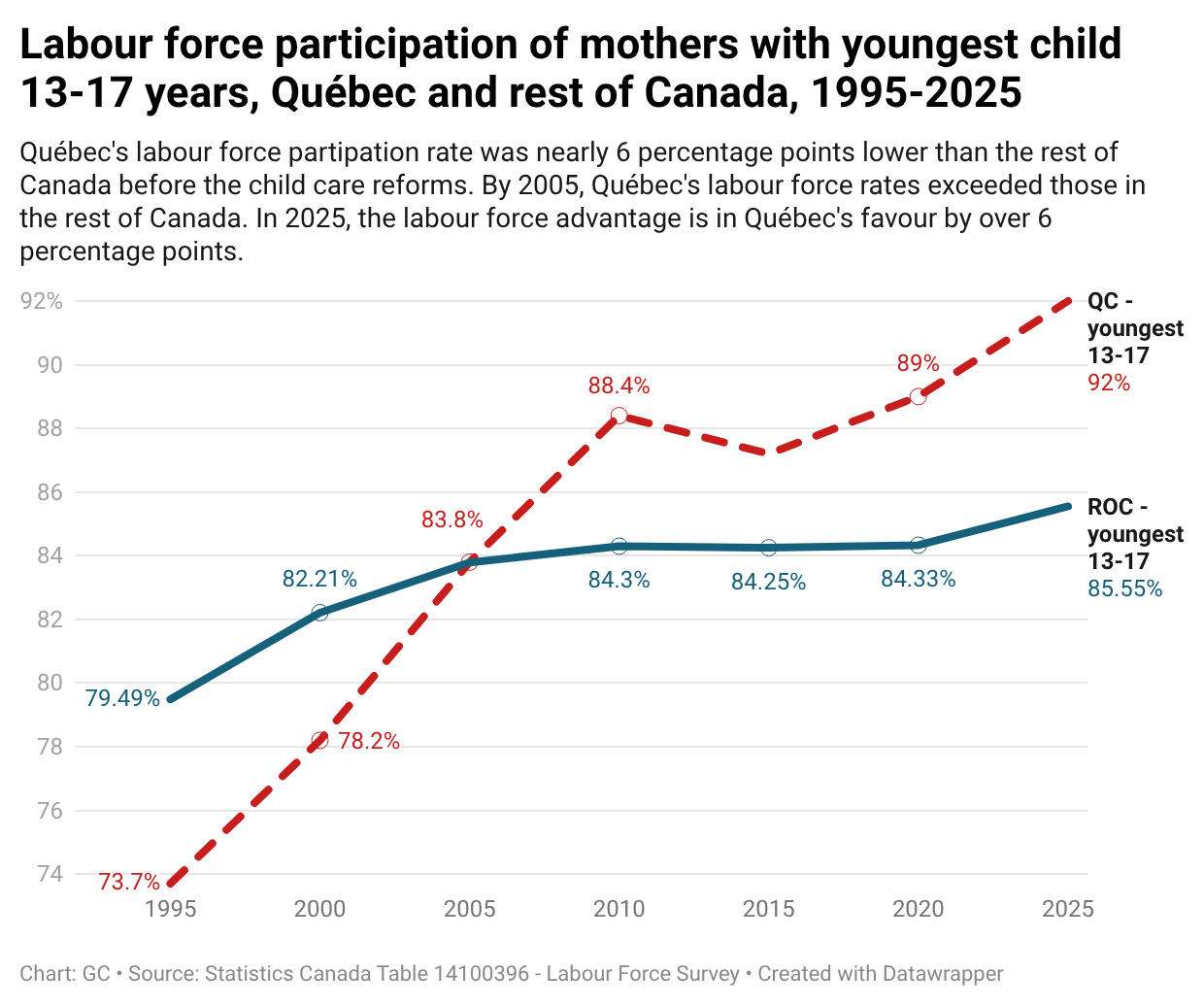
The same story is repeated for families with youngest child 13-17 years of age. If behaviour in the rest of Canada matched Québec, there would be 45,000 additional mothers in the labour force with youngest child 13-17 years of age.
So, a conservative estimate of the potential changes in labour force behaviour of mothers each year in the rest of Canada outside Québec would sum together these additions to the labour force – 105,000 + 54,000 + 45,000 = 204,000 extra mothers boosting up Canada’s supply of labour.
I say this is conservative because I haven’t taken into account hours of work. Baker, Gruber and Milligan found that most of the new employment was full-time rather than part-time. Nor have I looked at any labour force impacts after children turn 18. And I haven’t taken into account the important economic boost from changes in mothers’ earnings that Baker, Gruber and Milligan found.
The key to Québec’s success was the rapid expansion of child care capacity after 1997 so most families with young children could benefit. Will we learn this lesson in the rest of Canada? Yes, if we deliver on the promise of the Canada-Wide Early Learning and Child Care program to provide affordable and available child care to all children who want and need it, the rest of Canada can replicate Québec’s labour force success.
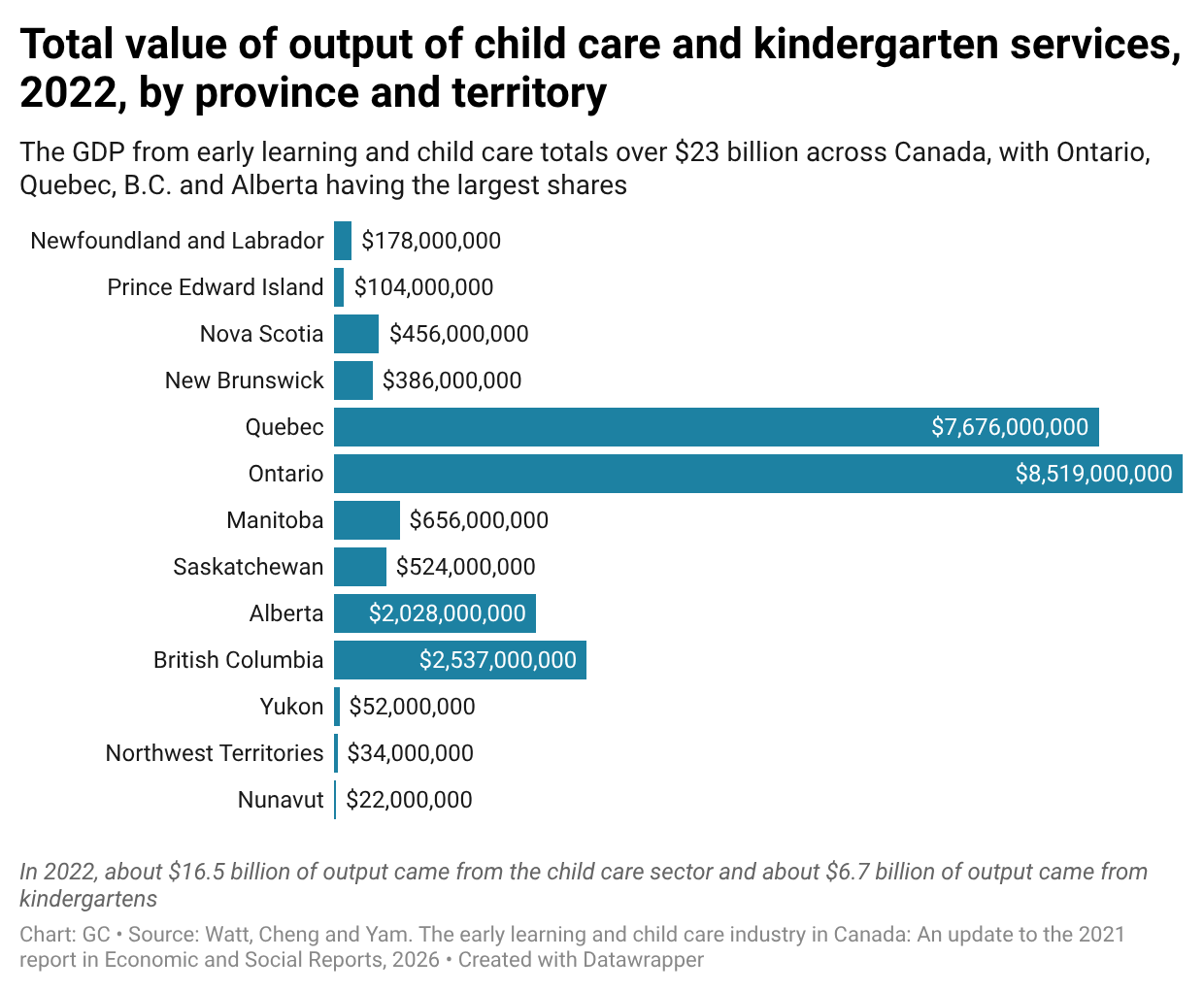
Early learning and child care is now recognized as a very significant part of the economy. It was before, of course, but now the recognized dollar value of production is very substantial. A recent Statistics Canada study put the value of ELCC services produced at $23 billion annually. That includes both child care and kindergarten – what they call the early learning and child care industry. The largest component of value comes from the child care side. The data is based on tax records and is current as of 2022. The chart below shows these estimates of the total value of output broken down by province and territory.
The rest of this blog post explores some important aspects of the supply of child care services, with data from the Canadian Survey on the Provision of Child Care Services (CSPCCS 2024). I’ve written before about problems with the sample used – it may well undercount centre-based child care services – but it provides a large amount of information not available elsewhere.
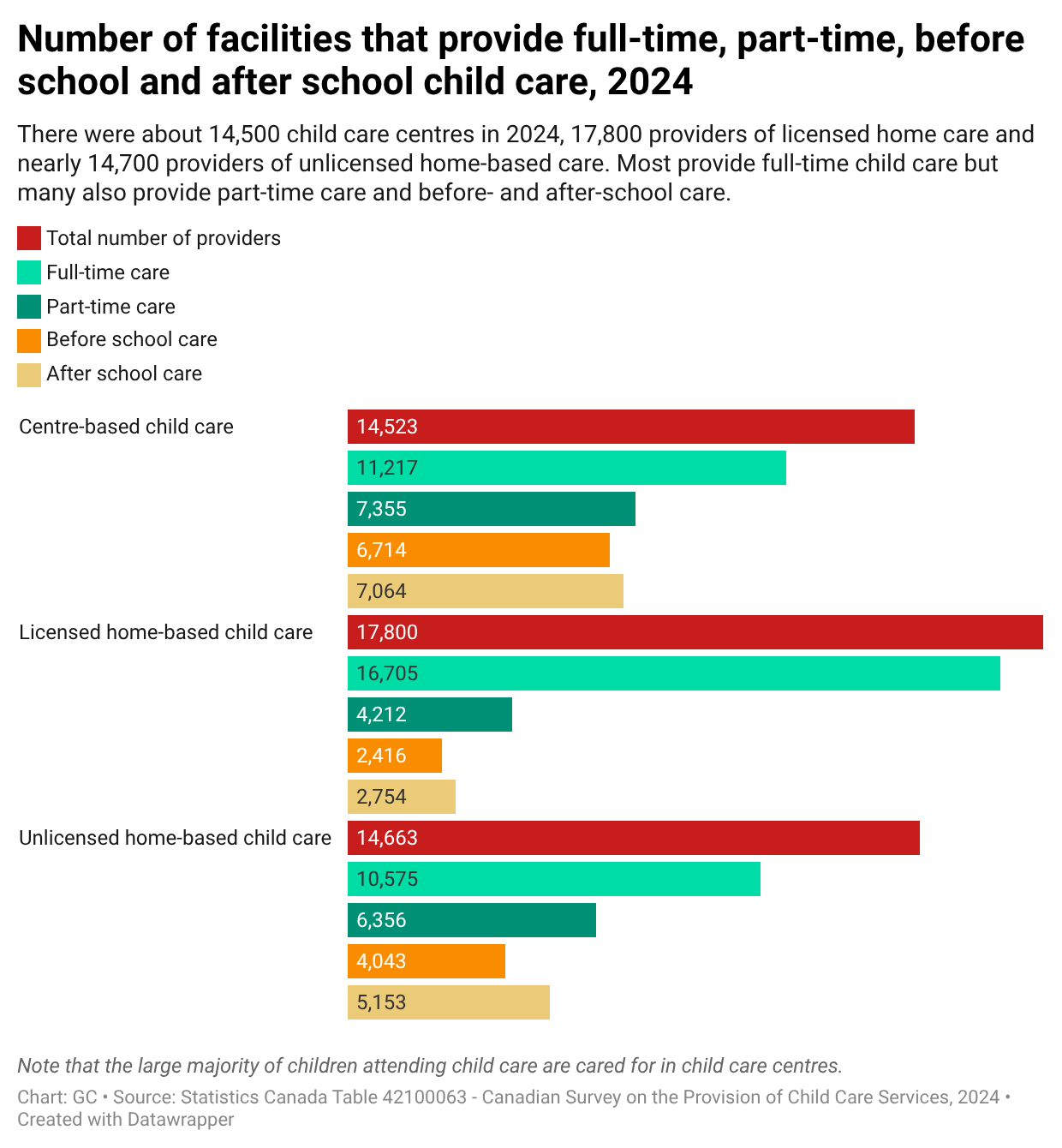
The survey tabulates the number of child care facilities that provide different types of service. And it does this for three categories of child care facility – child care centres, licensed/regulated home-based care, and unlicensed home-based care. If we count “facilities”, there are 17,800 licensed/regulated home child care providers, 14,663 unlicensed home child care providers, and only 14,523 centres. However, this provides a distorted picture of the child care sector.
In fact, as the report from Statistics Canada on the 2024 CSPCCS makes clear, 83% of the children in child care across Canada (0-12 years of age) are cared for in child care centres, 11% in licensed/regulated home-based child care and only 6% in unlicensed home-based care.
The chart below shows that all types of child care offer a range of different services. For instance, Statistics Canada reports that over 75% of Canada’s child care centres offer full-time child care, over half offer part-time child care and about half offer before school and/or after school child care.
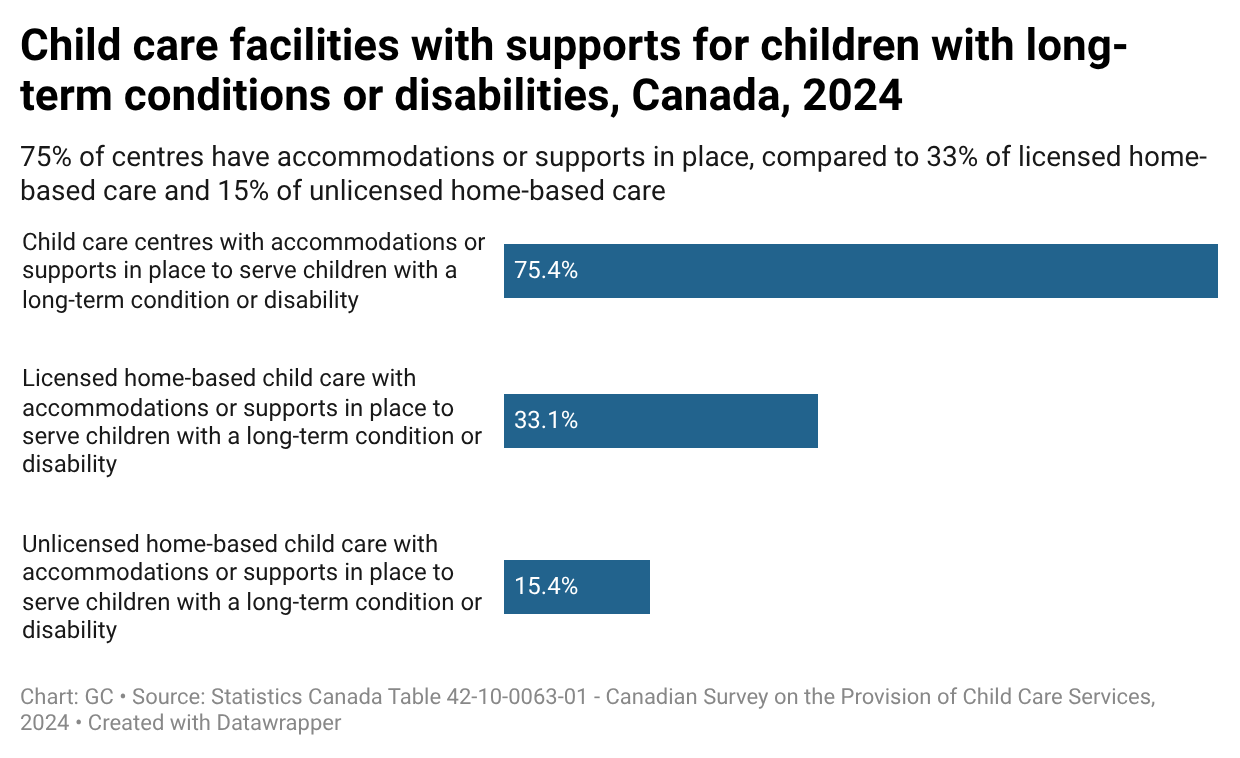
The chart below shows the number and percent of facilities of each type that have accommodations or supports in place to serve children with long-term conditions or disabilities. This is true of 75% of child care centres, but only 33% of licensed/regulated home-based child care and only 15% of unlicensed home-based child care.
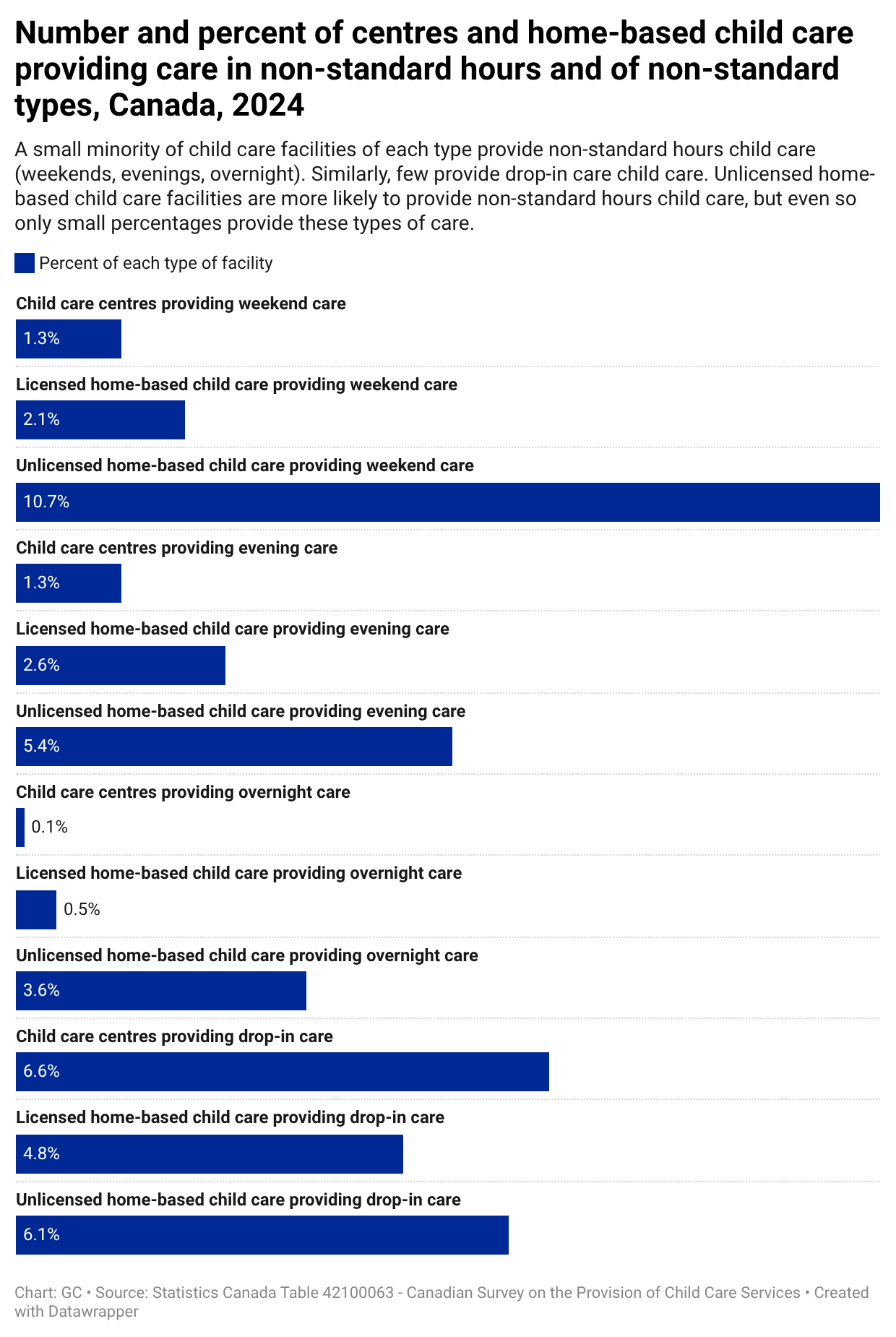
Another important aspect of child care services is the hours of service available. The chart below shows that not many child care facilities of any type offer non-standard-hours child care whether this be evening, weekend or overnight care. Since governments have been promising that child care would be “flexible”, some see this as a big problem.
It IS a problem, but it is easy to overstate the size of the problem. Statistics Canada’s Canadian Survey on Early Learning and Child Care from 2023 asked parents during what hours they would like to use child care. There are over 1.2 million children 0-5 years of age who are using some form of non-parental child care, but only 2% said they would like to use late evening care and only 1% would like to use overnight child care. There were larger percentages wanting to use weekend care (6%) or care in the early evening or early morning (about 5% each). These are not cumulative totals – the same family might want weekend care AND early evening child care.
A similar question was asked of parents not currently using any non-parental child care. Over 25% of them would be willing to use child care if they could find what they need and want for their child, but of these families 84% said they wanted child care during standard weekday hours.
Have a look at the website https://givekidsastrongstart.com/. 22 prominent Canadians have put their names to an open letter telling governments and citizens that more child care is good for business and the economy and good for children and their families. In other words, more child care is good for Canada. The open letter calls on leaders from all sectors to join them in supporting early childhood education as a nation-building investment in Canada’s future.
The 22 signatories are a cross-section of senior Canadian corporate, financial, health, research and civic leadership, with multiple signatories from business and finance as well as academics, Canadian Olympians, and a prominent former politician.
Did you see the Globe and Mail editorial last Sunday (June 28)? The Globe has plans to fix everything that’s wrong with the Canada-Wide Early Learning and Child Care program. A good objective, but I do wish the Globe would do some serious research before trotting out the same tired old solutions that have never worked for child care.
Their plan would return us to market-driven child care solutions with no controls on rising fees, no financial accountability for the expenditure of public dollars, and no preference for non-profit child care. There would be financial assistance for low-income families but not for others. Child care is apparently not a women’s issue and a children’s issue, it’s only a poverty issue. We’ve been there before. It didn’t work and we don’t want to go back.
The Globe and Mail wants free market child care with the add-on of a new voucher or tax credit system – to be run by Canada Revenue. The plan is to provide nearly free child care for low-income Canadians but little or no financial assistance to families that earn higher incomes.
Has the Globe and Mail investigated either of the Canadian examples of a tax credit used to fund child care? If it had, it would find the results have not been impressive.
Ontario’s CARE tax credit was implemented in 2019. Families earning above $150,000 were not eligible. Despite this, the Financial Accountability Office of Ontario reported that “Approximately two-thirds of the total CARE tax credit benefit will be distributed to families with incomes over the 50th income percentile…. Only three per cent of the total CARE tax credit benefit will be distributed to families with incomes below the 25th income percentile.” And the average benefit that a family receives is only $1,300 per year. So this tax credit is not very generous and apparently not a good way of helping low-income families that the Globe and Mail says it wants to prioritize.
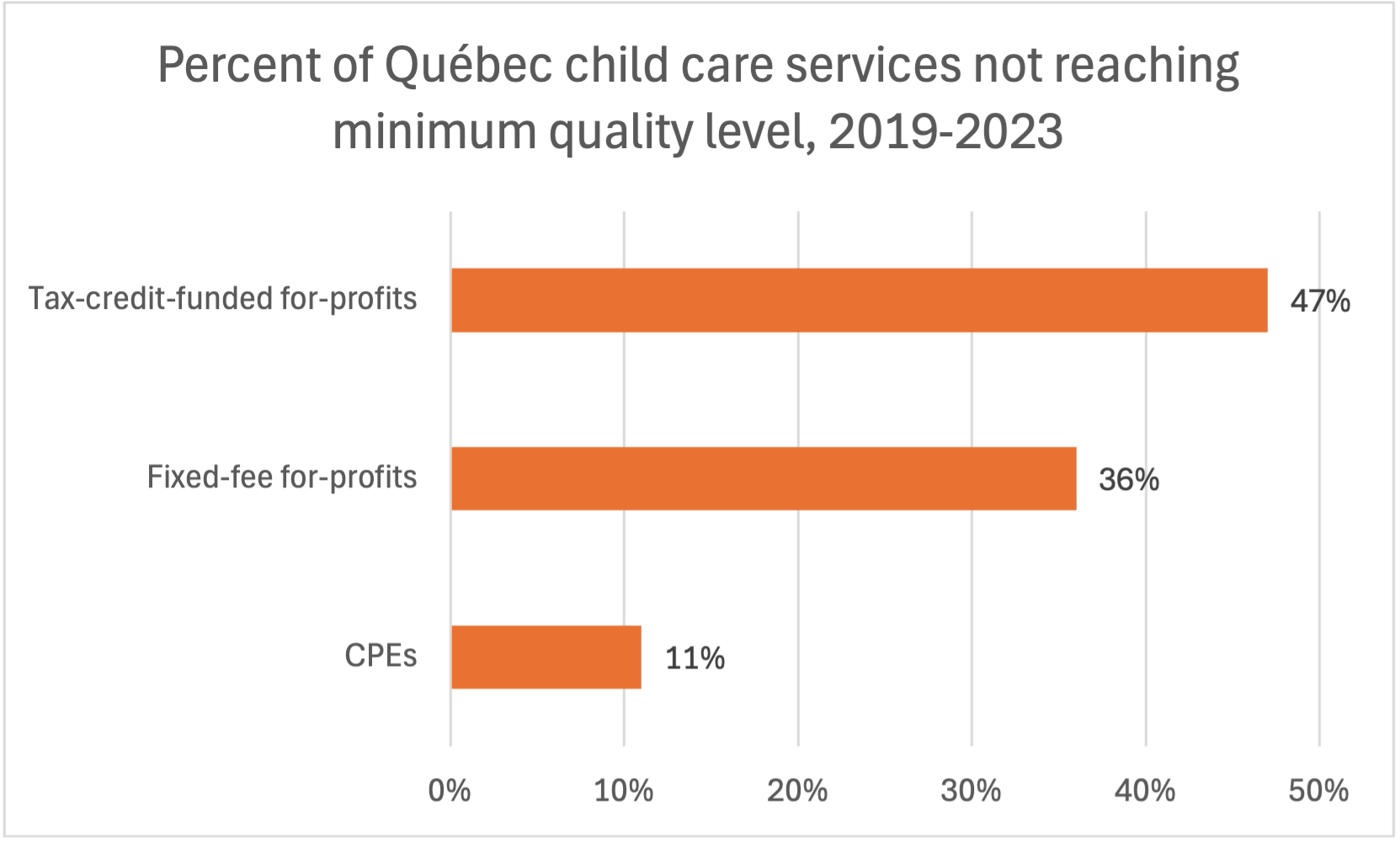
The other example of a tax credit to fund child care is in Quebec. From about 2009, this tax credit was used to encourage for-profits to enter the sector and provide more capacity. These providers could set their own fees and did not have the financial reporting requirements faced by other centres. Money poured into this part of the sector; it provided an increase in spaces but these spaces are publicly acknowledged to be of shocking average quality. Quebec’s Auditor General reported that nearly half (47%) of these tax credit funded child care centres did not even reach the minimum quality level. As shown in the charts below, staffing is much worse in these for-profit child care centres – apparently not their priority – and low quality follows as night follows day. Now that there is sufficient child care capacity in Quebec, large numbers of families are leaving these tax-credit-funded child care centres.
The Globe and Mail gets so many other things wrong, they are hard to count. They want to get rid of universal Canada-Wide child care because according to them:
there are staff shortages that are not improving,
the compensation of educators is not rising,
the Canada-Wide child care program is failing to have any perceptible effect on mothers ability to access employment
one-third of all Canadians with preschool children are on waiting lists and unable to access child care
there is a narrow focus on non-profit child care, with punishing restrictions required by Ottawa on subsidies to for-profit child-care centres
On every one of these indicators, the Globe is wrong or misleading.
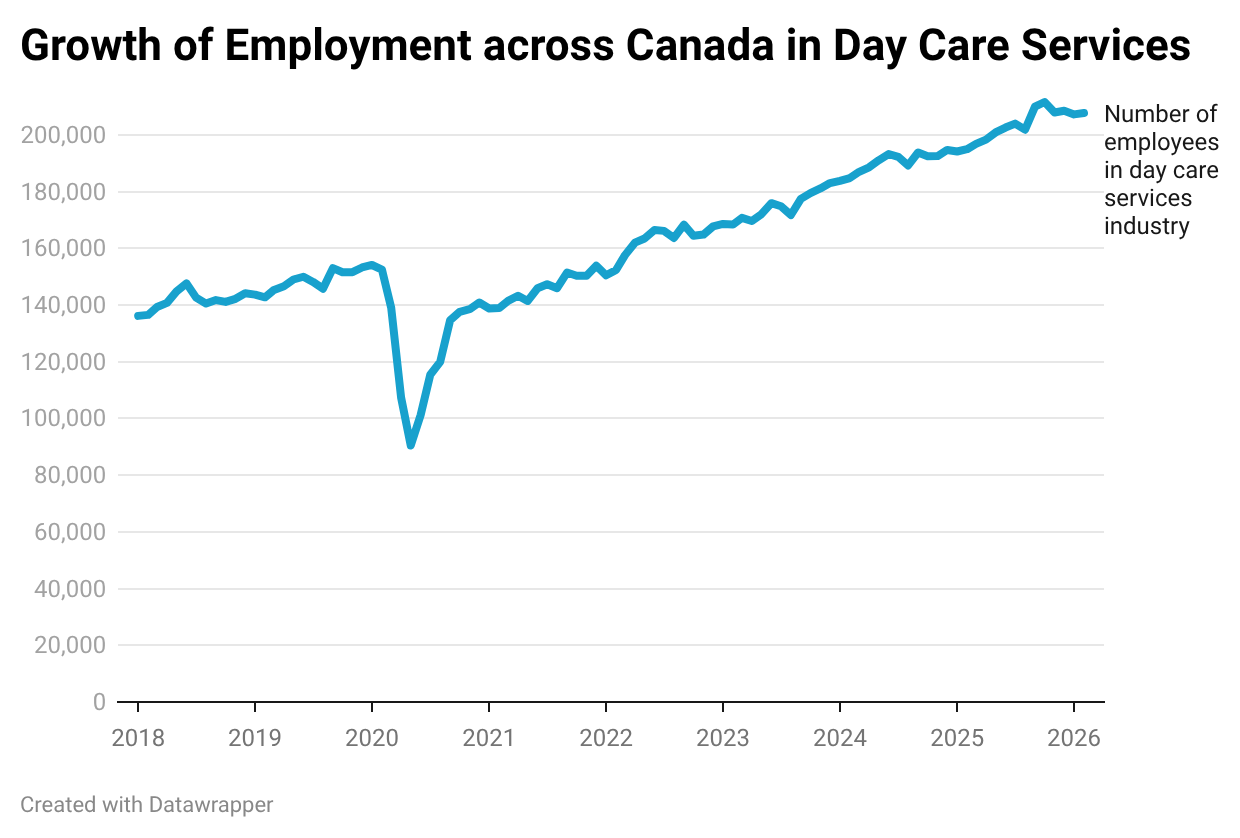
After reading the Globe editorial, you would probably be surprised to learn that the number of employees in the day care industry in Canada outside Quebec rose by 44.1% between January 2019 and January 2026 (Statistics Canada Table 14100220). Over that same period, across all industries the growth in employment was 8.5%.
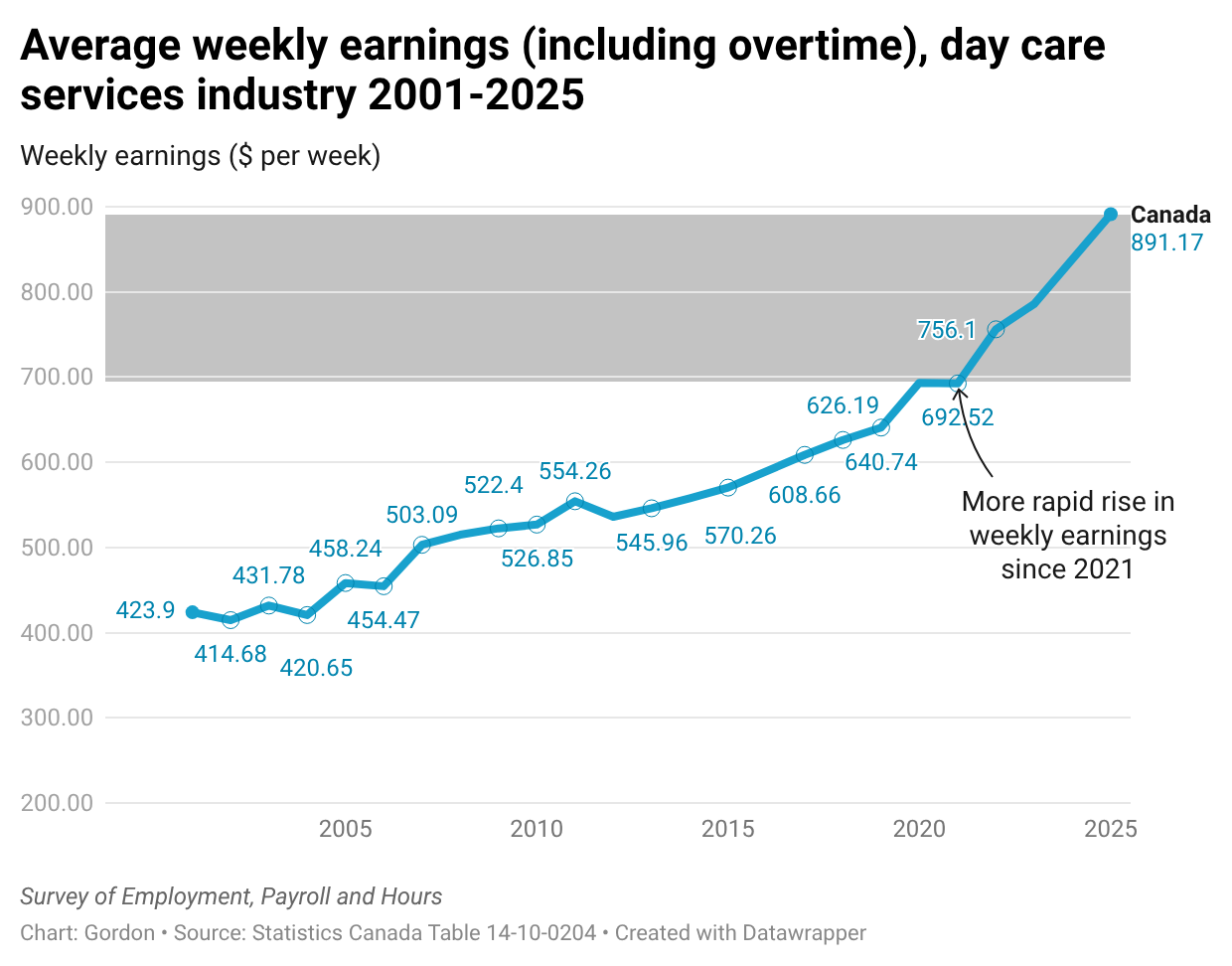
You might also be surprised to hear that average weekly earnings in the day care industry rose by 43.5% from April 2019 to April 2025. Over the same period, average weekly earnings across all industries rose by 27.4%. Compensation for child care educators is still low relative to other industries – average weekly earnings across all industries was $1,302.86 in 2025 – but it is improving.
Again, you might be surprised to hear that, contrary to what the Globe and Mail would have you believe, there is good evidence of rising labour force participation of mothers most affected by the child care reforms. Labour force participation rose by 3.7 percentage points from 2019 to 2025 for mothers with a youngest child 0-5, meaning about 65,000 mothers joined the labour force. For an appropriate comparison, look at mothers with children not affected by the Canada-Wide program. Mothers with a youngest child 6-12 increased their labour force participation over this same period by only 0.7 percentage points. And mums with a youngest child 13-17 increased labour force participation by only 1 percentage point.
It’s true that there are a lot of children on waiting lists. Of course there are, because child care fees have fallen by 50% and more. But if you dig into the big parent survey that Statistics Canada conducted in 2023, you find that only about 16% of families are both on a waiting list and not already in licensed child care. You see, parents can be already using licensed child care and at the same time on a waiting list for a preferred licensed arrangement. Removing these still leaves a lot of children who need either new child care spaces or need existing spaces closed due to staff shortages to become operational – about 350,000 compared to the 927,000 children already in licensed care. We would need to increase enrollment by about 38% to eliminate these waiting lists and this, in my opinion, is where policy attention should be focused.
The Globe would have you believe that the “narrow focus on non-profit child care” is a big problem. Statistics Canada finds that about half of all child care centres serving children 0-5 years are for-profit businesses. Because non-profit child care is typically of better quality than commercial child care, the agreements signed between Canada and the provinces and territories call for new child care growth to be predominantly in non-profit, public and family child care facilities. Contrary to the Globe’s beliefs, this policy has not been a major barrier to for-profit child care expansion. Only 27% of new spaces since 2022 have been in non-profit facilities and another 16% in home-based child care. The rest of the expansion (57%) has been in for-profit facilities.
As you can see, most of the Globe’s analysis of the situation in Canadian child care is based on incorrect information. The Canada-Wide program is beginning to work – increased affordability, increases in child care capacity, increases in employment of child care staff, increases in the pay of child care workers, increases in the labour force participation of mothers with young children. It’s not fast enough and governments fight over who should pay the bills, but there is measurable progress.
The Globe has a point when it says: “Still, money is the main obstacle: There simply isn’t enough of it to keep fees this low and also create enough spaces to meet demand.”
There is good recent evidence that governments would find spending on child care to be a wise investment. The Globe editorial refers to this: “Recent research based on data from Quebec, finds that when child-care subsidies help mothers join or stay in the labour force, the benefits last for the long term, with women working and earning more throughout their careers. This boosts tax revenue and reduces reliance on social assistance for decades after families stop needing child care.” But the Globe apparently thinks that this research only applies to mothers with low incomes. In fact, that research shows that universal child care, available to all mothers in Quebec, generates enough fiscal return to pay for itself. Quebec’s program encouraged many lower-income mothers into employment, but the fiscal payback comes disproportionately from the increased taxes on mothers who earn above the median. Universal child care may pay for itself. Heavily targeted financial assistance for child care will not.
Even if governments are currently cash-strapped, throwing away universal child care in favour of a narrowly targeted voucher would not make sense. The maximum child care fee in Ontario is currently $22 per day, rather than $10. Staying at $22 makes a lot of sense if money is too tight, as long as governments also have equitable and accessible child care subsidies for low-income families. Reaching $10 a day can wait for another day. The immediate priority is expansion.
Despite cherry-picking evidence from the C.D. Howe paper, they ignore one of its two key recommendations: “Ensure stable, long-term funding for the CWELCC system while promoting provincial accountability and progress toward consistent national standards.” Instead, the Globe and Mail plans to solve the money problem by cutting off financial assistance to many families. And they have the gall to claim in their editorial’s last line that their voucher/tax-credit plan will “provide a child-care spot for every kid who needs one.”
We all know about the studies (here, here and here) that show that Quebec’s $5 a day child care had really significant positive impacts on women’s labour force participation. The employment rate of Quebec women went from substantially below the rest of Canada to substantially above. The fixed, predictable parent fee removed a major barrier to mothers’ employment.
And Pierre Fortin and his colleagues (here) have given us good reason to believe that these increases in women’s employment generated by predictable parent fees brought in enough additional tax revenue to more than pay for the costs of the child care program.
But this paper by Baker, Gruber and Milligan goes farther and deeper than that. This paper uses Labour Force Survey data and anonymized tax records to:
Show that the short term rise of about 9% in mothers’ employment generated by the Quebec program stayed at a permanently higher level, rather than being temporary. Most of this employment was full-time
Show that over time mothers who were affected by the child care program had incomes that grew much faster than they otherwise would have, as a result of their attachment to the labour force and not losing skills when their children were young
Show that there is a substantial fall in family poverty in the childbearing years
Show that the program was particularly important for those without a university education – the policy did not provide a significant employment boost to those with university degrees but had a consistently strong effect on mothers with lower levels of education.
Confirm that even if we only consider income taxes and social benefit savings, Quebec’s $5 a day child care reforms generated enough government tax revenues to pay for the costs of the program (or very close). Earlier work had calculated that the short run fiscal return to governments was nearly 40% of the program cost. These new results show that the fiscal return over the lifetime of those mothers affected by the program is approximately enough to cover the total cost (between 75% and 117% of the total cost depending on what discount rate is used in the calculations).
Our Carney government needs to hear this message. Most provincial and territorial governments are telling him now that the current federal commitment of money to this program – about $8 billion per year – is too small to keep it alive for the next five years. Some are talking about leaving the program altogether or changing it dramatically to make parents pay more. It makes no sense to ditch a social program that helps hundreds of thousands of Canadian families, raises employment, raises women’s earnings, and increases tax revenues sufficiently to pay for the program.
But there is more in this study that the federal government should hear. One way of viewing the results of this study is to focus on the message – “Universal child care can pay for itself!”.
But, a second way of viewing these results is that there is strong evidence here that universal child care dramatically improves women’s lives for the better.
As many of us know, having children tends to have strong negative effects on women’s labour market outcomes, but not on men’s. This has come to be called the “motherhood penalty”, or sometimes the “child” penalty. For example, Canadian economists have found that, even ten years after a birth, mothers’ earnings are typically 34.3 percent lower than they were before birth, and on average nearly 15 percent fewer of these mothers are employed. That’s a huge motherhood penalty.
But, the research in Baker-Gruber-Milligan paper shows that Quebec mothers who benefited from its universal $5 a day child care program in the early 2000s had much higher earnings later in life as a result. This earnings impact was progressive, reaching an average of 27% by the time these mothers reached age 50.
So, not only did Quebec’s child care program more or less pay for itself, it also dramatically reduced the motherhood penalty that Quebec women faced throughout their lives. If that’s not a good news story, I don’t know what is.
And what it means for our government is that the investments they make right now in child care will make mothers’ lives better and family incomes higher for years and years to come. It sounds to me like the Canada-Wide Early Learning and Child Care program is just the kind of Major Project that Prime Minister Carney should be investing in. And while many of the Major Projects being discussed appear to be somewhat male-oriented, this one dramatically helps women to overcome the barriers that hold them back in the workforce.
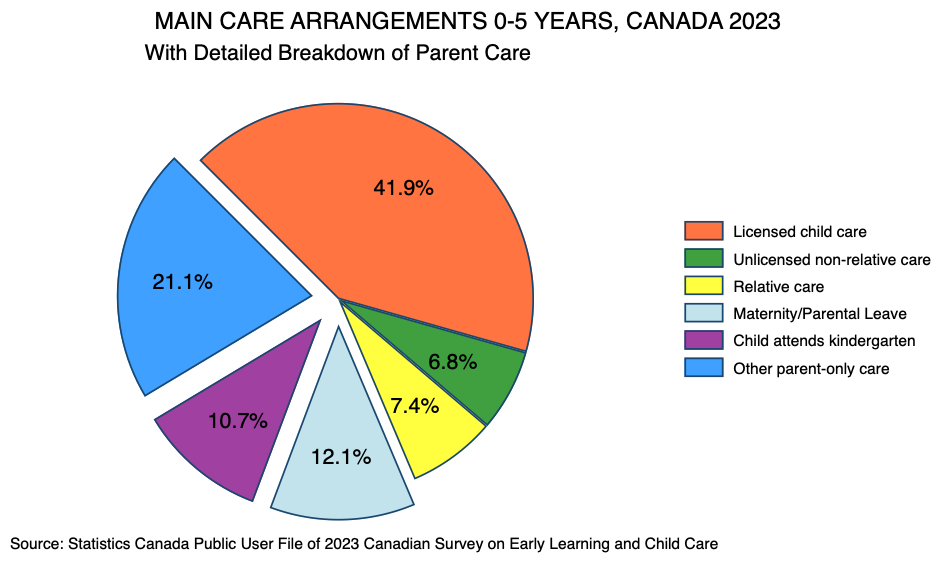
56% of children 0-5 years of age across Canada use some form of non-parental child care on a regular basis. This is the finding of a large parent survey – Statistics Canada’s 2023 Canadian Survey on Early Learning and Child Care. However, nearly 980,000 or 44% – are cared for exclusively by their parents. This seems surprising to many, and apparently contrary to the notion that families need child care when their children are young. However, when the data are looked at more closely, some of the reasons become clear.
In the first year, or sometimes the first eighteen months of a child’s life, many parents are eligible for paid maternity and parental leave in order to spend time with their newborns. According to the Statistics Canada data about 270,000 children or 12.1% of all 0-5 year-old children have a main caregiving parent who would normally be employed during the day, but is currently on maternity or parental leave.
There are another 235,000 children, or 10.7% of the total who are 4 or 5 years of age and currently attend a different form of early childhood education – kindergarten – for much of each weekday. Kindergarten is not considered to be a child care arrangement by Statistics Canada, but kindergarten does provide care for children. The large majority of kindergarten arrangements across Canada now cover the full school day, and often for 4- year-olds as well as 5-year olds. Sometimes, before-and-after-school child care is available for these children, but not always at a low parent fee. Many parents are able to adapt their work or school schedules so their children do not need any non-parental care other than kindergarten.
Another 475,000 children – 21.1% of all 0-5 year-old children – do not have parents on leave and are not in kindergarten, but in any case are cared for entirely by their parents. Close to half of these children – about 202,000 – have a main caregiving parent who is currently employed. Parents may cover child care needs while they are at work through off-shifting between parents (parents working or studying different shifts so one can always be with the child). Or one parent could be providing care while working from home. About 55,000 of these children were on a waitlist for child care in 2023.
A bit more than half of these children – about 269,000 – have a main caregiving parent who is not currently employed. About 41,000 of these children were on a waiting list for child care.
In sum, the picture of children in parent-only care is a complex mix of different situations in which parents currently do not use child care. Many of these children will use or have used child care and kindergarten at different ages, but are not currently using child care.
CHILD’S AGE
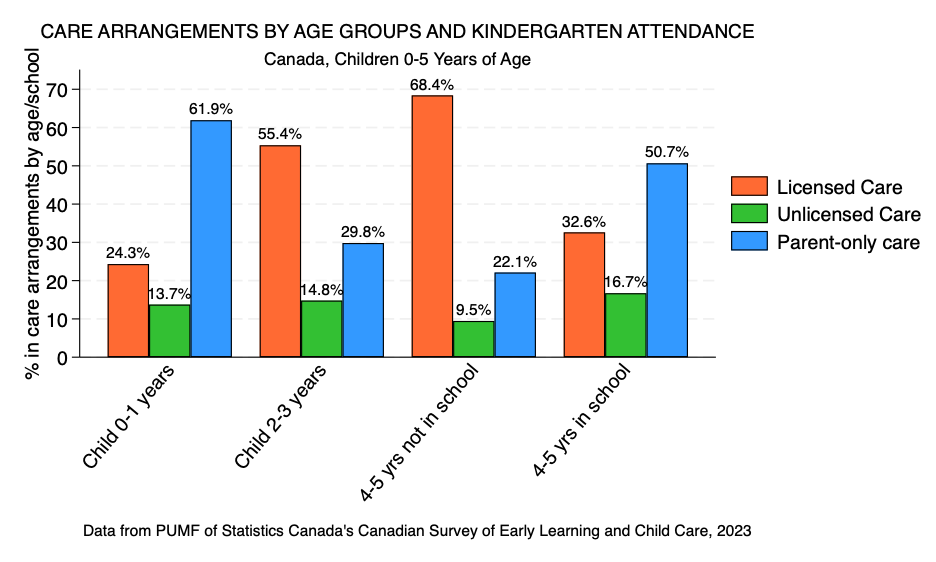
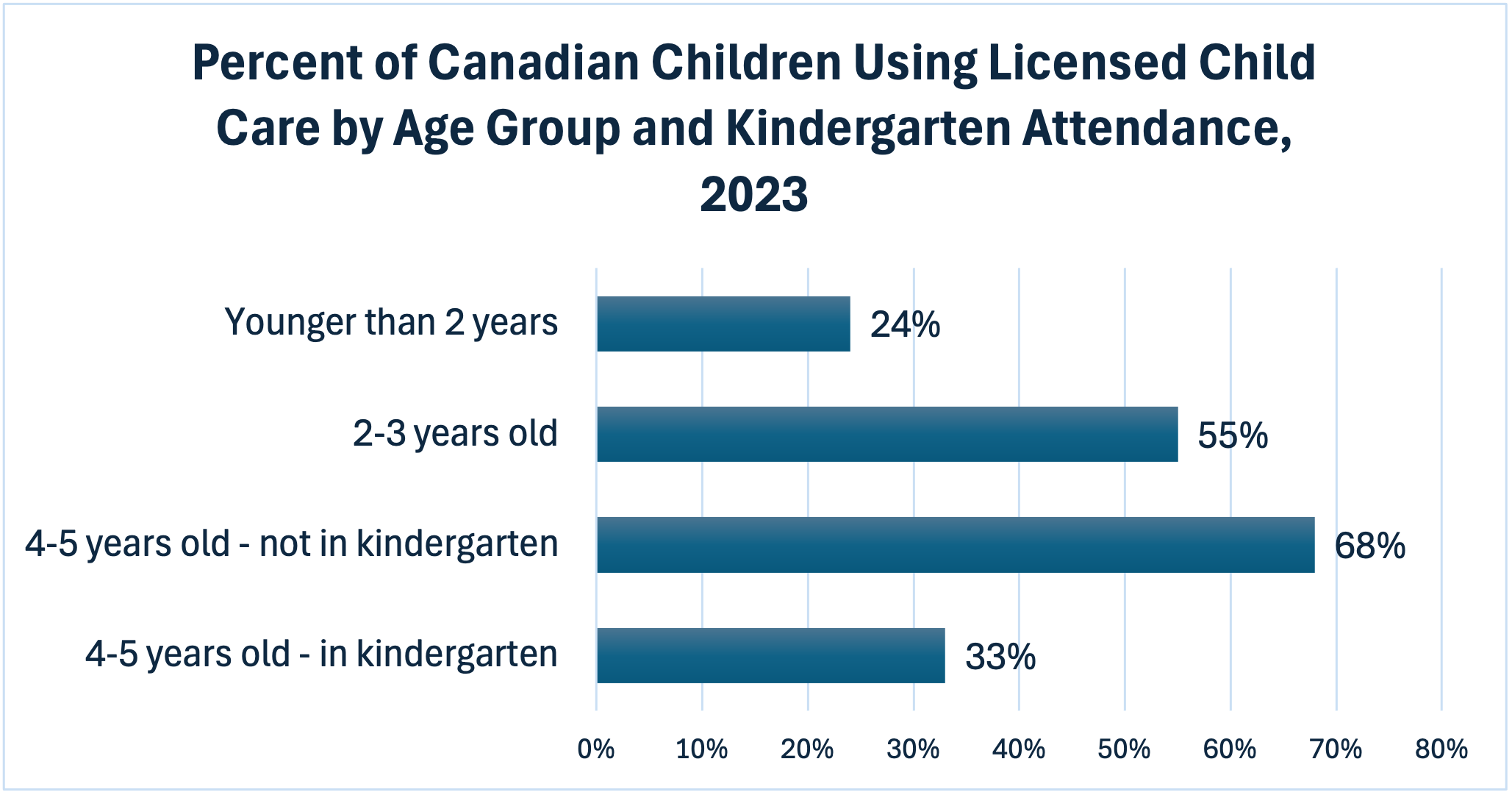
The likelihood that children participate in licensed child care is strongly affected by the child’s age. Only 24% of children who are less than two years of age (0-1 years) currently use licensed child care. This is, perhaps, unsurprising because so many parents take a year (or in some cases, eighteen months) of paid maternity and parental leave when children are first born.
However, 55% of Canada’s children who are two or three years of age are in licensed child care. When children are four or five years of age but not yet in kindergarten, 68% currently use licensed child care. For children who are four or five years of age and are currently attending kindergarten during the day, 33% use licensed child care.
The use of parent-only care also varies strongly by child age. 62% of children who are less than two years of age (0-1 years) are cared for only by their parents. This falls to 30% when children are 2-3 years of age and 22% when children are 4-5 years of age and not yet in kindergarten. For 4-5 year-olds who are already in kindergarten (full-school-day in most provinces), parent-only care is the main complement to kindergarten for about 51% of children.
Since its beginning, Canada’s plan to build a system of child early learning and child care – the “$10 a day plan” – has been panned by a handful of players. These include spokespeople for some political parties, some child care centre owners, right-wing “pundits”, and social and economic conservatives, all with their own agendas. Relying on misrepresentation of research literature, misinterpretation of public opinion polls and Statistics Canada surveys, the common agenda is to paint the $10 a day plan as a “failure” and “disaster” rather than the first largely successful phase of a Canada-wide project to build a workable child care system for all families and children over time. (Really, it is the second phase because back in 1997, Quebec began to build a largely successful and largely universal low fee child care system of their own).
This blog comments on a policy brief published by Cardus in November 2024. Cardus advertises itself as a non-partisan Christian think-tank; it takes a socially conservative approach and promotes ways of thinking that pre-date the Royal Commission on the Status of Women that reported in 1970.
Cardus would have you believe that very few Canadian children and families benefit from low fee licensed child care. Cardus’ staff members Mitchell and Mrozek have written that: “…most Canadian families receive no benefit from the billions spent – only 29% of children aged 0-12 had access to a licensed space in 2021.” (November 2024). It’s a pity that Mitchell and Mrozak inappropriately use data on children 0-12 years to reach this conclusion. Most of these children (the 6-12 year olds) are not even covered by the new funding programs to make child care universally affordable for families. Cardus should instead have informed themselves with the latest Statistics Canada data (the parent survey in 2023 that looks at children 0-5 years of age). It’s called the Canadian Survey on Early Learning and Child Care. Or, Cardus could have read the report entitled Giving Parents Money Doesn’t Solve Child Care Problems published by the Prosperity Project in September 2024. It provided much of the same data we include in this blog.
Many families already benefit from low fee child care
If Cardus had consulted the appropriate data, they would find out that the truth is somewhat different from their biased conclusion. The latest data are from 2023, two years after the beginning of the $10 a day program and about 25 years since Quebec began phasing in universal child care. There are about 2.2 million children 0-5 years of age in Canada and close to a million of them (938,000 children or 42% of all children) are already using licensed child care.
Families prefer to use licensed child care
In fact, 75% of the children 0-5 years of age who use any kind of non-parental child care in Canada now use licensed child care. About 1.25 million children 0-5 regularly use some form of non-parental child care and 938,000 of them are using licensed child care.
Licensed child care provides strong support of parental employment
A major reason why governments in Canada are spending billions of dollars to provide low fee child care is to support parental employment. And this support of parental employment is happening. According to the recent Statistics Canada parent survey, 59% of parents (mostly mothers) whose main activity is working at a paid job or business already use licensed child care for their young children. Many others – another 115,000 who are on a waiting list – would like to use licensed child care and will happily do so when more supply becomes available.
Child age and availability of kindergarten explain patterns of use of licensed child care
The demand for licensed child care is strongly related to the child’s age. Parents with children less than two years are less likely to use licensed child care, so satisfying the demand for licensed care does not mean having spaces for 100% of children.
When considering child care use, it’s important to take other family or education programs into account. For many families with very young children, parent-only care during maternity or parental leave is their choice. For many children who are already in full-school-day kindergarten at four or five years of age, they do not need or their parents do not want supplementary child care.
Across Canada:
24% of children younger than two years of age are in licensed child care. In this age bracket, 62% are in parent-only care, with many of these parents on maternity or parental leave.
55% of all children in Canada who are two or three years of age currently use licensed care.
68% of all four- and five-year-olds who are not yet in kindergarten currently use licensed care.
But, when those four- and five-year-olds reach kindergarten, the use of licensed child care drops to 33%.
From the Public User Microdata File of the Canadian Survey on Early Learning and Child Care, 2023.
Licensed Child Care and Low-Income Families
The other main claim in Cardus’ brief is that low-income families do not get much access to child care services when child care is universally funded. The implication is that low-income families would be better served by a targeted child care program. And that universal $10 a day child care will mostly serve affluent families rather than those who have low-incomes.
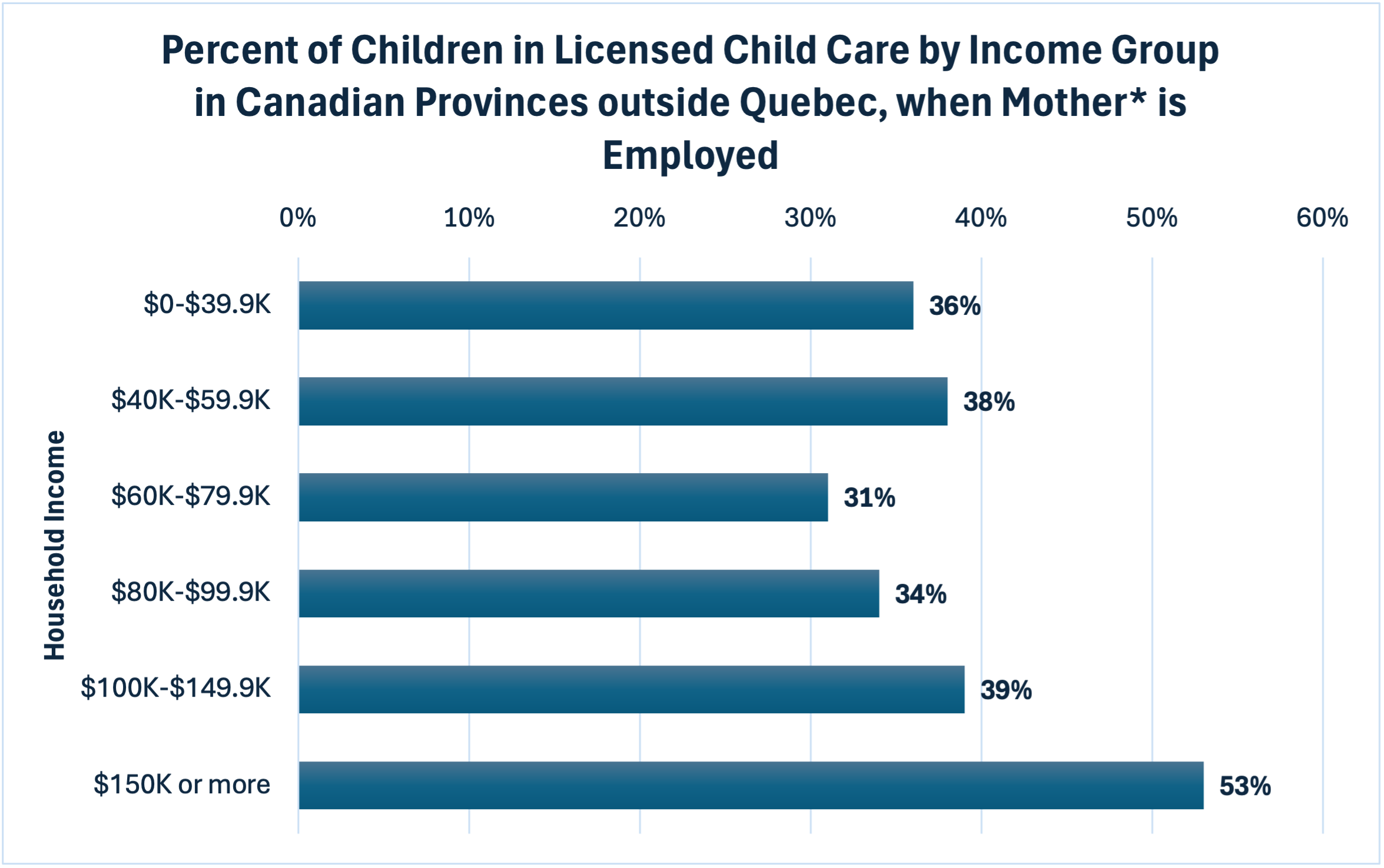
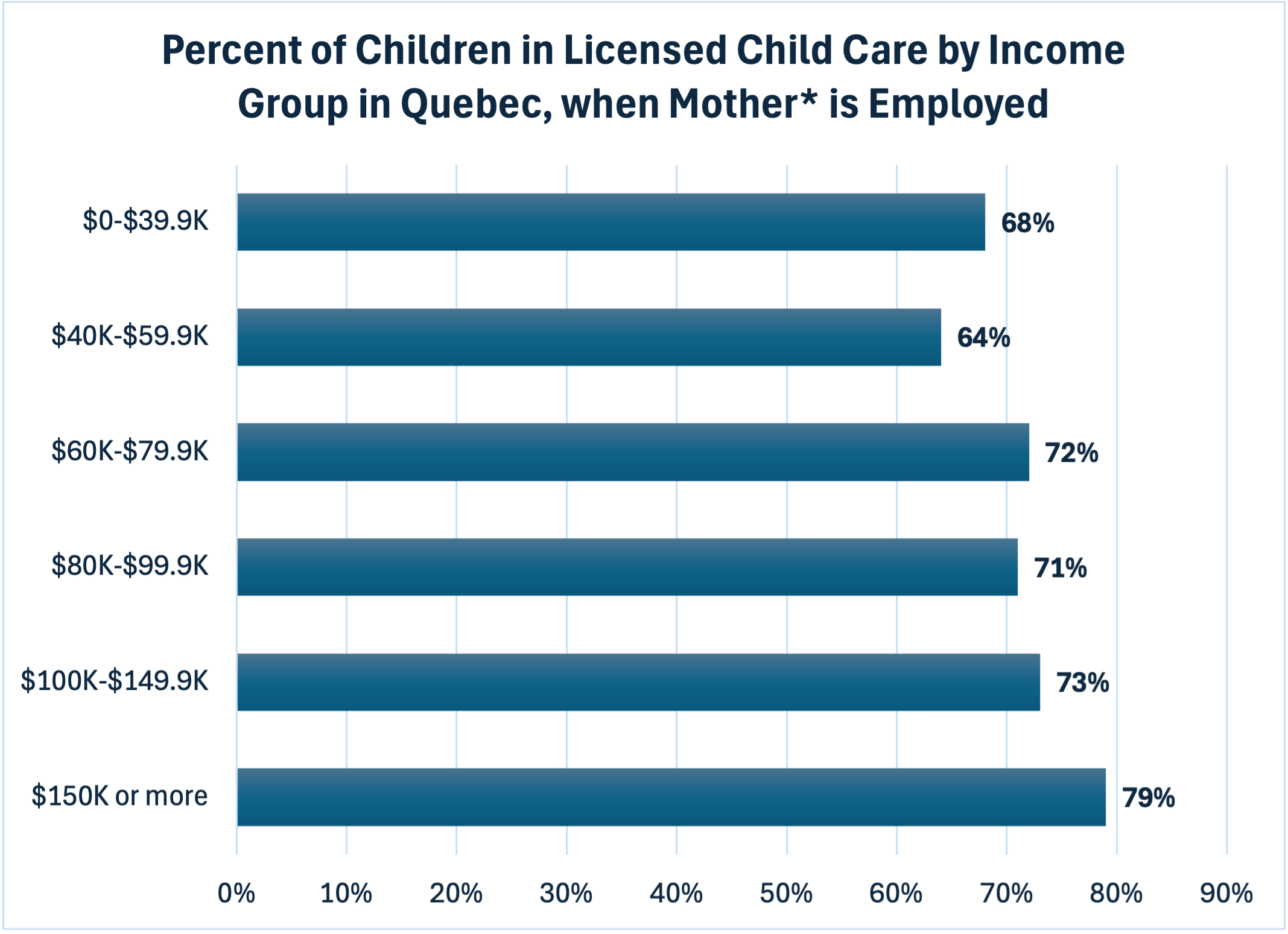
There are two problems with this. First, the use of licensed child care by low-income families is already larger than you might imagine. In Canada outside Quebec 36% of children with employed mothers from the lowest income group use licensed care. And in Quebec, 68% of children with employed mothers from the lowest income group are in licensed child care.
Second, Cardus has identified the wrong culprit for the important inequities that remain. It is market-driven child care that disadvantages low-income families. It is universal child care that does a better job of welcoming the participation of low-income children to licensed child care.
We can see this by comparing access to licensed child care for different income groups where the mother is employed in provinces outside Quebec to the same data from Quebec. Two conclusions are obvious in the charts below. First, in Quebec, a much greater percentage of children from these low-income families are able to access licensed child care than is the case in the rest of Canada’s provinces. Second, the gap in access between the lowest and highest income groups is much smaller in Quebec than it is in the rest of Canada. As before, this data is from Statistics Canada’s recent parent survey.
What’s the explanation? When child care fees were uncontrolled (as they were in Canada outside Quebec until 2021 or 2022) many families have found licensed child care to be completely unaffordable. Most low-income families were squeezed out. Targeted child care subsidies were not enough to reverse this trend. Naturally, the majority of child care users were from more affluent families. But this was a result of the mostly unrestricted operation of the free market in child care, not the result of a massive program to lower fees.
From the Public User Microdata File of the Canadian Survey on Early Learning and Child Care, 2023.
Note: * The vast majority of parents responding to the survey were mothers
From the Public User Microdata File of the Canadian Survey on Early Learning and Child Care, 2023.
Note: * The vast majority of parents responding to the survey were mothers
As Cardus would know if they had looked at the federal-provincial-territorial agreements that have brought us the $10 a day child care program, improved equity in access for children from different backgrounds is a key objective of the federal program.There are substantial federal, provincial and territorial efforts to ensure that new child care capacity is directed towards underserved populations – low income children, vulnerable children, children from diverse communities, children with special needs, and Francophone and Indigenous children. Still, there is too little access to licensed child care for low-income families – on this we agree with Cardus. But eliminating funding support for child care services and instead paying money to families to stay at home is the opposite of a solution to this problem.
Cardus wants to make child care unaffordable again
Cardus does not really want financial support for licensed child care at all. Instead, Cardus wants us to return to some version of Stephen Harper’s Universal Child Care Benefit. They estimate that if the federal spending on the $10 a day child care program was divided equally amongst families instead of going directly to day care centres to lower fees, each family would receive $3,869 per child, per year. But, right now, families using low fee child care are receiving $5,000 – $15,000 in child care fee reductions. With the end of direct funding of child care, child care fees would soar and nearly a million families would be much worse off than they are currently. Child care would be unaffordable once again, and mothers would be squeezed out of employment by high fees. How is that a sensible and affordable child care policy? No wonder 75% of Canadians think that a Conservative government, if elected, shouldn’t end the $10 a day child care program.
There Is still a lot of work to do to build a $10 a day child care program for all the families that want to use it – especially in expanding the qualified workforce and the supply of services. But already many Canadian children and families are much better off than they were in 2021. The priority now is to finish the job of providing affordable, accessible, quality child
I met Sebastien Montpetit at the Canadian Economics Association meetings in Winnipeg last year. He is a Canadian and Quebecer who has been studying for his PhD in economics at the University of Toulouse. And he, with co-authors, has come up with a really fascinating analysis of the impacts of Quebec’s universal child care program ushered in the late 1990s and the early 2000s.
The paper is complex, has multiple parts, and the latest version of it is available here. It has been selected as one of three finalists for the Canadian Labour Economics Forum prize at the upcoming Canadian Economics Association meetings in Toronto. I’ll give you the main take-home points right away, and then delve into where the results come from.
Sebastien’s main conclusions?
The importance of the supply of child care services has been underrated. Greater supply of child care – availability – is as important as improvements in affordability. In Quebec, the regions that had the largest increases in child care supply had the biggest impacts on mother’s employment and increased child care use. Lowering fees without increasing coverage has modest effects on the benefits to families. The bottom line: increasing local child care supply is key to the effectiveness of child care reforms.
The economic benefits from improved maternal labour supply in Quebec have been well studied and Sebastien confirms them. But, there are very substantial non-monetary benefits for mothers too. Think of this as work-family balance, things like the reduced search time for child care, the shorter distances that have to travelled each day when child care is much more available and affordable.
When all the benefits are summed, benefits total more than 3.5 dollars of benefit per dollar of net government spending – more than twice the benefit that comes from looking only at increased mothers’ earnings.
Earnings gains for mothers impacted by Quebec’s child care reforms are concentrated in the fifth through the eighth decile of income. In other words, many of the fiscal benefits to governments of a universal child care reform come from mothers who can earn moderate to reasonably high incomes. These are mothers who will not be reached by a targeted approach to child care spending. A universal approach may therefore be more fiscally responsible than targeted child care initiatives.
Michael Baker, Kevin Milligan and Johnathan Gruber became renowned for their paper concluding that there were a range of negative effects on children who lived in Quebec during the early years of Quebec’s child care reforms (and may have participated in child care). Sebastien looks at data on those children many years later and assesses whether their educational development was negatively impacted. He finds no evidence of this; educational attainment of students in Quebec and the rest of Canada is very much the same.
Michael Baker, Kevin Milligan and Johnathan Gruber gained some additional notoriety for a follow-on paper that found increased juvenile criminality amongst Quebec children who were exposed to Quebec’s child care reforms. Sebastien Montpetit looks at the evidence on juvenile crimes and finds that most of the increased juvenile crime that may have occurred was very minor and that the societal cost is relatively small.
The main data source for all of his analyses is the National Longitudinal Study on Children and Youth. He also uses data from the Canadian Censuses of 2016 and 2021.
There are four types of analysis that compose this complex paper. First, with new data on regional child care coverage rates, Sebastien uses a difference-in-differences approach to compare mothers in Quebec to those in the rest of Canada. He finds that in regions where child care supply increased the most, employment and child care use increased much more when other factors are controlled.
In particular, in regions where child care supply expanded more, the child care reforms boosted mothers’ labour force participation by 40% more than in other regions
Further, Sebastien finds that mothers with low levels of education also respond more in these regions with high levels of expansion.
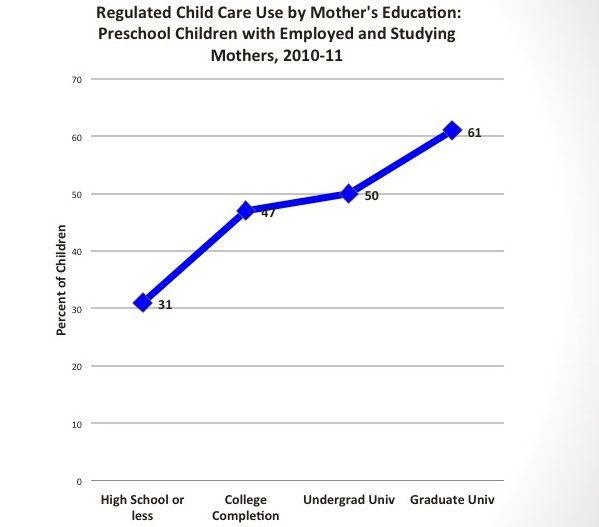
Results suggest that for high educated mothers with a post-secondary qualification, the main incentive to take up employment was the fee reduction. For mothers without a post-secondary qualification, access to a space was key.
Sebastien uses a non-linear difference-in-differences model to estimate earnings gains across mothers’ income distribution. Mothers’ earnings gains from the child care reforms are found to amount to $1.42 per $1.00 of net government spending.
Baker, Gruber and Milligan found that eligible children in two-parent families experienced worse developmental outcomes and lower consistency in parenting. Other researchers found substantial heterogeneity in these results. Haeck et al (2015,2018, 2022) found that most negative impacts on children and parental behaviour fade away over time.
In order to look at children’s educational attainment later in life, Sebastien employs a triple-difference model which compares education levels of same age individuals born before or after the reforms in Quebec to similar individuals in the rest of Canada.
The paper concludes: “We find no evidence of negative effects on educational attainment of eligible children in the long-run. This pattern is true for each educational level, namely for university, high school, and college completion….
As a result: “…the negative impacts on child behavior documented by Baker et al. (2008, 2019) do not translate into depressed economic outcomes later in life.” (p. 2) “…this evidence thus suggests the absence of negative fiscal impacts stemming from eligible children’s economic outcomes in the long run.” (pp. 2-3).[1]
Triple-difference estimator compares same-age individuals who vary in eligibility status based on the census year and their province of birth. He finds no evidence of negative effects on educational attainment of eligible children in the long run. This pattern is true for every educational level.
Sebastien Montpetit takes Baker and colleagues’ estimates of increases in youth criminal activity (2019) and estimates what the victimization costs and productivity losses would be. Using recent estimates of the costs of crime, he finds that these social costs are small.
Difference-in-differences estimates seek to use good control groups to help judge the effectiveness of some policy change. So, for instance, children 0-4 years of age in the rest of Canada where there was no major child care reform, might be considered to be a good control group to compare to what happened with children 0-4 or the mothers of those children in Quebec. Why is it called difference-in-differences? Because this statistical technique does not compare the level of a variable (like mothers’ labour force participation) in Quebec to the same level in Canada. Instead, it compares the change in mothers’ labour force participation (called a difference) in Quebec to the change over a few years (another difference) in the mothers’ labour force participation in the rest of Canada. This analysis is done in a regression framework including other variables, so that we can see the impact of those variables on the policy result.
Montpetit then estimates a structural model of maternal labour supply and child care choice in order to make inferences about the size of the non-monetary benefits that mothers receive from Quebec’s universal child care system. The non-monetary benefits are found to be substantial. Using the model to do additional simulations, Sebastien concludes that these non-monetary benefits are particularly closely related to the availability of child care services in the local area. He concludes that universal child care policies for children 0-4 can generate substantial social returns. And he concludes that increased availability of child care is particularly important to these returns.
Sebastien notes that the quality of Quebec child care in this period was very uneven with CPEs having higher quality and other child care centres having lower quality. Sebastien is not able to include quality measures in his analyses.
Altogether a very interesting, carefully crafted and timely paper. Congratulations Sebastien and co-authors!
A major new study (https://childcarepolicy.net/wp-content/uploads/2021/12/Ten_a_day-paper-web.pdf ) addresses the question of whether the $10 a day program will truly improve child care affordability and reduce barriers to employment for families. It was written by economists Gordon Cleveland and Michael Krashinsky from the Department of Management at University of Toronto Scarborough.
Their study focuses on the situation facing couple families with one infant child and one preschooler in each of the three provinces at different possible levels of income. The authors’ main conclusion is that the $10 a day program can and should dramatically change child care affordability and make employment a worthwhile option for many caregiving parents. However, even if provinces and territories adopt a flat fee of $10 a day, they will need to have some kind of sliding scale to ensure that low-income families are not disadvantaged.
On the basis of this work, Dr. Gordon Cleveland says
“Ontario should sign a funding deal soon with the federal government; if they don’t reach an agreement by early next year, Ontario will lose about $1 Billion in child care funding.”
“Our work shows that child care costs are a very large barrier to employment for many two-parent families, and that $10 a day child care will dramatically reduce those barriers.”
“To reach an agreement, Ontario needs to develop a child care Action Plan. That plan needs to include support for dramatic expansion of non-profit child care – at least 150,000 spaces over 5 years. It needs a plan to phase-in more affordable child care, so that supply and demand increase together. And it needs plans to pay early childhood educators more so we can recruit more trained staff now.”
Finance Minister Chrystia Freeland’s April Budget is spending $30 Billion over 5 years to make child care affordable enough to eliminate this major barrier to the employment of mothers of young children across Canada. As of December 2021, nine provinces and territories have signed on to the $10 a day early learning and child care program, with Ontario being a notable holdout. This timely study seeks to determine whether the $10 a day policy gamble is likely to work, and what kind of funding reforms will make the effects more equitable.
Specific conclusions of the study include:
Under current policies, if a couple family with two children cannot access subsidies in Ontario (and most cannot) licensed child care at any income level is remarkably unaffordable.
If Ontario offered licensed child care at a flat fee of $10 a day per child along with the existing tax credit, a couple family with two children would pay less than 15% of the caregiving parent’s income contribution in child care fees, no matter what their income level. The child care cost barrier to employment would be dramatically reduced.
Alberta’s new funding policies agreed to with the federal government will improve affordability, particularly for families at higher levels of income. Alberta plans to offer substantial operating grants to child care centres and homes to allow them to lower parent fees. And Alberta is extending its subsidy system to cover families with partial subsidies out to $180,000 of family income.
The combination of grants and subsidies will still leave Calgary couple families with two children giving up more than 30% of net extra employment income if the caregiving parent earns less than $44,000 (family income of $110,000). In other words, child care will be unaffordable for these families even when Alberta’s new child care policies are fully implemented.
Edmonton families will be better off than Calgary families because median fees start off at a lower level before the new funding programs. Only families where the caregiving parent earns less than about $18,000 (family income of $45,000) will find child care unaffordable (30% or more of the net income contribution of the second earner).
Manitoba pioneered flat fees for child care, and operational funding to lower fees. However, its positive reputation is not supported by measures of current child care affordability.
A flat fee of $10 a day per child (with no subsidy system) would improve affordability for nearly all couple families with two children in Manitoba except when the caregiving parent’s income is $14,000 or below. However, a flat fee will mean that affordability is always worse for families the lower their income.
Recently, Prof. Bob Brym invited me to join others in exploring the issue of equality in contemporary Canadian society. The occasion was the inaugural S.D. Clark Symposium on the future of Canadian society. My topic was to assess how good a job child care is doing in Canada in improving different types of equity – gender, child and family. I’ve attached my (rather lengthy) notes for the talk. You should look for the volume based on this Symposium to be published soon by Oxford University Press. It will contain chapters from each of the authors, including my own.