ACE National is an organization that groups together child care operators, most of them for-profits, to lobby for reforms that serve their interests. Their chair and most prominent spokesperson is Krystal Churcher, who owns a child care centre in Fort McMurray, Alberta, and also heads up the Churcher Group which is a consultancy firm supporting child care operators.
ACE National recently published a report recommending 10 major reforms to CWELCC in Ontario. These reforms would apparently create “A Structurally Sustainable Framework for CWELCC” for the years 2027–2031.
Unfortunately, their report is actually a slide deck – with 10 very briefly described reforms and no research or evidence evaluating their likely impacts. So, this is more like a press release than it is a report. Nonetheless, it is worth looking at to see what ACE National has to offer.
According to the report, their recommendations are aimed at helping Ontario continue its participation in CWELCC. They say that their proposals would avoid the need for substantial new funding, would preserve affordability for families and would control costs structurally. It sounds like a dream.
Unfortunately their 10-point plan would reduce services offered to children and families, increase costs to parents, and totally eliminate eligibility for some children and families. On top of this they want to reduce measures of financial accountability for the public money that providers receive, and they want to shovel public money towards the 8% of providers in Ontario that have refused to enter the CWELCC program (almost all of them for-profit operators charging high fees without any financial accountability). None of this passes my sniff test as a useful, well thought out set of policy reforms to make CWELCC sustainable.
Let me give you a few details about their 10-point plan:
ACE would adopt a “Tiered Affordability Model”. Apparently this means parent fees that vary with income. There would still be a fee maximum, but we don’t know how high, or how much families would pay at different income levels. And we don’t know how it would be administered. Would operators have to income-test parents to determine how much they would pay? Parents wouldn’t like that. According to ACE, a few $10 a day spaces would be available but only to a “limited budget-controlled subset” of families. ACE suggests that this tiered affordability system would save $300 million – $600 million per year, which is less than would be saved by simply keeping the maximum fee at its current $22 a day level while increasing subsidy funding for low-income families. Not a very sensible suggestion in my opinion.
ACE would make the standard child care day only 8 or 9 hours per day, rather than the current 10 or 11 hours. Any family who needed to use extra hours would have to pay extra. Of course, this means that most parents working an 8 hour shift would face extra-billing.
ACE would cancel eligibility for child care for ALL children in Junior or Senior Kindergarten. There are currently about 128,000 before-and-after-school spaces for these children in Ontario. All these children would lose CWELCC child care assistance. That’s close to 40% of the children currently benefiting from CWELCC in Ontario.
ACE wants to get rid of cost-based funding of child care in Ontario (i.e., the funding formula). Instead, child care providers would get “standardized per space operating grants”. And, there would not have to be detailed financial accountability for public money received. Instead only risky operators would have to undergo audits. Apparently, there would also be no more limits on the percent of public revenues each year that can be taken as profit, unlike with the current funding formula.
ACE wants the province to define clearly which services are part of CWELCC and which are not. Services that are not included would be additional costs to parents above the daily fee.
ACE wants the government to provide money to operators who have refused to join the program so they can provide low-fee child care for families. Currently, government subsidies and revenues are only available to operators who are part of the CWELCC system. But ACE wants to reverse that and subsidize the profits of these operators outside CWELCC.
ACE wants to eliminate local planning restrictions on expansion of child care services. Instead of planned expansion with a priority on underserved communities, expansion would be allowed wherevershortages exist (i.e., everywhere) and whenever projects were ready to go. Sounds like a free-for-all for the for-profit sector which would receive guaranteed future operating funding for new spaces they are willing to provide.
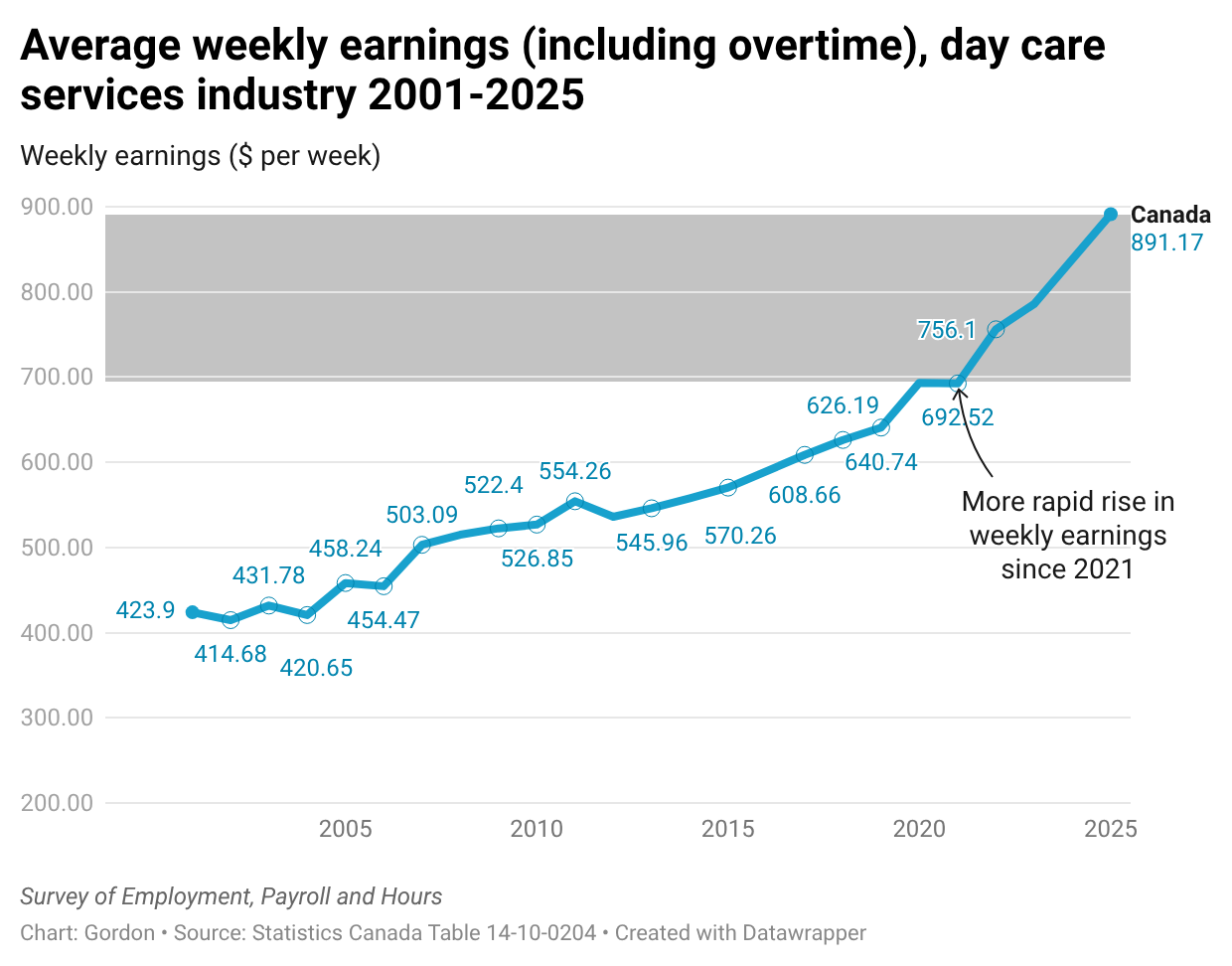
Even when it comes to a recommendation about staff wages, ACE can’t get it right. There is currently a wage floor of $25.86 per hour for Registered Early Childhood Educators, rising over time. ACE wants to establish a wage floor for non-RECEs – program staff that are not required to have any child-related qualifications. However, ACE proposes that unqualified program staff – Early Childhood Assistants – should have a guaranteed wage that is no less than $2.00 per hour below the RECE wage! I wonder how many RECEs will want to spend two or more years getting qualifications and paying annual registration fees to the College of Early Childhood Educators when they could earn nearly as much with no training.
Overall, this is an incoherent mishmash of ideas designed to reduce services to families, charge extra to families for the “voluntary” services that they need, eliminate child care services for children who are in kindergarten, and reduce or eliminate financial accountability and restrictions on the amount of profit. All of this in a proposal which is free of any evidence that supports its claims.
On top of this, government revenues would now be funneled towards the 8% of (for-profit) operators that refused to join the program initially. And any operator who wanted to open and had the money to open a new child care centre could do so with few restrictions and then would receive government operating funding as a right.
ACE National calls this “A 10-Point Plan to strengthen affordability, access, and accountability in Ontario childcare.” However, as we’ve seen, their plan would reduce affordability, access and accountability. Sounds like a dream scenario for some entrepreneurs and a nightmare for parents and the Ontario government. This is policy advice the Ontario and federal governments should reject.
The House of Commons Standing Committee on Finance has been taking pre-budget submissions from whoever wants to contribute. I chose, unsurprisingly, to focus on funding child care, especially child care in Ontario. Here’s what I wrote:
RECOMMENDATIONS
Expansion is the key priority for this next 5 year period. Provinces who are not yet at $10 a day should be allowed to get to $10 a day more slowly than originally planned to focus scarce funds on expansion.
The federal government should increase its annual amount of CWELCC funding sufficiently to allow child care capacity to continue to grow in all provinces and territories. Equally important, the federal government needs to credibly commit to maintaining and expanding the child care program. Across Canada, an extra $4 billion to $6 billion annually would allow for maintaining the program and increasing capacity. A clear commitment to maintaining and expanding the program can substantially reduce expansion risks for non-profit child care providers.
In Budget 2024, the $1 billion Child Care Expansion Loan Program for non-profit child care was announced. This program should now be implemented in its original or amended form. Non-profit child care operators have little access to capital funding to expand. This would be of great assistance, especially to multi-site non-profit operators.
The Child Care Infrastructure Fund of $625 million to support expansion is being sunsetted. This has been a good model, with money distributed through provincial/territorial authorities. It should be repeated and expanded, perhaps with some tweaks to funding rules.
TOPICS
The benefits of universal child care
How much more child care does Ontario need?
How is Ontario doing on expansion?
Why is child care expensive to provide?
What is the average operational cost of a child care space?
What could Ontario do with additional federal funding?
Should Ontario lower its fee to $10 a day?
Would income-testing help?
The benefits of universal child care
Much has been written about the benefits of universal child care. Two recent papers are especially important.
The first is by economists Michael Baker, Johnathan Gruber and Kevin Milligan.[1] They analyze universal child care in Quebec to show that:
Mothers’ employment in Québec rose by a lot and stayed permanently higher through those mothers’ lives (+12 percentage points by age 50).
Mothers’ incomes grew very substantially over their lifetimes as a result of maintaining attachment to the labour force and not losing skills when their children were young (+27% by age 50).
There was a substantial drop in the level of family poverty, particularly during childbearing years. The program was particularly important for those without a university education – the policy had a consistently strong effect on mothers with levels of education below university
Based on analysis of Canadian tax records over a long period, Quebec’s $5 a day child care reforms generated enough government tax revenues and reduced social benefit payments to pay for the costs of the program.
The second paper, again analyzing universal child care in Quebec, is by economists Montpetit, Carrer and Beauregard.[2] They uncover two important results:
In addition to the important gains in employment and earnings for mothers, they measure substantial additional benefits that we might describe as work-family balance. Universal child care makes all the tasks associated with caring for children less stressful and onerous for the family.
This point is obvious but generally overlooked. All of the benefits of universal child care – employment, earnings, work-family balance, etc – depend on increasing the supply (availability) of child care even more than on improvements in affordability. The benefits depend on making more spaces available to families.
Our takeaways from these studies: Not only does early learning and child care deliver very substantial economic benefits to mothers and families, it also delivers very substantial fiscal benefits to governments. These benefits depend on continuing to grow the child care system, making it available to all families.
How much more child care does Ontario need?
The federal government has set 59% of children 0-5 years of age as a target. This is a reasonable definition of “universality” given that Ontario already has full-day early learning for children 4 and 5 and maternity/parental benefits and leave for children up to 12 or 18 months of age. To reach 59%, Ontario would need to have 515,430 child care spaces for children 0-5.[3] As of the end of December 2026, Ontario plans to have 375,111 spaces.[4]
After December 2026, Ontario would reach the federal target if it had 140,319 additional spaces inside CWELCC and all of them were operational.
How is Ontario doing on expansion?
In Québec’s successful child care rollout, growth happened quickly – was planned and organized. Québec started with 18% coverage of 0-4 year old children in 1997. By 3 years later, it had added another 11 percentage points of coverage. By 8 years after the program started, it had added another 23 percentage points of coverage and provided enough child care for 52% of all children 0-4 by 2005. This strong commitment to expansion of the program greatly aided its acceptance and ultimate success.
In the first 3 years, from 2022 to 2025, Ontario’s centres grew from about 34% coverage of children 0-5 to about 39%, an increased coverage of only about 5 percentage points. Ontario’s child care system is growing much more slowly than Québec’s did. Without this growth, families and governments will not reap the benefits of a universal affordable child care program.
Why is child care expensive to provide?
It’s not a surprise that child care is expensive; it requires a lot of skilled labour. Registered Early Childhood Educators (RECEs) in Ontario now earn about $27 an hour on average and Educator Assistants earn about $22 an hour.
As an example, how much in staff salaries does it cost to provide care for toddlers in Ontario? According to regulations, one RECE and two Assistants can look after 15 toddlers and the child care centre is open for perhaps 10 or 11 hours per day. If these ratios need to be maintained all day, you can calculate these salary costs on a 10 hour day and add 20% for benefits (not generous). Then the staffing costs per toddler amount to nearly $57 per day per child.
That’s without adding in the cost of food and food preparation, supplies, the costs of leasing the centre and playground, the cost of replacement staff for holidays and a share of the costs of the supervisory and administrative staff. Or the cost of providing an allowance for profit. So, the provision of child care can be expensive, even on the relatively low salaries and benefits that are currently paid.
What is the average operational cost of a child care space?
Ontario has a funding formula that they developed based on evidence that the Ministry of Education collected about the cost of providing child care. We can reverse engineer this funding formula to give us estimates of the typical operational costs of providing child care – program staff, supervisory staff, operations and accommodation.
In Ontario, this estimate based on the 2026 funding formula is $130 per day for infants, $85 per day for toddlers, $65 per day for preschoolers and $35 a day for kindergarten children. A single cost estimate per space, irrespective of child age, is meaningless; costs vary depending on the ages of children using child care. Note that costs in Ontario are higher than in many other provinces, for good reasons. Typically, the quality-related regulations are stronger and better enforced in Ontario. That’s good for children.
What could Ontario do with additional federal funding?
Many of Ontario’s child care spaces – about 80,500 – are licensed but non-operational. The Auditor General of Ontario advises that “many of these centres operate below their capacity because of staffing shortages, including RECEs” (Auditor General of Ontario, 2025, p. 42).
To solve staffing shortages, compensation of early childhood educators will have to rise. Currently the average educator wage for program staff appears to be about $27 per hour and for staff without these qualifications about $22 per hour. A rise of about 25% in compensation (wage and benefit improvements) has been called for to aid recruitment and retention of staff.[5]
If Ontario had an extra $1 billion of operating funding, I estimate it could fund nearly 70,000 of these already licensed but non-operational spaces at rates allowing for a 25% compensation increase for educators.
Alternatively, $1 billion of new operational funding could support services in about 57,000 NEW spaces with a 25% compensation increase for educators. New spaces receive a growth supplement to operational funding in Ontario and therefore cost more.
Ontario needs at least $2 billion additional funding in order to stay on track for building an affordable universal child care system. Since, Ontario is about 38% of Canada’s population, an extra $2 billion annual funding for Ontario would imply about $5.3 billion annual funding for all provinces and territories combined.
More one-time-only funding is also needed for capital grants to support expansion. Overall, the federal commitment needs to rise by between $4 billion and $6 billion annually. That would allow building of adequately staffed and stable child care services serving over 100,000 more children in Ontario than was true in 2025.
Should Ontario lower its fee to $10 a day?
No. Not right now. The parent fee of a maximum $22/day (actual average $19/day) brings in significant revenue which is needed given Canada’s current economic situation. Ontario has had a good child care subsidy system targeted at lower income families and vulnerable children. It subsidizes many families that cannot afford $22/day and should subsidize more. This subsidy system should be made more accessible; it is important to retain and improve access to child care subsidies.
Would income-testing make child care more affordable for governments?
The existing child care subsidy system is a form of income-testing, helping those who cannot afford $22 a day ($5,742 per child for a full year). Maintaining this subsidy system or improving it is very important. However, this is not what most people mean when they advocate income-testing.
There are two other types of proposals for income-testing. One would mimic the funding system used in Québec for several years (2015-2019) under Premier Philippe Couillard. In Québec, everyone using a fixed-fee provider paid the provider $7.30 per day. Then, at tax time, the family would be assessed for how much child care they had used and would pay an income-tested extra amount to the Québec government.
The scheme became unpopular very quickly. Families were “surprised” when they had to pay a few thousand extra dollars at tax time. And, it didn’t raise that much additional revenue for governments. So, the incoming CAQ government cancelled income-tested fees and returned to a fixed fee, rising over time with inflation.
The other kind of income-testing is like that used by the Australian Government.[6] The trouble with this kind of scheme is that it is entirely market-based. There are no controls on provider fees and fees tend to rise constantly. The average total fee charged by providers in Australia, irrespective of child age, is over $130 per day. And there is no financial accountability by providers for the subsidy money they received on behalf of parents. This results in an unaffordable and unaccountable set of funding arrangements.
Both of these income-testing alternatives take a considerable amount of administration. Unless governments are willing to have some parents pay much higher fees, they don’t raise that much revenue from parents. On the other hand, a fixed fee model provides certainty to parents and, arguably, is a large part of the reason why the labour force impacts of Québec’s child care program have been so large over time.
Staying at $22/day with a well-functioning subsidy system is a better alternative than dropping the fixed-fee to $10 a day and layering income-testing on top of it.
[3] Ontario has 873,610 children 0-5 years of age as of July 1st, 2025 (Statistics Canada table 17100005).
[4] Auditor General of Ontario (2025) Performance Audit: Canada-Wide Early Learning and Child Care Program. Special Report 2025. Office of the Auditor General of Ontario, p. 15. But also see Moran, H. (2025) Updates to 2025 Ontario Child Care and Early Years Funding Guidelines. Memo to SSMs. https://efis.fma.csc.gov.on.ca/faab/Memos/CC2025/EYCC01_EN.pdf. This memo suggests capacity at end December 2026 will be 400,881 licensed spaces. This may include spaces outside CWELCC.
[5] A. Shariati (2024) Addressing the Early Childhood Educators Labour Shortage in Canada: Challenges, Solutions and Impacts. Centre for the Study of Living Standards Report prepared for YMCA Canada.
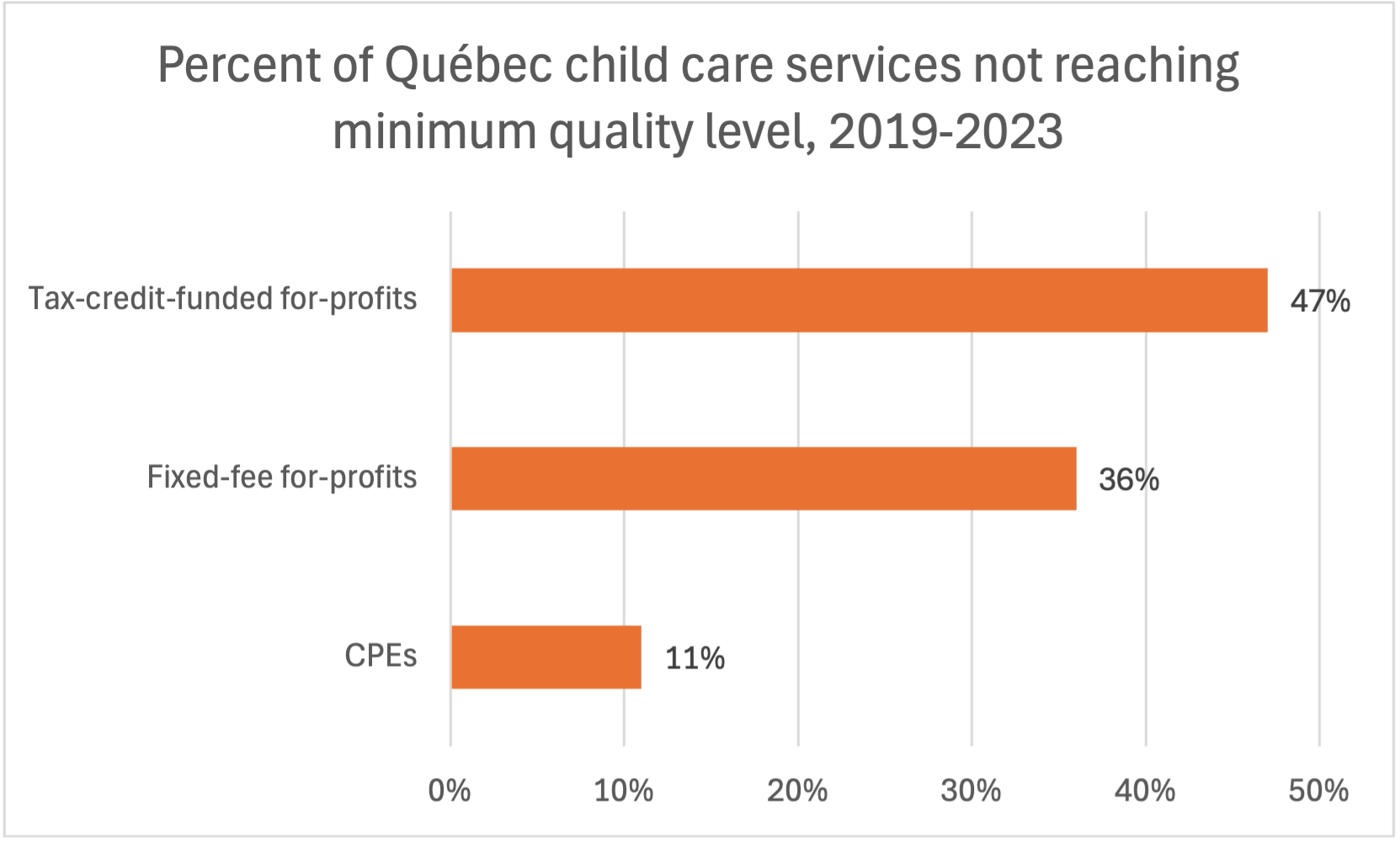
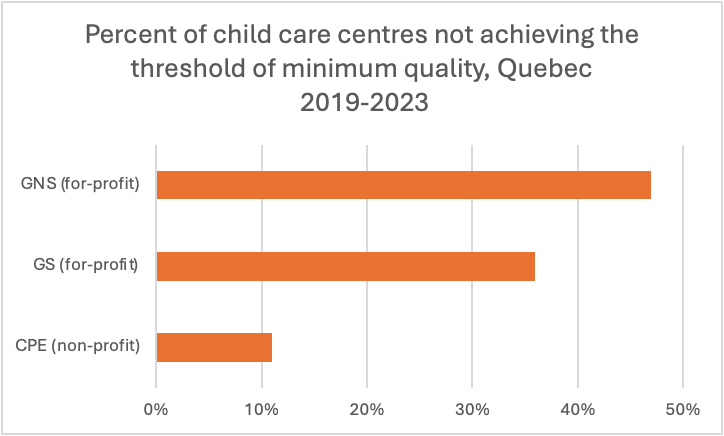
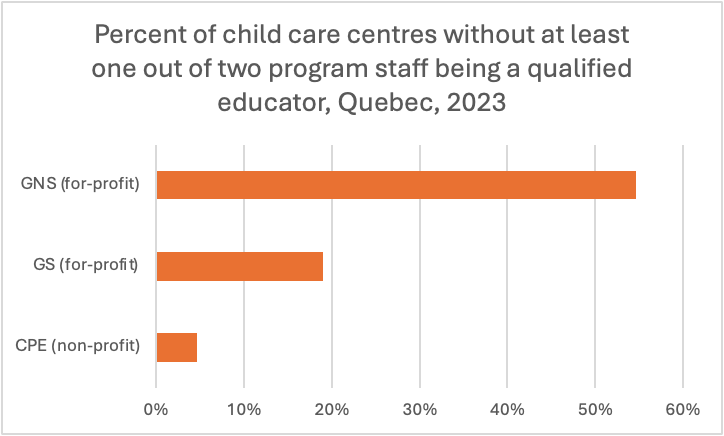
This week in the Hill Times, Peter Jon Mitchell says he wants to get rid of the $10 a day federal child care program. But too many families now love it and depend on the increased child care affordability that has made their lives better. So instead Peter Jon argues that the Canada Child Benefit or the Child Care Expense Deduction should be amended to provide child care assistance to those who can’t find child care. But neither solution would be much help. The Canada Child Benefit goes to nearly every family independent of whether they want to use any form of child care so this would be a very expensive way to deliver assistance. And the type of tax credit that Peter Jon would use to replace the Expense Deduction has been an unmitigated disaster for child care quality in Quebec, as the charts below show.
Peter Jon hopes to convince us that the federal child care funding program is a complete failure and shambles, so he throws as much mud as possible at the wall to see if any of it will stick. He has these complaints about the program:
Space creation is difficult because the child care agreements favour expansion predominantly in the not-for-profit/public/family child care sector
Many existing licensed spaces are empty or not operating
Most children under six years of age don’t benefit from the program
Only 71% of centres are in CWELCC – the federally funded program
The program breeds inequality. Child care enrolment by low-income families is declining – by 31% in Ontario.
Not-for-profit
The not-for-profit issue has been tested in practice. As Peter Jon reminds us “Quebec’s daycare program, upon which the CWELCC is modelled, has long depended on private, for-profit childcare businesses.” It’s true that since about 2010, Quebec has relied on a tax-credit-funded expansion of for-profit child care operators. There are three types of centres in Quebec. There are the CPEs which are not-for-profit community-based centres that charge a flat fee less than $10 a day. There are the funded for-profit child care centres (shown as GS on the charts) that also charge the low flat fee. There are the tax-credit-funded child care centres that grew since about 2010, shown as GNS on the charts.
The first chart shows us the results for on-site quality evaluations by the Ministry. The other shows us the percent of centres that fail to meet the current requirements for fully-qualified staff (which is one out of every two staff). Together they indicate that for-profit child care, which seems to be Peter Jon’s preference for the rest of Canada, is much lower in quality and cuts costs by avoiding hiring the required numbers of qualified staff, compared to the not-for-profit CPEs.
So, yes, there are good reasons to want space creation to take place predominantly in the not-for-profit and public sectors. Relying on for-profit expansion may seem faster and cheaper in the short run, but at what cost for our children’s future?
Enrolment
It’s true that there are too many existing licensed spaces that are empty or not operating. The Auditor General of Ontario found this was true of 27% of the funded spaces in Ontario, but it is also true elsewhere. The substantial majority of this is due to staffing shortages. Early Childhood Educators in most of Canada require a college education to be a fully-qualified educator, but they earn wages that are surprisingly low. As a result about half of all new hires in child care do not stick around for very long. Recruitment and retention of staff both fall well behind what is needed.
However, empty spaces suggest a solution different from Peter Jon’s – raise educator wages and benefits closer to the average wage in the province or territory. I’m sure that many trained educators currently working in retail and elsewhere will come flooding back to allow the spaces to open. Families would be happy, educators would be happy and the child care system would be more stable. The number of parents having difficulty finding child care would drop fast.
How many children benefit?
Peter Jon says that most children in Canada don’t benefit from CWELCC. CWELCC is intended to be a universal program, but that doesn’t mean that everyone will want to use child care from their child’s birth through until school. Many families take a year or more off after a child’s birth using maternity and parental leave to spend time with their infant. Many families live in jurisdictions with full-day kindergarten, sometimes for both four and five year olds and don’t need additional child care beyond that. Some parents want to stay home with their young child and do not need child care.
If we looked only at families where the main caregiving parent was employed, was not on maternity/parental leave, and whose child was not in kindergarten, then already in 2023, 62% of Canadian children were enrolled in and attending some form of licensed child care across Canada, most of it receiving federal funding. We still have a way to go to serve all children who need or want good quality affordable child care, but we’re much farther forward than Peter Jon says we are.
Is it true that nearly 30% of centres are not in CWELCC?
In fact, there are very few eligible centres not enrolled in the CWELCC program. Mr. Mitchell should be more careful with his “facts”.
The source he cites looks at centres serving children 0-12. This data source says that only 71% of centres said they were enrolled in CWELCC. But many of these centres serve only school-age children and these centres are not eligible to get federal funding, which is only for children 0-5.
Ontario is the province (outside Quebec) with the largest number of centres that are not part of CWELCC and as of March 31, 2025, 91.8% of all centres serving children 0-5 in Ontario were enrolled in the CWELCC program.
Child care enrolment by low-income families
This is a serious issue, but Peter Jon misunderstands it. It is true that the Auditor General of Ontario recently found that the number of children receiving child care subsidies in that province has declined by 31%. But that is compared to 2019 before CWELCC started, and the decline in subsidies before Ontario signed onto CWELCC was more rapid than since that time.
There is a legitimate worry that not enough low-income families will be able to access newly available spaces. The Auditor General cited favourably a program in one region where a percent of spaces in each centre are reserved for children receiving child care subsidies. This might be a useful reform that I hope Peter Jon would support. Already, there has been a strong prioritization for child care expansion in Ontario to favour underserved areas with more vulnerable populations.
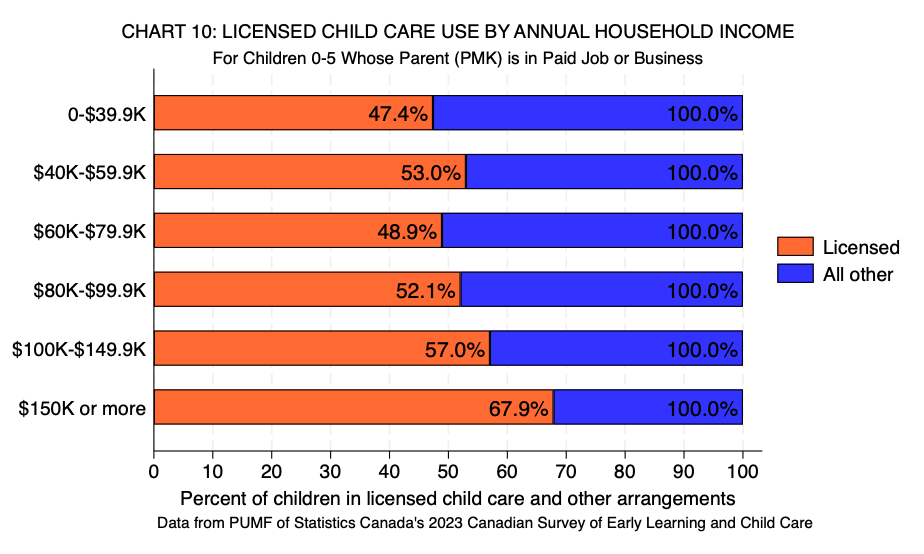
However, rather than look only at subsidies, there is more comprehensive data on child care use by family income that comes from a 2023 parent survey done by Statistics Canada. Here’s what it shows:
The data suggests, yes, that access to licensed child care by lower income families is not as high as for the more affluent. But the differences are probably smaller than you thought they were. I don’t mean to minimize the issue. Most studies show that children from lower-income or vulnerable families are especially likely to benefit from quality child care. So working on this issue is a high priority. However, the sky is not falling. It is just a persistent problem that provincial and territorial child care systems need to address. In fact, it is a persistent problem in child care systems, no matter how they are funded, often less so the more universal the service is.
Instead of trashing the $10 a day child care program, maybe Peter Jon Mitchell should spend his time lobbying the Alberta Government to re-instate the child care subsidy system that they completely eliminated this year! This will definitely hurt lower and middle income families in Alberta. The Alberta Minister complained at the time that federal funding regulations did not allow him to fund a targeted program like child care subsidy. However, he had a subsidy system receiving federal funding ever since signing the CWELCC agreement with Ottawa, and nearly all other provinces have child care subsidy systems, so that excuse is untrue. Alberta should re-instate its subsidy system as part of its CWELCC funding.
What is to be done?
The $10 a day child care program is only partly developed and is far from perfect. Much more affordable licensed child care is now wanted by many more parents. Of course. And expansion of services is too slow. There is little capital funding and too little planning for expansion of not-for-profit child care. Also, crucially, child care wages in most provinces are too low to attract qualified educators.
Making child care more accessible is central to the health of the program. I hope Mark Carney recognizes that in the upcoming budget. After all, isn’t a universal child care system a pillar of the new economy that families with children need – the kind of nation-building project that will make Canada stronger, fairer, and more affordable?
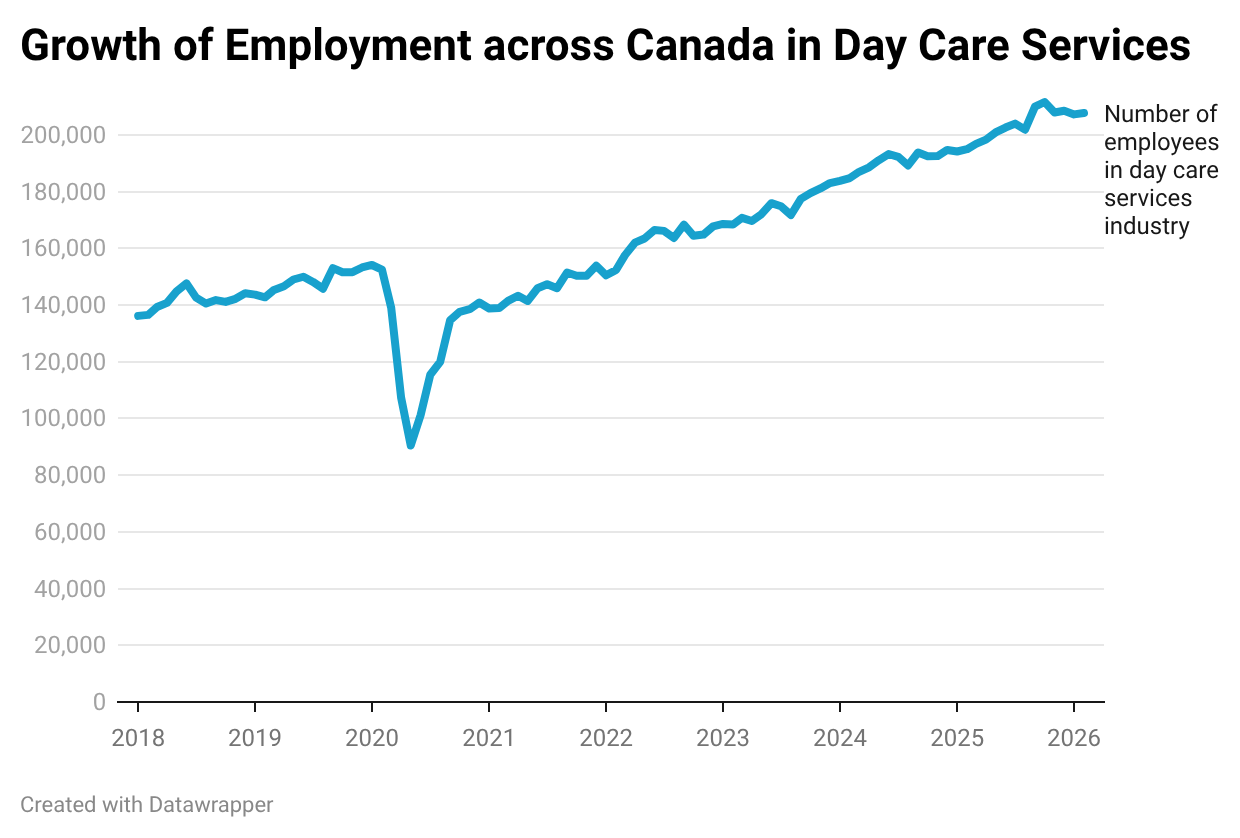
One of the main barriers to expansion of child care supply is a widespread shortage of qualified educators. This is mostly due to wages and benefits that are insufficiently high to attract and retain staff. As a result, there are long waiting lists to get into licensed child care (115,000 children with mothers whose main activity is paid work).
We do not have much good current data on our child care workforce, but Statistics Canada is attempting to begin to fill that hole. Towards the end of December last year, Leanne Findlay and Thomas Charters from Statistics Canada published a report on child care workers who care for children 0-5 years of age. The data is from 2021-22 and its source is the 2022 Canadian Survey on the Provision of Child Care Services (CSPCCS).
The authors restrict the sample to look only at centres who provide child care to children 0-5 years of age, and they address several issues:
Centre employees – hours, training and roles
Typical rates of pay
Numbers hired, departed and staff vacancies
How all of the above vary by auspice and organizational structure
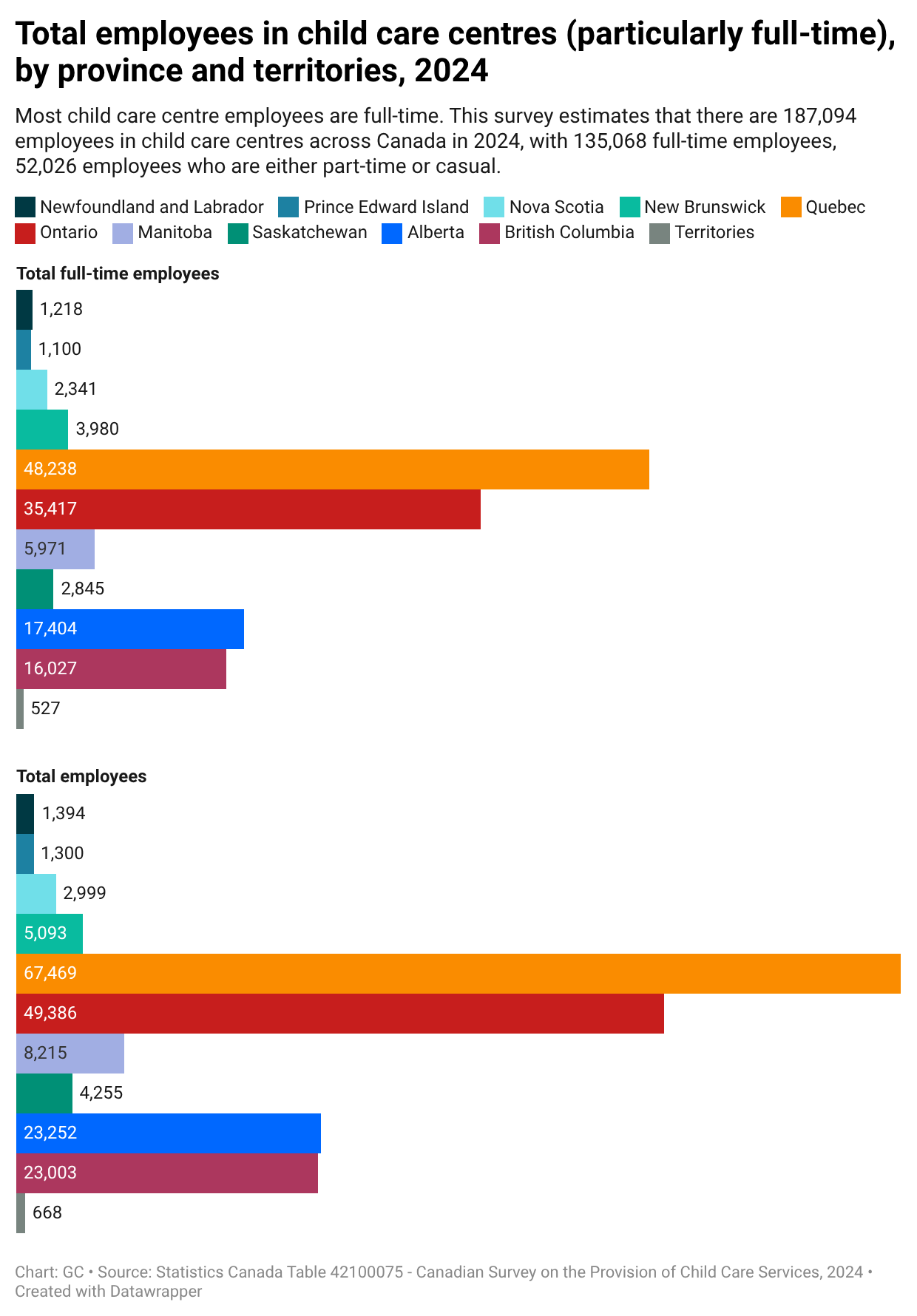
There are some important findings and observations in this study. The study reports on weighted results for nearly 12,000 centres serving children 0-5. Nearly half (48.6%) of child care centres serving children 0-5 are for-profit. Centres employ nearly 137,000 staff, including full-time and part-time, program staff, supervisors, and support staff. Nearly 90,000 of these employees are in Ontario and Quebec, and close to 15,000 each in Alberta and B.C. About 38% of these staff are hired in multi-site centres and about 62% in single-site centres.
A typical centre has about 56 children and close to 12 staff. About 8 of these are front-line program staff. There are either 1 or 2 supervisors and between 1 and 2 support staff.
Staff Qualifications
Most centres (83%) have a supervisor with an ECE certificate, diploma or degree. For-profit single-site centres are below this average at 77%.
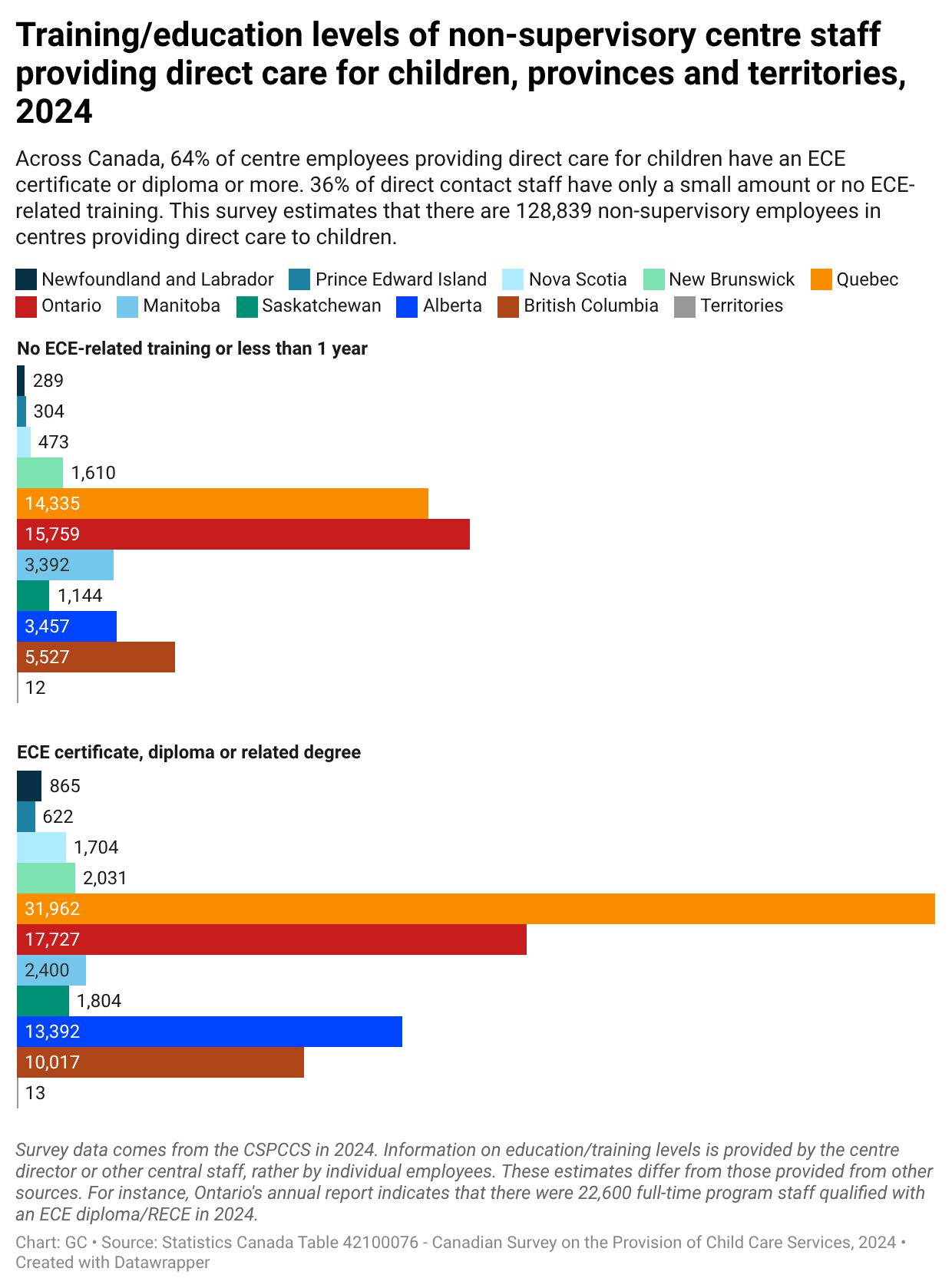
50% of centres have at least one staff member with no ECE training, and in those centres on average there are 3.7 staff members with no training. 47% of centres have at least one staff member with training of less than one year and on average in those centres there are 3.1 staff members with this modest level of training. 88% of centres have at least one staff member with a one-, two-, or three-year ECE certificate or diploma and these centres have on average 6.5 staff members with this level of training. Finally, 17% of centres have at least one staff member with a four-year ECE degree or higher and on average these centres have 4 staff members with this level of training/education.
Wages
Survey respondents provided information about the most typically paid hourly wage rates for different categories of staff. The average for supervisors was $27.80 per hour, but for-profit centres paid between $25 and $26 typically, and not-for-profit centres on average paid between $29 and $32.
The same pattern was seen for wages of staff with an ECE credential – the for-profits paid an hourly average wage of between $20.50 and $21.50. The not-for-profits paid between $22.50 and $23.00.
Unfortunately, the wage question asked respondents to include wage enhancements but not provincial top-ups when reporting on staff wages. This may have resulted in underreporting of wages in some centres. In any case, it is obvious that typical wages in the sector are rather low.
Benefits
Amazingly, only about 76% of centres report that they provide any benefits at all to centre employees! Those benefits include supplementary health and dental plans, life or disability insurance, pension plan contributions or group RRSPs, paid sick leave, paid vacation leave and financial assistance or paid time for training.
The provision of benefits varies a lot by auspice and organizational structure. Only about 62% of the single-site for-profits have any employee benefits. Between 78% and 79% of both the multi-site for-profits and the single-site non-profits offer some employee benefits. On the other hand, 93% of multi-site non-profit centres have at least some employee benefits.
The biggest gap appears to be in pension benefits. Only about 20% of for-profit centres of either kind have some pension or RRSP benefits. About 46% of single-site non-profits have these benefits and 63% of multi-site non-profits do, as well.
Vacancies
The survey also provides information about job vacancies experienced by centres. In April 2022, there were 7,560 vacancies in centres for ECE positions and another 2,960 vacancies for non-ECE positions. In other words, nearly 8% of staff positions were vacant. No wonder expansion of services has been slow and difficult. In fact, 35% of centres had at least one vacancy for an employee with ECE credentials or training.
All of these issues are good ones to look at and the authors have done a good job with the data, but there are problems that affect interpretation and clarity. In particular, the data is cross-Canada data; the sample size was too small to break responses down by province and territory.
Further, CSPCCS is not a survey of members of the child care workforce, with questions answered by each staff member. Instead, the CSPCCS is a survey of centres, so the respondent is some representative of the centre, and the responses are statements about the whole centre, not about the individual staff member. So, there is less detail than you would like in some answers. As an example, the categories for staff qualifications are (1) No ECE-related training, (2) ECE training of less than one year, (3) one, two or three year ECE certificate or diploma, (4) Four-year ECE degree or higher. So, we can’t see how many staff have certificates vs. diplomas. That’s potentially a very important difference.
The information is useful, but we still need a workforce survey where the respondents are individual supervisors, educators and assistants (and perhaps support staff as well). That kind of survey, with a large enough sample, would allow us to get more detailed information about qualifications, remuneration, and recruitment and retention issues.
If we raise wages in the licensed child care sector in Canada, will it make much difference? How much difference would it make?
There’s not much research around that can help us answer these questions. And yet, they are really important to policy makers, to advocates and to parents who are trying to find scarce child care spots.
Now, some really capable economists in the U.S. have published a paper (Cunha and Lee, 2023) in the National Bureau of Economic Research Working Paper series that can help us. There’s a lot in this paper, but our focus is more narrow. Let me summarize some key results of interest.
Turnover is defined as moving out of the child care industry (NAICS code 624410) over the course of one year, between the third quarter of one year and the second quarter of the next.
The authors are concerned with turnover in the sector, because they believe that turnover is likely to negatively affect children’s development. Overall, turnover rates are 39% in the ECE sector in Texas where their data is from and that’s quite a bit higher than in other sectors. And turnover is higher for workers with a college education, which means that workers with more education are more likely to leave.
The authors estimate that the elasticity of turnover is -0.5, which is to say that a 20% rise in staff compensation will reduce turnover by about 10%.
The authors go on to estimate the elasticity of labour supply in the ECE sector and find it is equal to 2.0. To put it another way, an earnings increase of 25% in labour income in the ECE sector would be likely to lead to a 50% increase in employment in the sector. We can say, therefore that labour supply in this sector is highly elastic – highly sensitive to changes in compensation. If we are able to raise child care staff wages in Canada, we should expect it to have a strong impact on recruitment and retention.
There are previous estimates of labour supply elasticities in the ECE sector in the U.S. by David Blau (1993, 2001), but they are from quite a few years ago. He, too, found that labour supply in ECE is quite sensitive to compensation levels. His overall estimates of labour supply elasticity were 1.94 and 1.15. He was able to estimate what are called the extensive, intensive and total elasticities. The extensive elasticity refers to the decision to be employed as an ECE or not. The intensive elasticity refers to the decision to work a larger number of hours. The total is the sum of the two. In 1993, his estimates were 1.2 for the extensive elasticity, 0.74 for the intensive elasticity, and 1.94 for the total. In 2001, using different data, his estimates were 0.73 for the extensive, 0.42 for the intensive and 1.15 for the total.
.
REFERENCES
Blau, David M. (1993) The Supply of Child Care Labor. Journal of Labor Economics 11(2): 324-347.
Blau, David M. (2001) The Child Care Problem: An Economic Analysis. New York: Russell Sage Foundation.
Cunha, Flavio. and Lee, Marcus. (2023) One Says Goodbye, Another Says Hello: Turnover and Compensation in the Early Care and Education Sector. Working Paper 31869, National Bureau of Economic Research. Cambridge, MA.
What would Canada’s child care system look like if we let it be dominated by for-profit child care providers? Particularly with Pierre Poilievre lurking in the wings, it’s an interesting question to ask.
So, into my inbox arrives a fascinating study from what they call the “A triple-C” (ACCC) or Australian Competition and Consumer Commission. When the new Labor Prime Minister of Australia – Anthony Albanese – arrived in office in 2022, he commissioned two big studies of child care. He asked the ACCC to examine how well or badly the market for child care was working. And he asked the Productivity Commission – a permanent body rather like the old Economic Council of Canada – to report on how best to make child care universally accessible and affordable in Australia.
Both of these bodies have now produced Interim Reports. This blog post will comment on the one from the ACCC. The ACCC report focuses on the cost of producing child care services, the nature of competition in child care markets and the effectiveness of Australian government attempts to regulate child care fees.
You don’t want to read the whole report, so let me cherry-pick some findings for you.
The cost of child care in Australia is pretty high. Centre-based child care fees per hour (averaged across ages 0-5) were $11.72 in 2022 or $117.20 for a 10-hour day.
Australia’s Child Care Subsidy system (like a tax credit for child care expenses) costs the government a lot but does not make child care affordable. For a couple on average wages with 2 children (aged 2 and 3) in centre based day care full-time, net child care costs came to 16% of net household income in 2022. In contrast, the average for OECD countries was 9%, with Australia ranked 26th out of 32 countries. This is despite the Australian Government contribution to fees being significantly higher than most other OECD countries – 16% in Australia compared to the OECD average of 7%.
From 2018 to 2022, gross fees in Australia increased by 20.6% in comparison to the OECD average of 9.5%.
Looking at detailed data on the cost of producing centre-based child care for children younger than school age, 69% was accounted for by labour costs, 15% by land/occupancy, and 9% by finance and administration costs. But these proportions are quite a bit different for for-profit and not-for-profit providers. 69% of centre-based child care services in Australia are provided by for-profit operators.
Land and occupancy costs are about 18% of the total of all costs for large for-profit providers compared to about 10% for large not-for-profit providers. This is not due to what the Aussies call “peppercorn rents” (i.e., below-market rents provided on a goodwill basis). As the ACCC report says, this may be due to non-arms-length transactions in land rental of for-profit providers (to be investigated in the final report).
Not-for-profit child care operators pay a higher proportion in labour costs for two reasons. They are much more likely to pay “above-award” wages – in other words, wages that are above the minimums set by the Fair Work Commission wage grid. About 95% of the staff in not-for-profit centres are paid “above-award” compared to 64% in for-profit centres. The second reason is that not-for-profit providers are much more likely to hire their staff on a full-time basis, whereas for-profit providers primarily rely on part-time staff. As the report suggests: “large not-for-profit centre-based day care providers invest savings from lower land costs into labour costs, to improve the quality of their services and their ability to compete in their relevant markets.” The ACCC finds that centre-based day care services with a higher proportion of staff paid above award and with lower staff turnover have a higher quality rating under the National Quality Standard.
The ACCC finds that parents and guardians typically prefer centr- based day care services located close to their home. Most households travel a short distance to child care – between 2 and 3 kilometres.
Parents’ and guardians’ perception of quality is a key factor driving decisions for selecting a child care service. As child care is an ‘experience good’, meaning it is difficult to accurately determine quality of a child care service without having used it, parents and guardians appear to rely on informal measures of quality over formal National Quality Standard ratings.
Providers’ decisions to establish child care centres are highly influenced by expectations of profitability within a particular area or market, which are driven by expectations of demand and willingness to pay. The willingness to pay for child care within a local area is heavily influenced by household incomes, as this influences the opportunity costs of not using child care services. These factors encourage supply to markets where demand for child care is highest, and parents and guardians are likely willing to pay higher prices. In particular, for-profit providers are more likely to supply these markets as the opportunity for profit is greater.
These markets tend to be in metropolitan areas of higher socio-economic advantage. This higher demand and greater willingness to pay explains why we find operating margins are higher in areas of higher socio-economic advantage and Major Cities of Australia. The child care sector is widely viewed as a safe and strong investment with guaranteed returns, backed by a government safety net
While providers’ supply decisions are generally driven by considerations of viability, we note that there are providers that supply some services at a loss. This reflects that – like many other human services – child care plays an important societal role. This results in not-for- profit providers accounting for a greater proportion of services in areas of very low advantage.
The nature of child care markets and the role played by price, as well as the impact of the Child Care Subsidy, also mean it is unlikely that market forces alone will act as an effective constraint on prices to ensure affordability for households (including households with low incomes and vulnerable cohorts) and to minimise the burden on taxpayers.
Large for-profit providers of centre based day care have consistently had higher profit and operating margins than not-for-profits since 2018. The average profit margin for large centre based day care providers was about 9% for for-profit providers and about 6% for not-for- profit providers in 2022.
In conclusion, the ACCC sees substantial benefit in a detailed consideration of supply-side models, the role of market stewardship and direct price controls for child care services. There will be a final report from the ACCC soon.
It is now widely acknowledged that the pay of early childhood educators is too low. Comparisons of ECE hourly wages to those in other competing occupations show that educators are paid as if they had a high school education rather than a college certificate or diploma. We can see the effects of this in the extreme shortages of fully-qualified ECEs for existing and new child care facilities. In most Canadian provinces and territories, growth in spaces is held back as much by the lack of staff as it is by the lack of organizational and financial support for planned and funded expansion.
The big questions for governments are (1) how much will it cost to raise wages? (2) how should they do it? and (3) who will pay?
Up till now, it’s been hard to answer the “cost” question because we haven’t had good data on how many program staff work in licensed services and what their average wages are now.
I’ve spent a large amount of time pulling together and analyzing the best publicly available data on this, province by province (sorry, I haven’t done the Territories yet). The details of this (staff numbers and typical wages by qualification level for each province) will appear in another blog on this site once I have finished crossing the t’s and dotting the i’s (lots of numbers and boring reading for most people). But, using those numbers, I can now make estimates of how much raising ECE wages will cost. If you have better numbers, I’m happy for you to send them to me so I can make revisions.
The table below shows my estimates of how much it would cost to raise the wages of fully-qualified ECEs across the country by 25% from whatever their current level is. For the average ECE, that would mean a raise of $5 to $7 an hour from current levels. I’m not trying to say that’s enough, or that this is the right way to raise ECE wages. If I look at the data on wage comparisons to other occupations, it very likely isn’t enough. But, it may begin to move the needle on the supply of early childhood educators. It may encourage more new ECE graduates and existing ECEs to stay in the sector.
Have a look at the last column province by province. Each cell shows the overall cost of raising qualified ECE hourly wages by 25% compared to what they are now (including the effects of wage grids, wage grants and wage supplements).
This is simply a simulation to give us all an idea of how much it will cost to have a significant rise in ECE wages. It is not a carefully thought out design for wage increases. What is needed will vary from one province to another; some provinces have done a lot already, others have done little. In provinces with generally high wage levels for all types of workers, a 25% rise in ECE wages may not do very much. In provinces that have already done a lot to raise wage levels and establish wage grids, a 25% wage rise might be very significant.
To see all of the columns, view the table below in a new window
ESTIMATED STAFF NUMBERS (0-12), CURRENT WAGE BILL, AND COSTS OF WAGE INCREASES FOR FULLY-QUALIFIED ECEs
Province
Number fully-qualified incl directors/ supervisors
Number of less qualified
Total program staff
Total FTE program staff
Current annual wage bill ($ mil)
Cost of 25% increase for fully-qualified ($ mil)
BC
16,800
6,800
23,600
20,600
$1,005.4
+$208.0
AB
13,000
10,750
23,750
21,000
$965.8
+$155.9
SK
1,650
1,300
2,950
2,600
$90.7
+$15.5
MB
3,400
3,000
6,400
5,700
$215.3
+$34.9
ON
35,000
20,000
55,000
51,000
$2,183.0
+$391.7
QC (0-4)
29,000
10,300
39,300
35,000
$1,576.0
+$315.9
NB
2,700
2,000
4,700
4,300
$186.0
+$29.9
NS
2,600
800
3,400
3,200
$142.4
+$29.9
PE
700
400
1,100
950
$42.3
+$7.3
NL
825
400
1,225
1,100
$48.2
+$8.9
CANADA
105,675
55,750
161,425
145,450
$6,455.1
+$1,198.0
CA – QC
76,675
45,450
122,125
110,450
$4,879.5
+$882.1
To see all of the columns, view the table above in a new window
Fully-qualified refers to ECEs with a 1-year college ECE certificate or a 2-year college ECE diploma, or more.
These calculations are produced by Gordon Cleveland, based on the estimated wages and staff numbers in Estimates of Staff Numbers and Wages in ELCC Centres, by Province, August 16, 2023. Numbers for the Territories are not yet included.
It is assumed that wages would have to rise equally for ECEs caring for children 6-12 years of age. However, in Quebec where fully-qualified staff caring for children 5-12 years are employed by the school system, numbers refer only to staff caring for children 0-4.
These numbers do not include the extra cost of compulsory benefits like contributions to pay for EI and CPP/QPP and vacation pay. That would add another 15%-18%, perhaps. However, these estimates do include an allowance for supply staff.
There is no magic in this 25% wage rise simulation. But, now, with data on current numbers of staff and on current wage levels, we can do whatever simulations we think are appropriate and estimate the costs of taking action (and compare them to the costs of inaction). That, I think, is a big step forward.
With these simulations in hand, we can turn to the next two questions. Question #2 was how exactly we should raise wages. That debate is too big for this blogpost, but let me make some observations. I believe that the big staff supply problem is centred in the inadequate supply of fully-qualified early childhood educators, whether that is a one-year ECE college certificate or a two-year ECE college diploma. Recruiting untrained staff or recruiting staff that need to take only an orientation course or two is not where the problem lies. That means we need to concentrate our scarce funds on raising the wages of qualified educators.
And once we have decided to concentrate our wage-raising efforts on fully-qualified staff, we need to avoid the Ontario mistake. Ontario decided to raise wages by concentrating their efforts on low-paid educators. In 2022, they boosted all early childhood educators earning less than $18 an hour up to $18, but they did nothing for anyone else. In 2023 and beyond, they are raising the pay of other educators by $1 per hour each year, but only if the educators currently earn less than $25 an hour; $25 is the top wage for this program. This focus only on low-paid educators ensures that ECE will continue to be a low-paid profession; even $25 an hour will keep educators well below competing occupations.
And, the Ontario wage supplement design ensures that most of the wage assistance will go to centres that previously were underpaying their workers, disproportionately those in the for-profit sector. The Doug Ford government is developing a bit of a reputation for favouring for-profit friends, whether it be the Greenbelt or child care, but this kind of wage supplement design will not do a good job of retaining the best-qualified and most experienced staff and making ECE an attractive profession.
Finally, there is the question of who will pay. I would be overjoyed if the federal government decided to come up with a billion dollars of extra annual funding, but I don’t think that will happen very soon, and wage rises do need to happen very soon. Some provinces may be willing to up their spending to solve wage problems, and that is welcome. But the most obvious immediate place to get funding for educator wages is to change priorities for the expenditure of federal dollars under the Canada-Wide Early Learning and Child Care Agreements. The very large majority of the federal funds under current Action Plans goes to lowering parent fees. Right now, many provinces are renegotiating Action Plans to cover the next three years. Why not allocate a larger portion of money in the next three years to cover wage increases for fully-qualified early childhood educators? And there should be provincial contributions to cover the wage increases for staff caring for 6-12 year-olds.
The numbers in the table above tell us about how much reallocation of dollars is needed in each province. Let’s get it done, or expansion will not happen and access to affordable child care will continue to be a dream for most families.
This is my submission to the Parliamentary Committee studying Bill C-35 in Canada.
I am an economist who specializes in the analysis of child care systems and in the design of child care policies and their effects. I have taught economics at the University of Toronto for 24 years. I have published numerous articles analyzing issues related to child care in academic and policy journals. I was the economist for the Special Parliamentary Committee on Child Care established by the Mulroney government in 1986-87. I was the main author of a major report on child care reform in Ontario for the Ministry of Education in 2018. I am currently a member of the National Advisory Council on Early Learning and Child Care but this brief reflects my own opinions, and not those of the Council.
I wish to address the issue of for-profit, not-for-profit and public child care services, a topic which has generated some controversy.
The Legislation Bill C-35 expresses a clear intent that expansion of early learning and child care services should be predominantly in not-for-profit and public auspices but also that all existing services of whatever auspice should be supported to provide affordable child care services.
Bill C-35 says that the aim of federal investments is to facilitate access to early learning and child care programs and services “in particular those that are provided by public and not for profit child care providers”. The legislation describes this as a “guiding principle” for federal investments in early learning and child care.
This is in accord with the principles articulated in the 2021 federal budget, which said that child care is essential social infrastructure, like the health and education systems. According to that document, the immediate priority is “building the right foundations for a community-based and truly Canada-wide system of child care. This includes working with provinces and territories to support primarily not-for-profit sector child care providers to grow quality spaces across the country while ensuring that families in all licensed spaces benefit from more affordable child care.” (p. 103). All of the thirteen agreements signed by provinces and territories indicate the consent of these jurisdictions to these purposes in the expenditure of federal money – about $30 billion over 5 years.
What is not-for-profit child care? Not-for-profit child care is defined by its essential purposes. Not-for-profit child care services are those services that spend revenues to enhance the well-being of families and children rather than to enrich the owners of the service. As the Canada-Wide child care agreements say they are “services to a community for a purpose other than generating a profit, including publicly-delivered child care operations. Providers/operations may generate a profit, but the surplus earnings, or other resources, are directed towards improving child care services (for example, improving family or child well-being or development) rather than distributed for the personal benefit of owners, members, investors or to enhance asset growth.”
Why does the federal government favour not-for-profit and public child care? The federal preference for not-for-profit child care derives directly from its desire to follow the example of Quebec in building a publicly-managed child care service for families. This fixed-fee child care system has been effective and popular in Quebec since the late 1990s. Following this model, by 2026, early learning and child care in Canada will be a publicly-managed service available for $10 a day to families.
Centres de la Petite Enfance (CPEs) are the not-for-profit child care centres that are at the heart of Quebec’s system. These services had a fixed fee, originally of $5 a day (now $8.85 per day). Child care services are funded according to the services they provide rather than being funded through money or vouchers given to parents. Because the majority of funds come from government, these services are financially accountable for how they spend public dollars, and must provide detailed annual reports. There is monitoring and assessment of quality. These fixed-fee services are incredibly popular with parents, in much the same way that kindergarten as a guaranteed affordable and accessible service is very popular with parents in the rest of Canada.
Unfortunately, the organizations that claim to represent for-profit operators have made clear their rejection of this approach to funding and managing Canada’s child care services. They are apparently unwilling to accept the fundamental elements that are necessary components of a $10 a day system: fixed-fees, direct operational funding of services, financial accountability for government funding of nearly 90% of their ongoing costs, government monitoring of service quality, public planning mechanisms to determine direct expansion of services to underserved communities, together with parental choice amongst a variety of different child care service options for their child (e.g., full-time, part-time, forest schools, evening and weekend services, special supports for children with disabilities, etc.)
What’s wrong with for-profit child care? In some other industries, the profit motive is a beautiful thing. Most of the goods and services we consume day-to-day are sold to us by private businesses, competing with each other to attract consumer dollars, each business striving to succeed in producing the most attractive and useful product at the best price. Some of these businesses may get out of hand with false advertising or delivery of shoddy goods, but government regulation may be able to control these negative behaviours and leave us with mostly positive results.
Competition is the force in markets that tends to make the self-interest of entrepreneurs broadly consistent with the public interest of consumers. In many markets, it is competition that keeps prices lower, encourages quality improvements and stimulates innovation. For a series of reasons, competition does not play this same role in child care markets – the fact that effective markets for any family are geographically very small, the importance of external benefits and the difficulties of accurately assessing quality. And so, typically, in the child care sector, for-profit providers have charged higher fees and provided lower quality services. In child care markets, self-interest is not curbed by competition; left unchecked, the desire to maximize profit can be directly opposed to the best interests of children and families.
Early learning and child care is a service where minor regulation of private profit-seeking businesses is not enough to deliver good results. Early learning and child care is a sector that has much in common with education. In general, education is much better when providers are public or not-for-profit. Primary and secondary education are delivered in public schools for free. Tertiary education is delivered by not-for-profit community colleges and universities for fees that are subsidized with public dollars.
As a society, we think that a primary and secondary education system that is delivered by public institutions (schools) behaves differently than it would if it were dominated by private profit-seeking businesses competing for the consumer dollar. We think that tertiary education delivered by profit-seeking businesses would be different and worse than when delivered by not-for-profit community colleges and universities. We think that kindergarten would be different and worse than when delivered by public institutions. There are issues of quality, there are issues of trust in the behaviour of the provider, there are issues of equity of delivery and guarantees of access. All of these make us prefer not-for-profit and public delivery of educational services and not-for-profit and public delivery of early learning and child care.
As Margaret Norrie McCain and Roy Romanow wrote back in 2005: : We have nothing against profit making except when it comes to profiting off publicly subsidized children’s services. Child care like schools, libraries or hospitals is a community-based service, not a commodity. Whether a centre opens or closes, where it its located or who it serves are not merely business decisions. They require democratic input. While child care centres should be business-like in their efficiencies; it must be recognized that the business of these organizations should be total fixation on the well-being of children…. The ministers should grandfather those now operating, but restrict expansion dollars to public and non-profit child care providers. (“Stand on guard for child care”, Globe & Mail, 4 Feb 2005).
Is this position just ideological? The position is not ideological; it is practical. Not-for-profit and public child care services have a better track record in providing the levels of quality that will best support children’s development. The consensus on this is sufficient that the Globe and Mail editorial board recently wrote that “Research here and in other countries has consistently shown that, on average, non-profit child-care centres deliver better care than for-profit ones.” (Feb 13, 2023).
Child care systems dominated by not-for-profit and public providers operate differently than those dominated by commercial providers. Just compare co-ordinated child care systems in Norway, Sweden, Finland, and Denmark to wild-west markets for child care in England, Australia and the United States. In child care systems dominated by not-for-profit and public provision, low-income families are better served, the quality of services is higher and more reliable and the costs are lower.
When parent fees drop to an average of $10 a day by 2025-26, the effective role of competition will be even weaker than it is now. Over 80% of the funds for children 0-5 years will come from government. Parents will be paying less than 10-15% of the full costs of providing care. No matter how you deliver the government assistance, that means that the parent is no longer the main consumer who controls child care providers by voting with their dollars for better quality, more services or lower fees. The main consumer, the main driver of what happens in the child care “market” will be the government, as it is in all levels of education. So, it is, more or less, a purely ideological statement to say that competitive child care markets will make for-profit providers be more efficient, that they will serve parent needs better, that they will provide better quality care, that they will be more responsive to what parents and children need and want.
Notice that the federal legislation and provincial/territorial agreements do not seek to abolish or eliminate for-profit child care. The intention is only to have limitations on the amount of its growth and to regulate its quality and accountability for funds received. Under this legislation, growth will be predominantly in not-for-profit and public services including home child care. Many families now have their children in for-profit services that will continue to get federal government funding and will thrive. So far as I know, there is not a single for-profit service that existed before the rollout of the $10 a day program that has been refused entry to the program and the funding that goes with it.
What we need are producers of child care whose primary objective is the provision of quality experiences for children, producers who are willing to make constant quality improvement their watchword. These producers need to be financially transparent and open (because government will need to monitor costs and account for expenditures). These producers need to pay staff well according to established salary grids to ensure stability and quality of services. These producers need to have as a key objective making early learning and child care into a public service at good quality and affordable for all.
If existing for-profit providers are willing to accept these types of conditions on their operation, they are welcomed to continue operation in the $10 a day system, with operational funding.
We should be aware that there will be substantial downward pressures on quality as the child care sector expands rapidly, even if it is dominated by not-for-profit and public providers. There will be many new staff with little experience, there will be shortages of trained staff, and there will be inadequate numbers of experienced educators to properly mentor new staff. In this circumstance, to rely on providers whose fundamental objectives do not align well with the promotion of quality would be a serious mistake.
Doesn’t for-profit child care provide more “choice” for parents? Not really. The “choice” that parents want and need is choice of services that are more convenient for parents in terms of location and hours and better for children in terms of availability of special needs programming, variety in programming (such as outdoor-oriented programs), support for particular cultural and language learning etc. Most of these programs are more expensive to offer than standard child care. For-profit operators, seeking to maximize profit, are less likely to offer them when fees are controlled. For-profit operators will only provide more “choice” in offering ancillary services for which they may be able to charge extra fees.
Is there any evidence that the quality of for-profit child care is worse than not-for-profit child care? There is good academic evidence that for-profit provision tends to be of lower quality. And noted Canadian economist Professor Pierre Fortin has summarized the quality results from two Quebec studies very nicely in this chart.
This evidence is based on lengthy and detailed on-site quality evaluations using accepted scales for the measurement of the factors important to children’s development. As the chart shows us, children in not-for-profit CPEs in Quebec have been receiving good or excellent quality child care. Many children in for-profit full-fee child care centres have been receiving child care of inadequate quality.
An important part of the reason is that for-profit child care has historically paid much lower wages to staff than has the not-for-profit sector.
But isn’t it true that public and not-for-profit enterprises are inefficient and for-profit providers can produce services at lower costs? There is little evidence of this. The Canadian Centre for Policy Alternatives recently made over 9,000 phone calls to child care facilities across Canada, inquiring about the fees they charge to parents (Macdonald and Friendly, In Progress: Child Care Fees in Canada 2019, 2020). Their conclusion: “We found that for-profit centres generally charge more for preschool spaces than not-for-profit centres do. In 19 of the 25 cities for which we had data (76%) for-profit centres charged at least 10% more than not-for-profit centres. In the more extreme cases (Calgary, Richmond, Richmond Hill and Edmonton), for-profit centres’ preschool-age fees were 50% to 60% higher than their not-for-profit counterparts.” (pp. 20-21). The chart below from that publication shows that, in 15 of the 25 cities, for-profits charge on average over 20% higher parent fees.
It is worth noting that in Australia, with child care provision dominated by for-profit operators, the average cost of full-time care is over $27,000 a year for all ages of children and has risen by 41% over the last eight years, much more than inflation (Australian Government Productivity Commission Report on Government Services 2021).
But isn’t it true that for-profits can build spaces faster? When it comes to growth, for-profit child care providers have structural advantages over not-for-profits. Community-based not-for-profit child care centres have typically been unwilling to go into debt, so unless there is a program of capital grants, loan guarantees or social investment to pay for the costs of building new facilities or repurposing existing buildings, it will be hard for not-for-profits to expand.
The mission of for-profit businesses is to make a profit, so expansion is a natural fit, particularly when the government is paying over 80% of the operating costs and therefore guaranteeing a continuing demand for services. Shareholders or banks are always willing to ante up when the government is willing to provide guaranteed funding for profit-making businesses.
But there are ways around these structural barriers faced by not-for-profits. Not-for-profits need two main things if they are to build new capacity quickly. First, is access to capital. Some of this should come in the form of capital grants to not-for-profits or municipalities or school boards who are willing to move quickly. Some of this can be in the form of low-interest loans. Not-for-profits are allowed to borrow money, but most banks and other sources of funds are unwilling to lend because of perceived high risk of defaultrtt. But governments can and should guarantee the loans, because, after all, there will be ample federally-provided operating funding for child care centres to pay back the loans over time.
The second thing that not-for-profits need is a development champion – a development agency that specializes in handling all the details involved in building new capacity or renovating existing capacity. This is familiar territory for co-operative housing or not-for-profit housing developments. There are specialized agencies that handle the housing development and then turn the housing over to co-ops or not-for-profit housing agencies to manage and operate.
Neither of these barriers is particularly insurmountable, but they do require governments to facilitate surmounting them. In many cases, public agencies such as municipalities, school boards, and community colleges can help a great deal in supporting not-for-profit and public developments. And the federal government should be open to expansions of kindergarten integrated with before-and-after school care. This is particularly true in Manitoba, Saskatchewan and Alberta that currently have only half-day kindergarten for 5-year-olds.
Ontario shows that rapid expansion of not-for-profit child care services is very possible. The information is available in the annual Ontario statistical report on early learning and child care (Ontario Early Years and Child Care Annual Report – various years). Over the last 10 years to 2019-20, centre spaces increased in Ontario by 198,600. Fully 85% of the increase (168,900 spaces) was in not-for-profit child care. As of 2020, there were 462,800 centre spaces in Ontario. Can not-for-profits expand rapidly? Given the right supports, yes they can and they have.
What about the growth of big-box corporate for-profit child care? Some for-profit child care providers are good, some are bad. This is not really a discussion about individual operators. Particularly when small for-profit operations are run by persons knowledgeable about early childhood education, they can sometimes do quite a good job providing child care services. The legislation in front of the Standing Committee does not and most of the provincial/territorial agreements do not exclude some expansion of for-profit care.
The real issue is “Should the early learning and child care systems that we are building in Canada be dominated by for-profit corporate child care operators?” We know that if government policy is agnostic between for-profit and not-for-profit, and generous operating funding for over 80% of costs is made available to both, we will quickly have for-profits dominate new provision of services.
We can look to Australia for evidence. In 2000, the Australian government introduced its Child Care Benefit, providing substantial child care funding for the first time. In 2001, ABC Learning began its corporate life with 43 child care centres. It quickly expanded, gobbling up existing centres and creating its own. By the time it collapsed in financial scandal in 2007, it had grown to over 1,000 centres – 25% of the entire child care market.
Now that there are billions of federal dollars on the table, corporations who never had any interest in children’s or families’ welfare are, all of a sudden, very anxious to be able to enter this market and profit from the financial bonanza. Now is the time to decide whether Canadian child care will be corporate or community-based. This legislation declares the intent of the federal government that federal funds should be used to create a community-based early learning and child care system.
Are for-profit operators being excluded from the new Canada-Wide child care system? That, of course, depends on the details of the agreements signed in each province and territory. However, in Alberta and Ontario where there has been the greatest clamour from the for-profit operators, it is clear that for-profit operators are not excluded. In fact, in both provinces, all existing for-profit operators have been invited to join and benefit from the funding guarantees provided by federal dollars.
In Ontario, the provincial government agreed that there could be growth in the number of for-profit spaces, but that the proportion of for-profits could not be greater than they were when the agreement was signed. Discrimination? Hardly. Instead, this is a policy preference of maintaining the existing predominantly not-for-profit and public balance of provision.
In Alberta, more than 60% of child care has been provided by for-profit operators. Most of the growth since the Canada-Wide child care agreement was signed has been in the for-profit sector. An opening for an additional 22,500 for-profit spaces has been recently announced. Does this sound like an ideologically-biased extermination of the for-profit sector? Hardly. If anything, the stick is bent too far in favour of for-profit provision. The federal legislation is a useful reminder that the intent is, over time, to create a child care system that provides a public service in which not-for-profit, public and home child care providers are the dominant group of providers dedicated to the public interest in child care.
Do for-profit child care operators in Canada support the $10 a day system? For-profit child care operators and their lobbyists want full access to federal dollars, but they don’t agree with direct funding of child care services to provide $10 a day care. They disagree with the fundamental design elements for the program that are laid out in the thirteen provincial and territorial agreements. Instead of accepting direct funding of services, the newly-formed National Advisory Council on Private Child Care says “The Council will advocate for a new approach to childcare that provides funding directly to families.”
That kind of tax-credit or voucher-type funding mechanism has been tried in Quebec and has been a failure. As a result of these failures, the current Quebec government has decided to convert up to 50,000 of the tax-credit-funded spaces (i.e., most of them) to fixed-fee spaces over the next five years.
The voucher-type funding model is similar to the one currently used in Australia where fee rises have been much higher than inflation and where there are few measures of financial accountability of operators for the ways they use over $10 billion of government money. Rising fees and few measures of financial accountability are very attractive to for-profit operators. But they are not good for parents, children or governments.
There’s a new Canada-wide organization of for-profit child care operators that has just been formed in Calgary. Appropriately enough, they were brought together by CIPR Communications, a PR and marketing company they have hired to state their case. They don’t like the new Canada-Wide Early Learning and Child Care system that the federal government and all provincial and territorial governments have agreed to create (to complement Quebec’s system). They don’t want you and other families to have $10 a day child care.
Instead, their new policy idea is the same as the much-tested and discredited old policy idea – fund the parents to buy child care at ever rising fees (if they can find it) instead of funding services to ensure that they are affordable and available for families. See discussion of these ideas here, here and here.
They are aggrieved that federal, provincial and territorial governments across the country have agreed that the preference should be for the expansion of not-for-profit and public child care services. These for-profit operators believe the preference for not-for-profit child care is ideologically driven. However, the Globe and Mail editorial this week told us why not-for-profits are preferred: “Research here and in other countries has consistently shown that, on average, non-profit child-care centres deliver better care than for-profit ones.” An important part of the reason is that for-profit child care has historically paid much lower wages to staff than has the not-for-profit sector.
And the private operators don’t like financial accountability. They are happy for the federal government to spend $10 billion a year on child care and for provinces and territories to pay a similar amount. But they don’t want the financial accountability that goes along with the new child care agreements. That’s why they prefer funding to go to parents – no need to report on or account for the 90% of your revenues that come from government. No limitations on profit earned. No limits on excessive spending. No need to account for the government money that buys you assets that you can then sell to others. Talk about pigs at the trough.
I recently gave a webinar presentation on behalf of Building Blocks for Child Care. Its focus was on expansion issues, but I talked quite a bit about the appropriate role of for-profit operators in building the new early learning and child care system. Let me quote at length from that presentation:
“There can be a role for for-profit operators in a universal system. Having a certain percentage of for-profits is not NECESSARILY a deal-breaker. … the key is that for-profits in our universal child care system must accept the rules of the game. What do I mean by rules of the game? Early learning and child care is becoming a public service somewhat like health and education. Child care will be largely publicly funded and must be accountable for the ways it spends public funds. Value for money received. Early learning and child care will be affordable to parents, will be of high quality, will be universally available in a wide range of forms suited to children’s and parents’ needs and will be delivered mainly by not-for-profit and public licensees, with some delivery of services by private for-profit operators.
“Something like 80%-90% of an operator’s revenues will come from government. Operators will have to be financially accountable for these funds and transparent about how they spend them. Some expenditures will not be legitimate and many will. There will be monitoring, quality evaluation, and extensive reporting requirements. That’s the way that a universal fixed-fee system has to work, but most for-profit operators seem not to accept these rules of the game.
“For-profit operators want very few controls on their spending and the costs that they can claim. They lobbied the Ministry [i.e., the Ontario Ministry of Education] successfully to get rid of most measures of financial accountability for the 2022 and 2023 funding guidelines. Yet, without financial accountability, they expect governments to compensate them for all of their costs above $10 a day. How can that work? It doesn’t. In fact, if you talk to for-profit operators for a little while, you find out that they don’t like a fixed-fee system at all. They want a tax credit scheme [i.e., funding provided to parents], in which for-profit operators charge whatever the market will bear, and governments give increasing amounts of money to parents to chase after the rising fees and try to make child care affordable. They don’t accept the rules of the game. And as long as they don’t accept the rules of the game, for-profit operators play a decisively negative role in our attempts to build a universal system of good quality child care services. “
These for-profit operators meeting in Calgary have just made clear what many of us already knew – many for-profit operators are unwilling to be participants in building an accountable, affordable, accessible, high quality system of child care as a public service for Canada’s families. They would prefer a child care funding system that enriches them without controls or accountability. Let’s ignore them and their PR company, but be willing to work with those for-profit operators that ARE willing to be part of building early learning and child care as a public service.
On average, not-for-profit child care centres reliably deliver better care than for-profit ones.
In Canada, we need expansion of spaces as a high priority.
This expansion must be accompanied by financial accountability for public money, caps on fees, higher wages, and better quality for children.
Around the world, we have prominent experiences where for-profit child care corporations feast on public money without accountability, drive up fees much faster than inflation, and slash wages to enhance profit.
Therefore, in Canada, we must resist limitations on the growth of for-profit child care and allow more entrepreneurs to enter the market.
It’s nice when opinion columns are logical; many people think it’s a requirement of the genre. But not so for the Globe and Mail. Their most recent editorial about not-for-profit and for-profit child care is insightful, but completely illogical.