We all know about the studies (here, here and here) that show that Quebec’s $5 a day child care had really significant positive impacts on women’s labour force participation. The employment rate of Quebec women went from substantially below the rest of Canada to substantially above. The fixed, predictable parent fee removed a major barrier to mothers’ employment.
And Pierre Fortin and his colleagues (here) have given us good reason to believe that these increases in women’s employment generated by predictable parent fees brought in enough additional tax revenue to more than pay for the costs of the child care program.
But this paper by Baker, Gruber and Milligan goes farther and deeper than that. This paper uses Labour Force Survey data and anonymized tax records to:
Show that the short term rise of about 9% in mothers’ employment generated by the Quebec program stayed at a permanently higher level, rather than being temporary. Most of this employment was full-time
Show that over time mothers who were affected by the child care program had incomes that grew much faster than they otherwise would have, as a result of their attachment to the labour force and not losing skills when their children were young
Show that there is a substantial fall in family poverty in the childbearing years
Show that the program was particularly important for those without a university education – the policy did not provide a significant employment boost to those with university degrees but had a consistently strong effect on mothers with lower levels of education.
Confirm that even if we only consider income taxes and social benefit savings, Quebec’s $5 a day child care reforms generated enough government tax revenues to pay for the costs of the program (or very close). Earlier work had calculated that the short run fiscal return to governments was nearly 40% of the program cost. These new results show that the fiscal return over the lifetime of those mothers affected by the program is approximately enough to cover the total cost (between 75% and 117% of the total cost depending on what discount rate is used in the calculations).
Our Carney government needs to hear this message. Most provincial and territorial governments are telling him now that the current federal commitment of money to this program – about $8 billion per year – is too small to keep it alive for the next five years. Some are talking about leaving the program altogether or changing it dramatically to make parents pay more. It makes no sense to ditch a social program that helps hundreds of thousands of Canadian families, raises employment, raises women’s earnings, and increases tax revenues sufficiently to pay for the program.
But there is more in this study that the federal government should hear. One way of viewing the results of this study is to focus on the message – “Universal child care can pay for itself!”.
But, a second way of viewing these results is that there is strong evidence here that universal child care dramatically improves women’s lives for the better.
As many of us know, having children tends to have strong negative effects on women’s labour market outcomes, but not on men’s. This has come to be called the “motherhood penalty”, or sometimes the “child” penalty. For example, Canadian economists have found that, even ten years after a birth, mothers’ earnings are typically 34.3 percent lower than they were before birth, and on average nearly 15 percent fewer of these mothers are employed. That’s a huge motherhood penalty.
But, the research in Baker-Gruber-Milligan paper shows that Quebec mothers who benefited from its universal $5 a day child care program in the early 2000s had much higher earnings later in life as a result. This earnings impact was progressive, reaching an average of 27% by the time these mothers reached age 50.
So, not only did Quebec’s child care program more or less pay for itself, it also dramatically reduced the motherhood penalty that Quebec women faced throughout their lives. If that’s not a good news story, I don’t know what is.
And what it means for our government is that the investments they make right now in child care will make mothers’ lives better and family incomes higher for years and years to come. It sounds to me like the Canada-Wide Early Learning and Child Care program is just the kind of Major Project that Prime Minister Carney should be investing in. And while many of the Major Projects being discussed appear to be somewhat male-oriented, this one dramatically helps women to overcome the barriers that hold them back in the workforce.
Relying on the private sector can make sense in competitive markets. The selfish pursuit of profit is counterbalanced by the force of competition, so that results may be socially positive.
But some pursuits don’t work well when dominated by private interests; early learning and child care is one of them. The counterbalance of competition isn’t there and guardrails need to be established to ensure socially positive results. Child care in Canada already has substantial amounts of for-profit child care – more than half of the providers in a majority of provinces are commercial operators. The Canada-Wide Early Learning and Child Care program has declared that child care is more like education and less like manufacturing cars, so we should bend the curve back towards non-profit and public child care. The care of children while parents work and study is of intense public interest and governments need to make sure it is done well.
In the last 5 years, we made a good start in transforming Canada’s child care system. Much lower fees, expanded services, new funding systems, higher wages for educators. Nearly a million children benefitting from better access to affordable child care.
The provinces and territories signed agreements setting up guardrails about how the new child care system should be developed – expansion prioritizing vulnerable and underserved families, focus on improving staff wages and conditions to enable recruitment and retention, emphasis on expansion of not-for-profit and public services to prioritize quality and service stability, fees dropping to an average of $10 a day.
But now, if rumours are right, many provincial and territorial ministers responsible for early learning and child care want to get rid of many guardrails. And If they don’t get what they want, they might pull out entirely! They want “flexibility” – where flexibility is code for getting rid of any of the guardrails these provinces and territories don’t like. The biggest guardrails are restrictions on the percent of expansion that takes place in for-profit operations, restrictions on the amount of profit that can be earned, and prioritization of expansion in vulnerable and underserved communities. The for-profit lobbyists don’t like these guardrails. But they are important if we want a stable high quality child care system that serves those in need and everyone else.
It’s true that we have big shortages of child care spaces and of qualified early childhood educators. And there has been considerable policy and program work for provinces and territories as new rules have been developed. And, in particular, the system needs more money. Federal money and provincial money. But these are not good reasons to throw the baby out with the bathwater.
What about the “for-profit” issue? Provinces and territories are often besieged by entrepreneurs that want to make a buck selling child care services to governments willing to provide 90% of the daily revenues. It’s the path of least resistance to change the rules and let for-profit entrepreneurs dominate in provision of new services. What could possibly go wrong?
We have been running a sort of natural experiment in Quebec for nearly 30 years to give us answers to that question. Quebec faced a big shortage of child care in the early 2000s and decided to invite in the for-profit sector. In 2022, the former Minister of Families, Mathieu Lacombe talked to the Globe and Mail’s Andrew Gee about the experience. “Allowing for the expansion of private daycare, he said, was the ‘biggest mistake the Quebec government committed in the last 25 years.’”
Quebec’s Auditor General Report from 2023-24 provides the evidence to explain this conclusion: the quality is much worse in Quebec’s for-profit centres, and part of the reason is that for-profit centres often find ways around regulations about using fully-qualified staff. Provinces and territories think that since regulations apply equally to for-profit and non-profit child care, both will provide the same quality of services to children. Quebec’s experience and a mountain of academic and policy studies suggest otherwise.
Federal, provincial and territorial ministers need to find more operating money for building the system, and capital money for expansion, but keep guardrails in place in new Action Plans. Ontario was able to double its kindergarten capacity in five years in the early 2000s. That same kind of public effort should go into doubling child care capacity now. Parents and children will thank you for building on a sound foundation rather than on sand.
On December 3rd, I sponsored a small webinar providing an assessment of how Ontario -the province I live in – is doing in the implementation of the Canada-Wide Early Learning and Child Care program (CWELCC).
It’s a bit of a misnomer to call it “Canada-Wide” because every province and territory is implementing this program differently. Some are making good progress, others not. So, I wanted to figure out for myself how I would judge Ontario’s efforts so far.
I sent out two slide decks to participants. The first reviews the basic regulations and the structure and responsibilities of institutions responsible for different aspects of ELCC in Ontario. The second slide deck pulls together evidence about progress implementing CWELCC in Ontario.
There is a caveat to this presentation. A couple of days after the webinar, Ontario posted its 2025 annual report on early learning and child care in Ontario, which can be used to update some of the data I present in this webinar. I haven’t taken this new report into account in this presentation.
56% of children 0-5 years of age across Canada use some form of non-parental child care on a regular basis. This is the finding of a large parent survey – Statistics Canada’s 2023 Canadian Survey on Early Learning and Child Care. However, nearly 980,000 or 44% – are cared for exclusively by their parents. This seems surprising to many, and apparently contrary to the notion that families need child care when their children are young. However, when the data are looked at more closely, some of the reasons become clear.
In the first year, or sometimes the first eighteen months of a child’s life, many parents are eligible for paid maternity and parental leave in order to spend time with their newborns. According to the Statistics Canada data about 270,000 children or 12.1% of all 0-5 year-old children have a main caregiving parent who would normally be employed during the day, but is currently on maternity or parental leave.
There are another 235,000 children, or 10.7% of the total who are 4 or 5 years of age and currently attend a different form of early childhood education – kindergarten – for much of each weekday. Kindergarten is not considered to be a child care arrangement by Statistics Canada, but kindergarten does provide care for children. The large majority of kindergarten arrangements across Canada now cover the full school day, and often for 4- year-olds as well as 5-year olds. Sometimes, before-and-after-school child care is available for these children, but not always at a low parent fee. Many parents are able to adapt their work or school schedules so their children do not need any non-parental care other than kindergarten.
Another 475,000 children – 21.1% of all 0-5 year-old children – do not have parents on leave and are not in kindergarten, but in any case are cared for entirely by their parents. Close to half of these children – about 202,000 – have a main caregiving parent who is currently employed. Parents may cover child care needs while they are at work through off-shifting between parents (parents working or studying different shifts so one can always be with the child). Or one parent could be providing care while working from home. About 55,000 of these children were on a waitlist for child care in 2023.
A bit more than half of these children – about 269,000 – have a main caregiving parent who is not currently employed. About 41,000 of these children were on a waiting list for child care.
In sum, the picture of children in parent-only care is a complex mix of different situations in which parents currently do not use child care. Many of these children will use or have used child care and kindergarten at different ages, but are not currently using child care.
CHILD’S AGE
The likelihood that children participate in licensed child care is strongly affected by the child’s age. Only 24% of children who are less than two years of age (0-1 years) currently use licensed child care. This is, perhaps, unsurprising because so many parents take a year (or in some cases, eighteen months) of paid maternity and parental leave when children are first born.
However, 55% of Canada’s children who are two or three years of age are in licensed child care. When children are four or five years of age but not yet in kindergarten, 68% currently use licensed child care. For children who are four or five years of age and are currently attending kindergarten during the day, 33% use licensed child care.
The use of parent-only care also varies strongly by child age. 62% of children who are less than two years of age (0-1 years) are cared for only by their parents. This falls to 30% when children are 2-3 years of age and 22% when children are 4-5 years of age and not yet in kindergarten. For 4-5 year-olds who are already in kindergarten (full-school-day in most provinces), parent-only care is the main complement to kindergarten for about 51% of children.
According to recent data, 938,200 children are regularly attending licensed or regulated child care services across Canada (not including the Territories). That is about 42% of Canada’s children 0-5 years of age who used licensed child care as their main care arrangement in 2023. A much smaller proportion of these young children (6.8% and 7.4%) respectively) are using unlicensed child care provided by a non-relative or care by a relative as their main arrangement.
The data comes from Statistics Canada ‘s Canadian Survey of Early Learning and Child Care, which collected data about child care arrangements from nearly 30,000 parents in 2023. The Public User Microdata File gives us the results shown here.
Nearly 44% of children 0-5 (982,910 children) are, for various reasons, not currently in child care. Close to half of these are children whose parents are currently on maternity or parental leave or are 4 or 5 year-old children attending kindergarten, often for a full school day.
Licensed child care is now the dominant type of child care arrangement that parents choose for their children 0-5. Of children using any type of non-parental child care arrangement, 75% use licensed care.
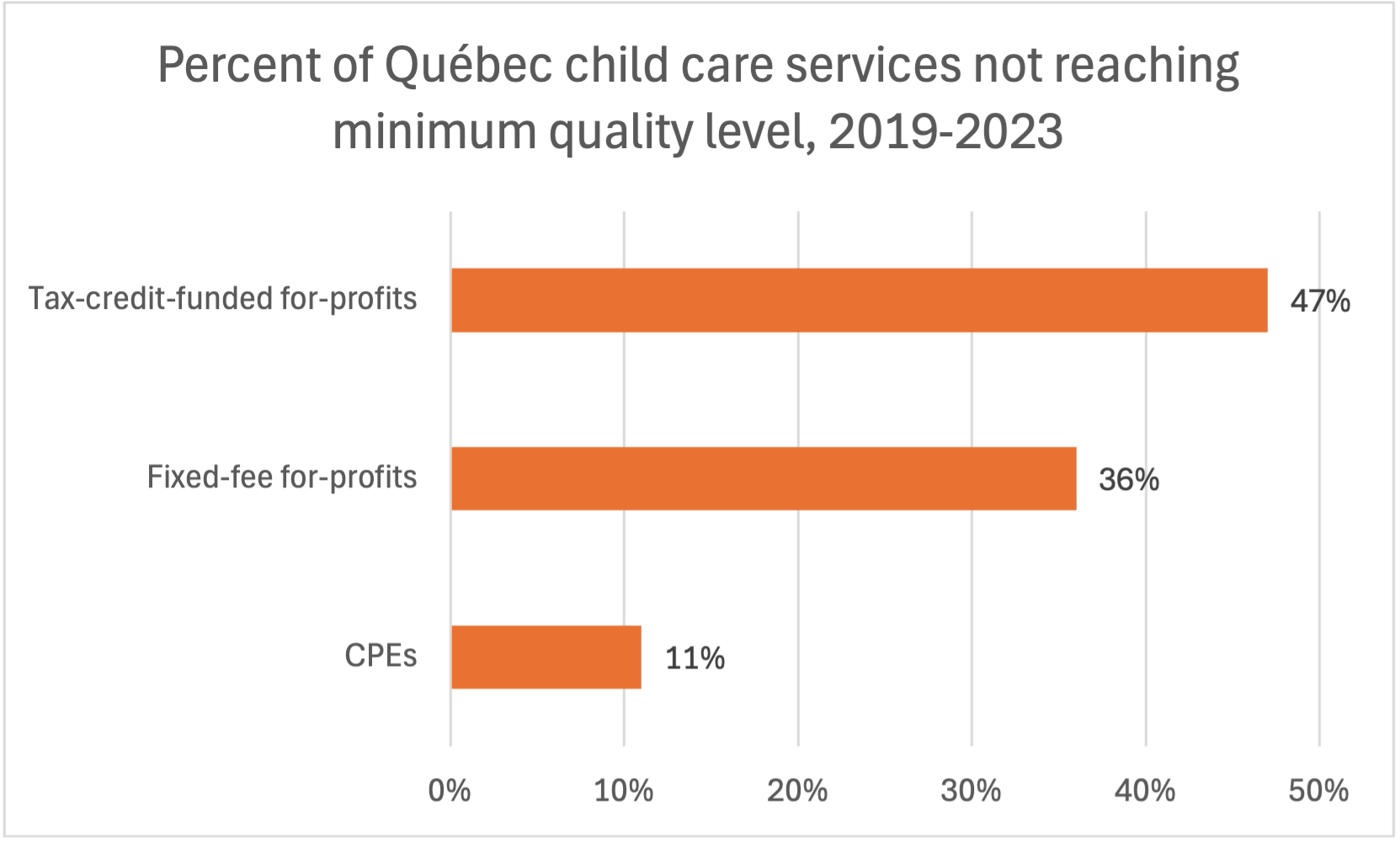
This week in the Hill Times, Peter Jon Mitchell says he wants to get rid of the $10 a day federal child care program. But too many families now love it and depend on the increased child care affordability that has made their lives better. So instead Peter Jon argues that the Canada Child Benefit or the Child Care Expense Deduction should be amended to provide child care assistance to those who can’t find child care. But neither solution would be much help. The Canada Child Benefit goes to nearly every family independent of whether they want to use any form of child care so this would be a very expensive way to deliver assistance. And the type of tax credit that Peter Jon would use to replace the Expense Deduction has been an unmitigated disaster for child care quality in Quebec, as the charts below show.
Peter Jon hopes to convince us that the federal child care funding program is a complete failure and shambles, so he throws as much mud as possible at the wall to see if any of it will stick. He has these complaints about the program:
Space creation is difficult because the child care agreements favour expansion predominantly in the not-for-profit/public/family child care sector
Many existing licensed spaces are empty or not operating
Most children under six years of age don’t benefit from the program
Only 71% of centres are in CWELCC – the federally funded program
The program breeds inequality. Child care enrolment by low-income families is declining – by 31% in Ontario.
Not-for-profit
The not-for-profit issue has been tested in practice. As Peter Jon reminds us “Quebec’s daycare program, upon which the CWELCC is modelled, has long depended on private, for-profit childcare businesses.” It’s true that since about 2010, Quebec has relied on a tax-credit-funded expansion of for-profit child care operators. There are three types of centres in Quebec. There are the CPEs which are not-for-profit community-based centres that charge a flat fee less than $10 a day. There are the funded for-profit child care centres (shown as GS on the charts) that also charge the low flat fee. There are the tax-credit-funded child care centres that grew since about 2010, shown as GNS on the charts.
The first chart shows us the results for on-site quality evaluations by the Ministry. The other shows us the percent of centres that fail to meet the current requirements for fully-qualified staff (which is one out of every two staff). Together they indicate that for-profit child care, which seems to be Peter Jon’s preference for the rest of Canada, is much lower in quality and cuts costs by avoiding hiring the required numbers of qualified staff, compared to the not-for-profit CPEs.
So, yes, there are good reasons to want space creation to take place predominantly in the not-for-profit and public sectors. Relying on for-profit expansion may seem faster and cheaper in the short run, but at what cost for our children’s future?
Enrolment
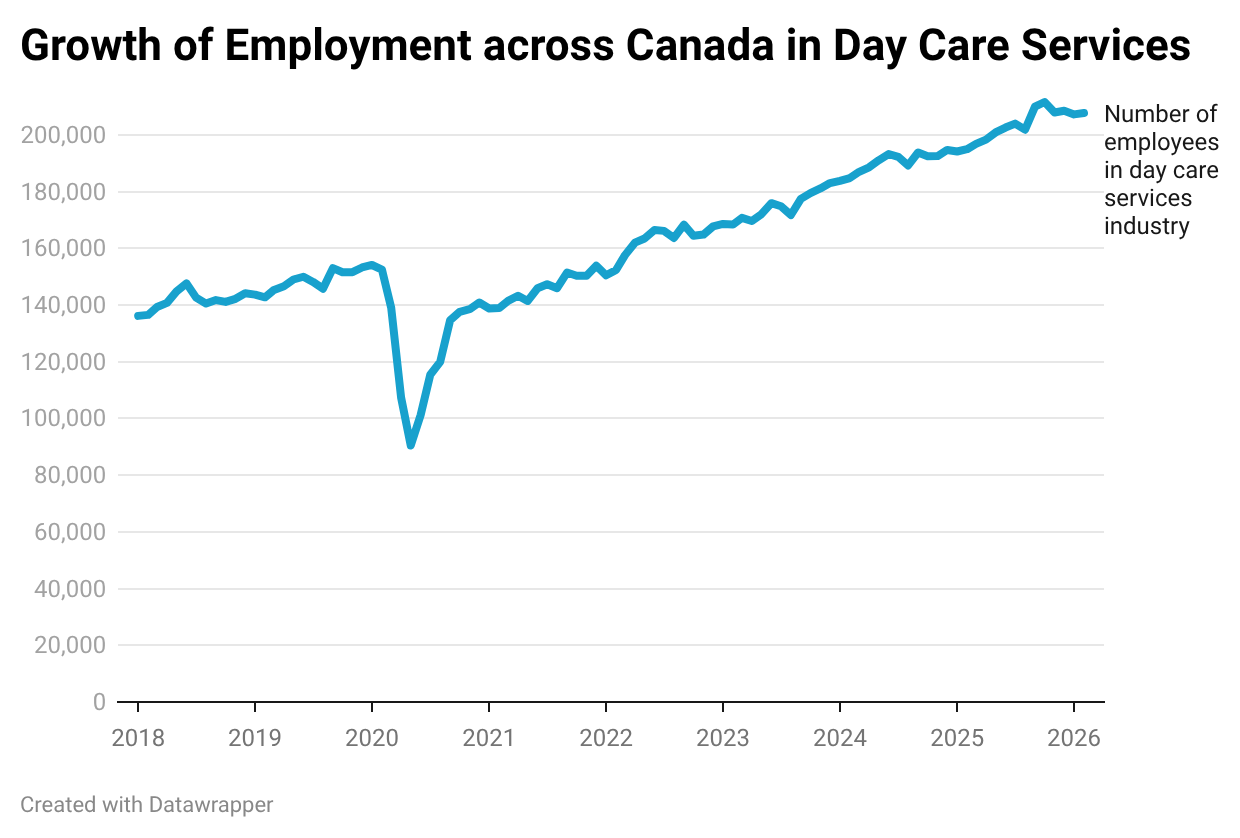
It’s true that there are too many existing licensed spaces that are empty or not operating. The Auditor General of Ontario found this was true of 27% of the funded spaces in Ontario, but it is also true elsewhere. The substantial majority of this is due to staffing shortages. Early Childhood Educators in most of Canada require a college education to be a fully-qualified educator, but they earn wages that are surprisingly low. As a result about half of all new hires in child care do not stick around for very long. Recruitment and retention of staff both fall well behind what is needed.
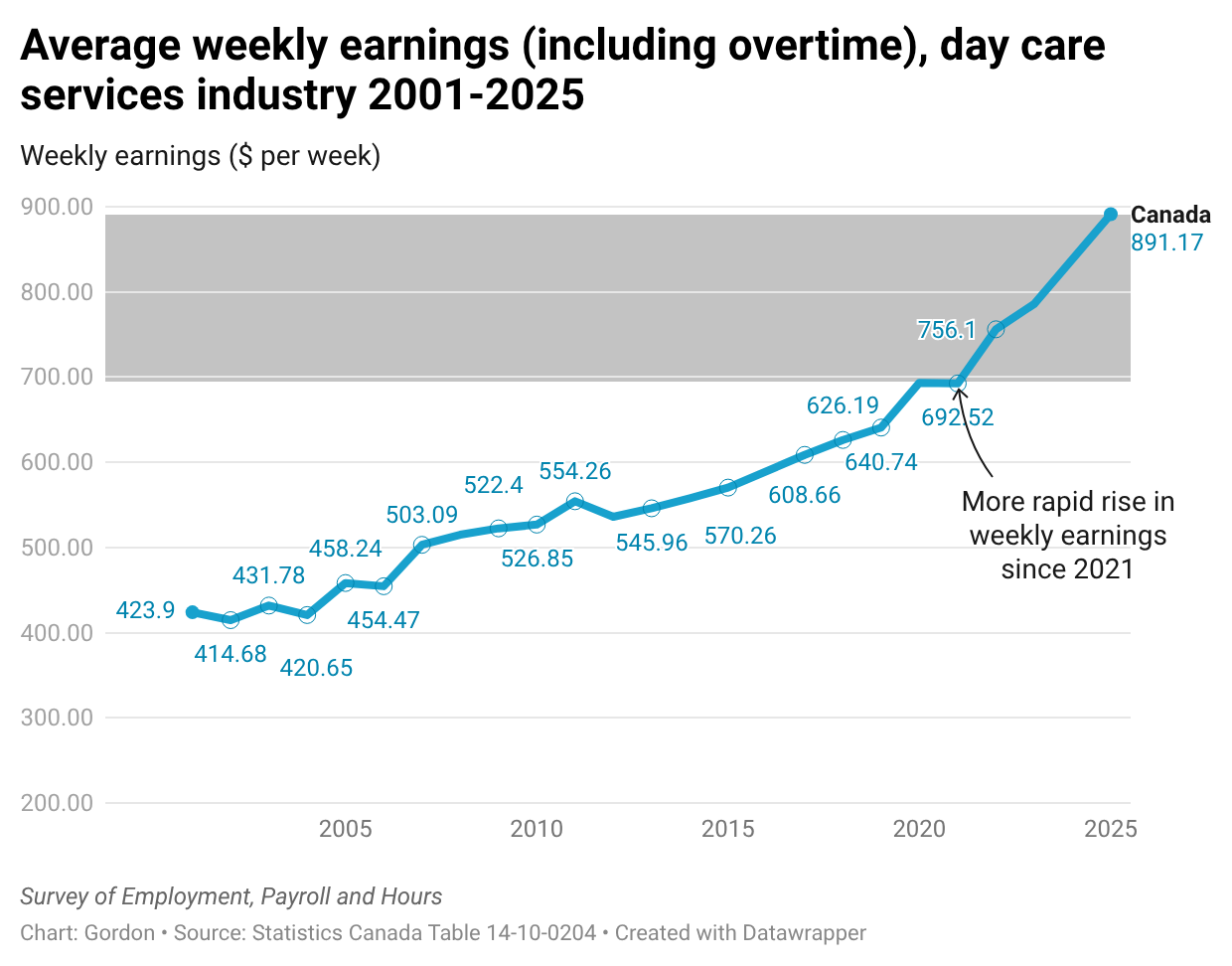
However, empty spaces suggest a solution different from Peter Jon’s – raise educator wages and benefits closer to the average wage in the province or territory. I’m sure that many trained educators currently working in retail and elsewhere will come flooding back to allow the spaces to open. Families would be happy, educators would be happy and the child care system would be more stable. The number of parents having difficulty finding child care would drop fast.
How many children benefit?
Peter Jon says that most children in Canada don’t benefit from CWELCC. CWELCC is intended to be a universal program, but that doesn’t mean that everyone will want to use child care from their child’s birth through until school. Many families take a year or more off after a child’s birth using maternity and parental leave to spend time with their infant. Many families live in jurisdictions with full-day kindergarten, sometimes for both four and five year olds and don’t need additional child care beyond that. Some parents want to stay home with their young child and do not need child care.
If we looked only at families where the main caregiving parent was employed, was not on maternity/parental leave, and whose child was not in kindergarten, then already in 2023, 62% of Canadian children were enrolled in and attending some form of licensed child care across Canada, most of it receiving federal funding. We still have a way to go to serve all children who need or want good quality affordable child care, but we’re much farther forward than Peter Jon says we are.
Is it true that nearly 30% of centres are not in CWELCC?
In fact, there are very few eligible centres not enrolled in the CWELCC program. Mr. Mitchell should be more careful with his “facts”.
The source he cites looks at centres serving children 0-12. This data source says that only 71% of centres said they were enrolled in CWELCC. But many of these centres serve only school-age children and these centres are not eligible to get federal funding, which is only for children 0-5.
Ontario is the province (outside Quebec) with the largest number of centres that are not part of CWELCC and as of March 31, 2025, 91.8% of all centres serving children 0-5 in Ontario were enrolled in the CWELCC program.
Child care enrolment by low-income families
This is a serious issue, but Peter Jon misunderstands it. It is true that the Auditor General of Ontario recently found that the number of children receiving child care subsidies in that province has declined by 31%. But that is compared to 2019 before CWELCC started, and the decline in subsidies before Ontario signed onto CWELCC was more rapid than since that time.
There is a legitimate worry that not enough low-income families will be able to access newly available spaces. The Auditor General cited favourably a program in one region where a percent of spaces in each centre are reserved for children receiving child care subsidies. This might be a useful reform that I hope Peter Jon would support. Already, there has been a strong prioritization for child care expansion in Ontario to favour underserved areas with more vulnerable populations.
However, rather than look only at subsidies, there is more comprehensive data on child care use by family income that comes from a 2023 parent survey done by Statistics Canada. Here’s what it shows:
The data suggests, yes, that access to licensed child care by lower income families is not as high as for the more affluent. But the differences are probably smaller than you thought they were. I don’t mean to minimize the issue. Most studies show that children from lower-income or vulnerable families are especially likely to benefit from quality child care. So working on this issue is a high priority. However, the sky is not falling. It is just a persistent problem that provincial and territorial child care systems need to address. In fact, it is a persistent problem in child care systems, no matter how they are funded, often less so the more universal the service is.
Instead of trashing the $10 a day child care program, maybe Peter Jon Mitchell should spend his time lobbying the Alberta Government to re-instate the child care subsidy system that they completely eliminated this year! This will definitely hurt lower and middle income families in Alberta. The Alberta Minister complained at the time that federal funding regulations did not allow him to fund a targeted program like child care subsidy. However, he had a subsidy system receiving federal funding ever since signing the CWELCC agreement with Ottawa, and nearly all other provinces have child care subsidy systems, so that excuse is untrue. Alberta should re-instate its subsidy system as part of its CWELCC funding.
What is to be done?
The $10 a day child care program is only partly developed and is far from perfect. Much more affordable licensed child care is now wanted by many more parents. Of course. And expansion of services is too slow. There is little capital funding and too little planning for expansion of not-for-profit child care. Also, crucially, child care wages in most provinces are too low to attract qualified educators.
Making child care more accessible is central to the health of the program. I hope Mark Carney recognizes that in the upcoming budget. After all, isn’t a universal child care system a pillar of the new economy that families with children need – the kind of nation-building project that will make Canada stronger, fairer, and more affordable?
By Martha Friendly, Executive Director, Childcare Resource and Research Unit, and
Gordon Cleveland, Associate Professor of Economics Emeritus, University of Toronto Scarborough
Many more children are in licensed child care (especially centres) now than before the $10-a-day program
In 2023, 177,900 more 0-5 year olds were reported by Statistics Canada to be in child care centres than at the end of 2020 just before the $10-a-day program began.
Nearly a million Canadian 0-5 year olds already benefit from low-fee licensed child care
938,000 children are using licensed child care that is eligible for the $10 a day program, according to 2023 Statistics Canada. If we add four and five year olds in kindergarten, and children at home with parents on parental leave, a total of 1.5 million young children are benefitting from public programs that support the care of young children as well as mothers’ employment and family incomes.
There is considerably more licensed child care than ever before
Between 2015 and 2023, the number of child care spaces for children 0-12 grew by 426,203 to a total of more than 1.6 million licensed spaces, despite the negative effects of the pandemic on child care services and mothers’ employment.
For the first time ever, child care has been made affordable for parents across the income spectrum
In eight provinces and territories (including Quebec), parents now pay $10-a-day or less for licensed child care. In the other jurisdictions, fees have been substantially reduced by provincial/territorial fee reduction or are provincially set. The fee changes mean that parent fees are between one-sixth to one-third of the fees before the $10-a-day program, depending on the province/territory. In addition, all provinces and territories except Alberta have fee subsidy programs to lower child care fees further for parents with particularly low incomes.
Waitlists for licensed child care were always long but have grown Although nearly a million Canadian children are benefiting from low-fee child care, there are too few licensed spaces and many families are still on waiting lists. Nearly 50% of child care users reported difficulty finding a space in 2023— about 10% more than the nearly 40% reporting difficulty finding care in 2020 before the CWELCC program began.
Many employed families who use other child care arrangements can claim financial assistance from the Child Care Expense Deduction, and most families with young children also receive the Canada Child Benefit – income support to help families with child rearing costs.
There is good agreement that provinces and territories must speed up expansion of spaces and hiring of qualified staff to reduce waitlists. To support this, federal government has made $625 million for child care infrastructure available to provinces and territories and allocated $1 billion of low-interest loans and grants for child care expansion to be distributed by the Canada Mortgage and Housing Corporation.
The $10-a-day child care program is very popular with parents, so demand for licensed child care, especially centres, is high.
Already in 2023, three-quarters of children in any form of non-parental child care were in licensed child care. On top of this, a majority of those not currently using any non-parental child care said they would like to use it too. Of these, 62% would prefer to use a child care centre.
For-profit providers are not being driven out of business
Mr. Poilievre claims that for-profit child care providers are being driven out of business. Agreements signed between the federal government and the provinces and territories included all existing child care providers willing to lower parent fees and provide accountability in exchange for very substantial, reliable public funding.
For-profit providers unwilling to participate in the low-fee program may set their own fees instead of relying on government funding. The agreements with provinces and territories specify that new spaces should be primarily in not-for-profit or public centres or in licensed family child care homes. This protective provision is intended to ensure that higher profits should not be the predominant rationale of a system of publicly funded services for children and families.
Pierre Poilievre’s “freedom and flexibility” child care policy would raise child care fees
Opponents of publicly funded universal child care claim that the $10-a-day plan is a bad idea—“a massive top-down bureaucratic system”, “one-size-fits-all”, and “worse today than when the Liberals took office”, arguing instead for payments to parents. Pierre Poilievre’s alternative is “more flexibility and freedom for parents, provinces, and providers”.
In other words, Mr. Poilievre’s alternative would allow provinces to eliminate the $10 a day program. Instead, providers will have the flexibility and freedom to set their own parent fees, and provinces will have the flexibility and freedom to use federal funds to support unregulated child care or favour for-profit operations. Slashing red tape will mean child care providers will no longer need to account for how they spend billions of dollars of funding.
Mr. Poilievre’s alternative is to go back to the previous scarce-space, high-fee, market-model child care. This didn’t work during the nine years in which the Harper government (of which Mr. Poilievre was a member) tried out its market model, and it won’t work now.
Many Canadians do not seem to realize that funding child care with tax credits would mean having no control over child care fees. Plus, there would be no financial accountability by operators for the public money they receive. Right now, child care fees are controlled in Canada – in eight of Canada’s thirteen jurisdictions, the fee is $10 a day. By April 2026, parent fees will be limited to $10 a day across the country. If we switched to tax credits (as the Conservative Party recommended in the last election), there would be no limitation on parent fees and no financial accountability for billions of dollars of public money. Child care operators could charge whatever the market would bear. And so, for many families, child care would be unaffordable once again.
I’m in Australia right now. It’s a gorgeous, sunny country with great restaurants, stimulating and dependable coffee, and very friendly people. But they have problems with their child care system that we can learn from.
You can give money to parents to fund their spending on child care; mostly, that’s what Australia does. Or you can fund the services to ensure that they will be available and affordable; mostly, that’s what Canada now does. The first is called demand-side funding. The second is called supply-side funding.
Demand-side funding comes under different names – a tax credit or a voucher or a parent subsidy; it amounts to the same thing. Australia has a Child Care Subsidy; there are bigger subsidies for low-income families and smaller subsidies for high-income families. The payments are made to the family’s chosen child care provider (from amongst approved child care providers), based on the amount of child care used. The parents have to pay whatever child care fees are not covered by the subsidy.
Australia has a market-based child care system. There are standard regulations on employee qualifications, staff-child ratios, health and safety, and so on. But, there are no effective government controls on the fees that are charged by providers and centres can be established wherever they choose – usually where it is most profitable. The majority of providers in the system are for-profit corporations and entrepreneurs.
Australia gives Canadians a chance to see how demand-side funding works in practice. And, I would argue, Australia gives a “best case” scenario for this approach. Australians have tried very hard over the years to make this subsidy/tax credit approach work equitably and efficiently for all families and they have done a lot to promote higher quality in child care services. I would argue that if Australia can’t make a demand-side funding system work effectively to make child care affordable, accessible and of high quality, then no one can.
In this context, the November 2024 report by Dr. Angela Jackson, Lead Economist for Impact Economics and Policy is well worth a read. The report – Time to Stop Throwing Good Money After Bad – was commissioned by the Minderoo Foundation, a charitable organization founded by Dr. Andrew Forrest (former CEO of the Fortescue Metals Group) and Nicola Forrest. The report provides an assessment of Australia’s child care funding and management system.
I think the best place to start is to look at two charts that Dr. Jackson features in the report.
Figures 4 and 5 are copied from her report. Figure 4 covers the period from 1991 until 2023. What you see are two lines. One is relatively straight, showing how the Consumer Price Index has risen pretty steadily over this period of 32 years. The fiscal year 2011-12 is the base year and gets an index value of 100. Compared to that, the average price level in the economy has risen from 50 back in 1991 to 140 now.
The second (yellow) line is very jagged. It goes up, then falls, then rises rapidly, then falls. Again and again. This line shows the “out of pocket costs” of child care. Out of pocket costs are the amounts that parents actually pay for child care after accounting for the child care subsidy they receive. When government increases the subsidy, the out of pocket costs go down. When fees charged by child care operators rise but the subsidy stays the same, then out of pocket costs rise.
In the battle between rising child care fees and increasing levels of subsidy, child care fees have been winning. Overall, the amounts paid by parents have been rising faster than inflation despite subsidy increases.
In Australia, there were major infusions of funding and reform of child care policy in 2000, 2007, 2008, 2018 and 2023. In 2020, during the pandemic, child care services became free for those continuing to use them. We can see each of these events on the chart as a sudden drop in the yellow line.
But none of these funding infusions have stopped the upward march of child care fees. Out of pocket costs of child care have increased quite a bit faster than inflation over this 32 year period DESPITE many government attempts to improve tax credit/parent subsidy funding arrangements to make child care more affordable. Child care has become, on balance, less affordable, not more affordable. In 2023, after Child Care Subsidy is accounted for, the average out of pocket cost of child care for parents in Australia was $44.42 per day (or over $11,500 per full year).
By how much have child care fees risen over this time period? Figure 5 provides this information. It includes the two lines from the previous figure but adds a new one. This third (red) line, rising above the other two shows the amount by which the cost of child care to parents would have risen had there been no improvements in child care subsidization. The underlying costs of child care have risen by 499.9% over this period – much much faster than the rise in consumer prices! In 2023, before subsidy, the average child care fee for full-day care in Australia was $133.96 (or nearly $35,000 for a full year).
This pattern continues to this day. As Dr. Jackson notes, over the last 12 months child care fees have increased by 10.6%, which has eroded the benefits of the new $5 billion child care expenditure program begun in July 2023.
“when government subsidies increase, out of pocket expenses decline sharply in the immediate term, but then quickly revert to levels preceding the subsidy change.”
Is this pattern a glitch? Or is it a feature that we should expect to observe if Canada were to adopt a tax credit system for funding child care? Those who support tax credits emphasize parent choice and flexibility. What they do not tell you is that tax credit systems mean that there is NO CONTROL over the fees charged by child care providers. There is no regulation of the decisions that corporations and entrepreneurs make about where to locate their services. And further, there is no requirement that child care providers account for the ways in which they spend the billions of dollars of government money they will be receiving when subsidized children attend their facilities.
With a tax credit system, additional government spending largely benefits providers, not families. True enough, this very generous funding system has encouraged providers to expand. There were enough centre-based spaces for only 7% of Australia’s children 0-4 years of age back in 1991 and there is now coverage for 42% in 2022.
Since there is little control over where providers locate, access to child care is concentrated in wealthier areas where providers can charge higher fees. 24% of Australia’s households with children are located in child care deserts.
The large majority of providers in Australia are for-profit enterprises. And for-profit providers have been found, in Australia as elsewhere around the world, to provide lower quality child care on average. Australia has put a lot of resources into measuring quality of services. Their quality rating system has five result categories: Significant Improvement Required, Working Towards National Quality Standard (NQS), Meeting NQS, Exceeding NQS, and Excellent. 35.4% of not-for-profit providers are rated as Exceeding NQS or Excellent. Only 12% of for-profit providers reach the same levels. Further, for-profit providers have been found to be half as likely to increase their quality ratings over time as the not-for-providers are.
Viewing the Australian experience with a Canadian lens, the tax credit approach has many weaknesses. In a tax credit system, the only way to make child care affordable for parents is through substantial infusions of government funding. However, if substantial government funding is combined with providers having the freedom to set and change their own fee levels, then the result will be rapidly rising fee levels and reduced affordability. On top of that, there is no requirement for child care operators to account for how public money is spent.
In theory, competition among providers is supposed to bring fees down and force providers to offer better quality of care. In practice, competition is very imperfect, partly because child care markets are very localized, so few providers compete directly with each other. Competition is also imperfect because parents can only perceive and evaluate child care quality imperfectly.
So a tax credit or voucher system pushes up child care costs, profits and fees but delivers child care that is expensive for governments, unaffordable for many families and very uneven in quality. Governments get into a cycle of additional spending to bring out of pocket costs down, then watching as provider fees rise to make child care unaffordable once again. Whatever its growing pains, $10 a day child care is a much better bet than tax credits to provide affordable, accessible, quality child care.
However, Supplementary Subsidy Funding Plays A Positive Role Most Canadian provinces and territories have child care subsidy systems that are supplementary to their main way of funding child care. The effect of this is positive. The main funding is on the supply side – funding to operators in exchange for child care services made available to families. On top of that, most provinces and territories have a subsidy system that can lower the parent fee from $10 a day (or, currently, a higher fee in five Canadian jurisdictions) for low-income or multiple-child families that cannot afford $10 a day. Most of these subsidy systems are imperfect, but they serve the very important purpose of ensuring affordability for all families, even those who cannot afford current reduced fees.
Those who oppose the $10 a day program often argue that there is a simple and better program to replace it – give money directly to parents instead. The logic is, at first glance, persuasive. If you give parents money, it seems like they should be able to purchase exactly the child care they need. And competition among different providers should, you might think, keep fees down. Programs that directly fund child care services, like the $10 a day program, are said to be bureaucratic and inflexible and to create huge shortages and long waiting lists.
There is some truth here, but much falsehood, and much deliberate ignoring of the evidence on the impact of a “family allowance” approach. I have just written a report for The Prosperity Project that examines the likely impacts of giving parents money instead of funding and providing child care services that parents can use. I unearth a lot of new data about families that are using child care in Canada and the number of parents who want access to affordable, accessible, high quality child care.
The evidence shows that this type of “family allowance” fails as public policy because it:
(a) isn’t what most families want
(b) doesn’t address families’ needs for child care
(c) would be much more expensive than the $10 a day program
(d) would have negative effects on women’s employment and the economy, and would increase the gender-based child penalty that mothers pay with reduced earnings
(e) has been tried before and hasn’t solved child care issues, and
(f) ignores the very large child benefit programs that already provide money to parents.
You should read the report in full (19 pages), or at least its Executive Summary (3 pages). Below, I provide a few tidbits to encourage you to dig deeper.
As of 2023, when Statistics Canada collected large amounts of data from parents about child care and employment, there are 938,000 Canadian children using licensed or accredited child care services – the kind of services supported by the federal government program. In fact, over three-quarters of children using any kind of child care are in licensed care. In 8 of Canada’s 13 jurisdictions, average fees for this child care is down to $10 a day or less. Other jurisdictions have lowered fees by at least half relative to fee levels in 2019-20. In other words, although the press scarcely covers it, a very large number of Canadian children and families are already benefiting from licensed child care that is subsidized to be affordable and more accessible.
Licensed child care is not the only part of the set of services and benefits that will make up a fully developed early learning and child care system. Many children benefit from full-day or part-day kindergarten at ages 4 and 5 years. Many children and families benefit from paid maternity and parental leave for up to 12 or even 18 months. If we put these all together, it is already true that in 2023 over 1.5 million children currently benefit from Canada’s early learning and child care and leave arrangements. That is about 2/3rds of all children 0-5 years of age.
Some people think that the reason some parents don’t currently use child care is because they don’t want to. But, outside Quebec, most families (58%) that currently do not use any child care would like to use some type of non-parental child care if they can find what they need and want. And, of these, the lion’s share – 62% – would like to use licensed child care, largely as a means to join or rejoin the workforce.
Some people argue that it is mostly affluent parents that benefit from universal child care programs and that marginalized families and those from diverse backgrounds are left behind. That is certainly true of market-based child care systems when fees are not controlled; high parent fees are only affordable by affluent families and many vulnerable families do not qualify for income-based subsidies. However in fixed-fee systems like the $10 a day program, families from all backgrounds gain access. I show a series of charts from Quebec making this point.
A family allowance program would have to give parents an amount of money that was equivalent, on average, to what they gain by having $10 a day child care. This family allowance program would cost the federal government just over $28.5 billion annually and its net cost would be three times as much as the cost of providing child care services.
Women who have children suffer substantial losses in earnings after the birth of a child. Economists have found that mothers’ earnings decrease by 49% in the year of a child’s birth. Even ten years later, women suffer from an average earnings loss of 34% relative to their earnings before childbirth. Universal child care has been found to substantially reduce these “child penalties”. In other words, accessible child care services make an important contribution to increasing gender equity.
Most child care in Ontario is provided by non-profit or public operators. This has been true for years. A full 70% of the licensed/regulated child care spaces for children 0-5 were non-profit or public back in 2022, when Ontario signed the Canada-Wide Agreement with Ottawa.
So, two things are not in doubt. First, it is obviously possible for non-profit and public child care services in Ontario to grow and expand, given the right conditions. They have done it successfully in the past, more successfully than the for-profit child care operators. Second, the Ontario government, with the support of municipal governments and school boards, knows exactly how to facilitate and co-ordinate the expansion of non-profit and public child care, because it has done this in the past.
So, if non-profit and public child care are not expanding rapidly in Ontario, it must have to do with the failures of Ontario government policy (as described in my recent blog post).
Ontario has failed to fix shortages of early childhood educators. Starting wages in Ontario are $5.00 an hour less than in P.E.I.!
It has failed to provide or enable sources of capital funding for expansion of community non-profit child care.
It has starved child care providers of revenue in the $10 a day program and has failed to provide any certainty about future revenue streams for operators.
Ontario has failed so comprehensively that you have to wonder if the failings are deliberate.
To cap it all off, we now find that Ontario is deliberately violating the terms of the Canada-Wide Agreement that it signed with the federal government back in March 2022. Ontario promised to increase child care capacity by at least 86,000 spaces, and it promised that a maximum of 30% of these new spaces would be operated by commercial for-profit operators. The balance would be community-based or school-based non-profit and public child care. It also promised that it would prioritize development of child care in underserved areas and amongst families with greater needs.
Instead, about 75% of the expansion that has occurred has been in for-profit spaces. And at least half of the new spaces are in areas of greater profitability rather than areas of greater need. Half of the new spaces can charge whatever fees they want, rather than being affordable spaces.
We know some details about Ontario’s expansion because of good journalism by Allison Jones of Canadian Press. She has recently written:
“Ontario’s deal committed the province to 86,000 new child–care spaces since 2019, though the deal was signed in 2022. But so far while there have been about 51,000 new spaces since 2019 for the kids five and under, the age group covered by the national program, only 25,500 of those are within the $10-a-day system.”
So, let’s do the math:
Pretty well all of the new spaces that are outside the $10 a day system (without any controls on fees) are for-profit, so that is already half of the 51,000 spaces.
Much of the growth inside the $10 a day system is also for-profit. When Ontario published its Action Plan in 2022 it told us that 15,000 spaces had opened since 2019 and 45% of this was for-profit.
A further 21,200 spaces were said to be “in the pipeline” and 66% of this was for-profit.
I estimate therefore that about half of the growth since 2019 that is inside the $10 a day system is for-profit (the Ministry of Education has these figures and is shy about releasing them, which tells you that they know they have something to hide).
In other words, about 75% of the total of 51,000 new spaces in Ontario since 2019 are in the for-profit sector.
This is a clear violation of the Canada-Wide Agreement Ontario signed in 2022. In that agreement it promised that “at the end of this Agreement, the proportion of not-for-profit licensed child care spaces for children age 0 to 5 compared to the total number of licensed child care spaces for children age 0 to 5 will be 70% or higher.” (emphasis added). The agreement clarifies the purpose of this clause: “to ensure that the existing proportion of not-for-profit licensed child care spaces for children age 0 to 5 will be maintained or increased by the end of this Agreement.”
In case there was any doubt, the “definitions” section of the agreement refers to the Child Care and Early Years Act, 2014 in defining licensed child care. In other words, it refers to all licensed child care governed by that act.
So, Ontario is taking federal money intended to build a publicly-managed, affordable and accessible high quality child care system and it is not doing what is necessary to provide spaces for children and families.
Of course, parents who are desperate for child care spaces right now don’t care if the spaces are for-profit, non-profit or public. They just want a space for their child and they want it now. The negative effects of relying on for-profit child care without sufficient controls won’t show up for a while.
That’s what happened in the early 2000s when the Government of Quebec, under Jean Charest, tried the same trick – relying on for-profit child care for expansion. The results were disastrous for the quality of child care services, with nearly half of the new for-profit centres failing quality assessments sponsored by the Quebec Government. Similar quality problems are what led Mathieu Lacombe, the Quebec Minister of Families from 2018 to 2022 to say that allowing for the expansion of private daycare, was the ‘biggest mistake the Quebec government committed in the last 25 years.”
As I wrote in that recent blog:
I am not trying to say that all for-profit operators provide poor quality child care or that all of them skimp on child care staffing. Some small for-profit operators provide good quality care and devote themselves to quality improvements. You can have a certain percentage of for-profit providers in a publicly-funded child care system, but there need to be strong measures of public management that limit the ability of for-profit enterprises to extract profit at the expense of quality.
That was the spirit of the Agreement that Ontario signed up to in 2022. If Ontario were to implement this agreement in good faith, it would adopt a generous funding formula to cover actual costs, it would make expansion of child care into an all-of-government priority with a range of provisions for capital financing, it would develop a wage grid for child care educators that is at least as generous as the one in PEI and it would implement the agreement it signed on the balance of non-profit and for-profit expansion. Ontario’s parents and children need the $10 a day child care system they were promised.