
Until the results of the Canadian Child Care Worker Survey are published by Statistics Canada, the Canadian Survey on the Provision of Child Care Services (CSPCCS) provides the most detailed information available about Canada’s child care workforce.
The CSPCCS is a relatively new survey, now collected every two years. The latest results available are from 2024. It samples child care locations – child care centres and regulated/licensed family child care homes and unlicensed family child care homes, as long as these locations have annual income of at least $2,500. We are particularly interested in the data provided by child care centres.
I wrote a blog previously about some workforce information from the 2022 CSPCCS.
I will review some data from the 2024 CSPCCS, but first I have to raise doubts about this survey. The information is useful, but there is reason to doubt that the sample is representative of the population. Let me explain
The 2024 edition of this survey collected data from April to June of 2024. The Statistics Canada report on the survey results tell us that there were 14,523 child care centres serving Canada’s children 0-12 years of age.
However, every couple of years, the Childcare Resource and Research Unit (CRRU) collects information on child care services across the country from the provincial and territorial governments who are best placed to know details about their child care systems. CRRU calculates (Table 26) that there were, in 2024, 18,378 child care centres across the country (over 25% more than Statistics Canada thinks there are).
That’s not all. The CSPCCS 2024 report says that there were 909,158 children 0-12 years of age enrolled in those centres. But, the CRRU report tells us that in 2024 there were 709,684 centre spaces for children 0-5 and another 734,076 centre spaces for children 4-12 (Table 20). That’s over 1.4 million centre-based child care spaces in Canada. For the CSPCCS data to be correct, over 530,000 licensed centre spaces would have to be sitting empty. The more reasonable explanation is that the CSPCCS has significantly undercounted the actual number of centres and centre-based enrollment in Canada.
You can also see this in Ontario. Ontario publishes an annual report on child care every year. Their report tells us that there were 5,836 child care centres in Ontario in 2023-24, whereas the CSPCCS only records 4,425 centres. The names and locations of all of these centres is public knowledge and the data is not hard to acquire. I’m not sure what the problem is. CSPCCS says there were only 249,473 children 0-12 years of age enrolled in Ontario child care centres. However, data provided to CRRU by the provincial Ministry of Education says that 332,379 children were enrolled in centres in Ontario in 2024.
Anyway, let’s look at some of this workforce data from CSPCCS 2024.
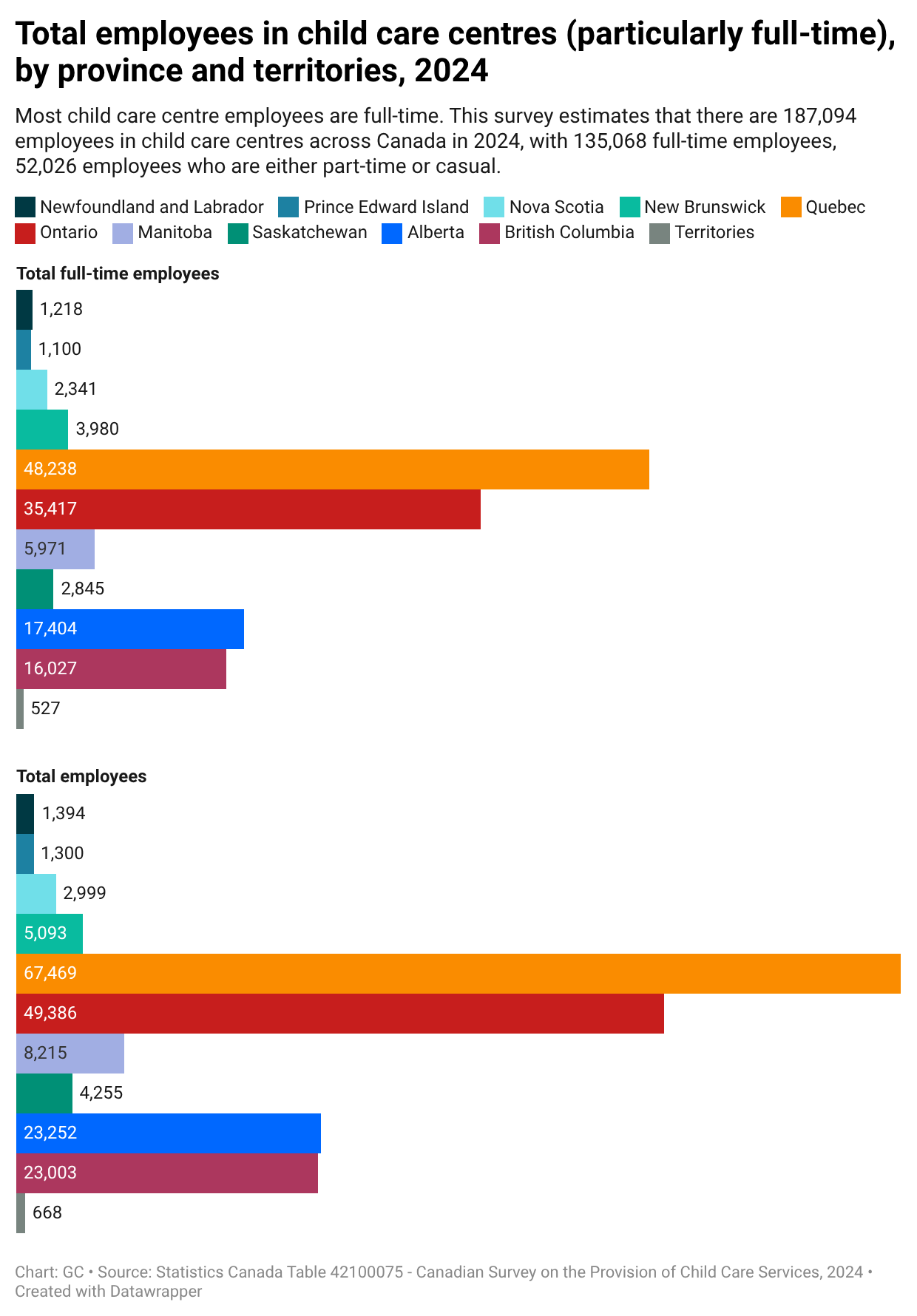
Here’s data on the number of employees (of all types) employed by centres in Canada’s provinces and territories. There are over 185,000 employees, with most of them working full-time. That’s a bit lower estimate than my recent blog, but close.
Québec, Ontario, Alberta and B.C. account for the large bulk of this workforce.
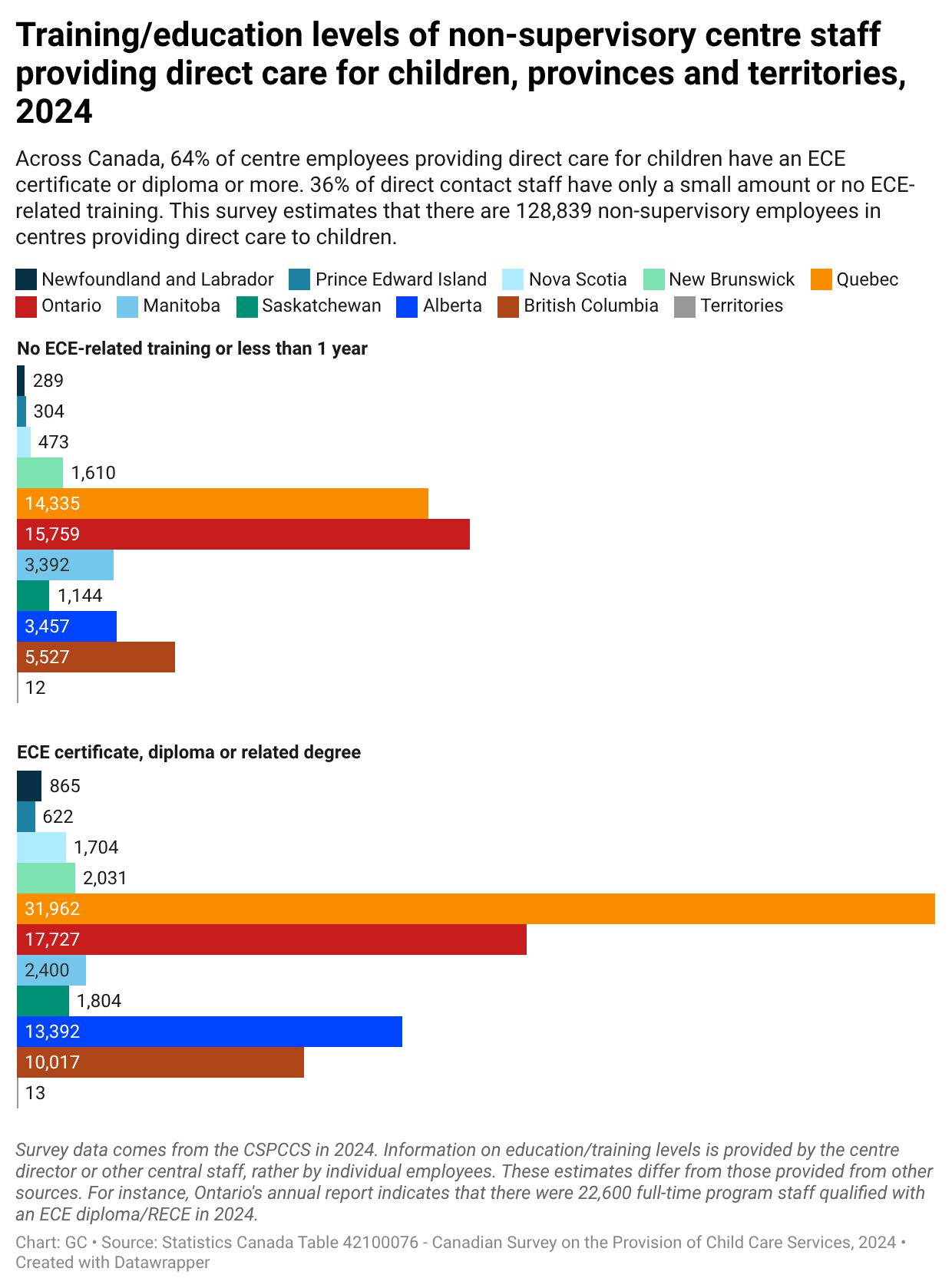
The next chart shows us staff education levels. We narrow our focus now to only “program staff”, those that are in direct contact with children on a day-by-day, hour-by-hour basis. It does not include supervisory staff that are more occasionally in contact with children. Nor does it include administrative and financial staff, cleaners and maintenance workers, etc. The CSPCCS 2024 survey estimates that there are 128,839 of these program staff employees and that 64% of them have a post-secondary ECE certificate or diploma or better. The remainder – 36% – have either no ECE training or only a small amount.
Conclusions:
There appear to be about 187,000 employees working in or for child care centres across Canada. This does not include staff working in centres that are directly operated by school boards who are not in the sample. For instance, this excludes all employees providing child care in Québec schools for children 5-12 years of age and in Ontario excludes employees in before-and-after school programs that are directly operated by school boards.
Most of the 187,000 workers identified in the CSPCCS 2024 are employed full-time and the bulk of them are employed in Québec, Ontario, Alberta or B.C.
Nearly 130,000 of these workers are non-supervisory program staff who provide direct care and education for children. Close to two-thirds of these program staff have ECE training in the form of a college diploma or certificate or other post-secondary qualification.
It is possible that these employment numbers are understated because of limitations of the sample used in the 2024 Canadian Survey on the Provision of Child Care Services.