
Some commentators believe that Canada cannot benefit from a substantial boost in labour supply when we make child care much more affordable and available. Labour force participation of mothers is already high in Canada they say. There’s not much room for increase.
But these judgements are wrong. In fact, it is reasonable to believe that more than 200,000 additional mothers of young children will be in the labour force annually when child care in the rest of Canada becomes as affordable and available as in Québec. And most of this new employment would be full-time.
Right now, labour force participation of mothers in the rest of Canada is much lower than inside Québec. Affordable and available child care in Québec has boosted labour supply and earnings for mothers of children 0-5 but also for mothers of older children who stay in the labour force as children get older. This can and should be replicated in the rest of Canada.
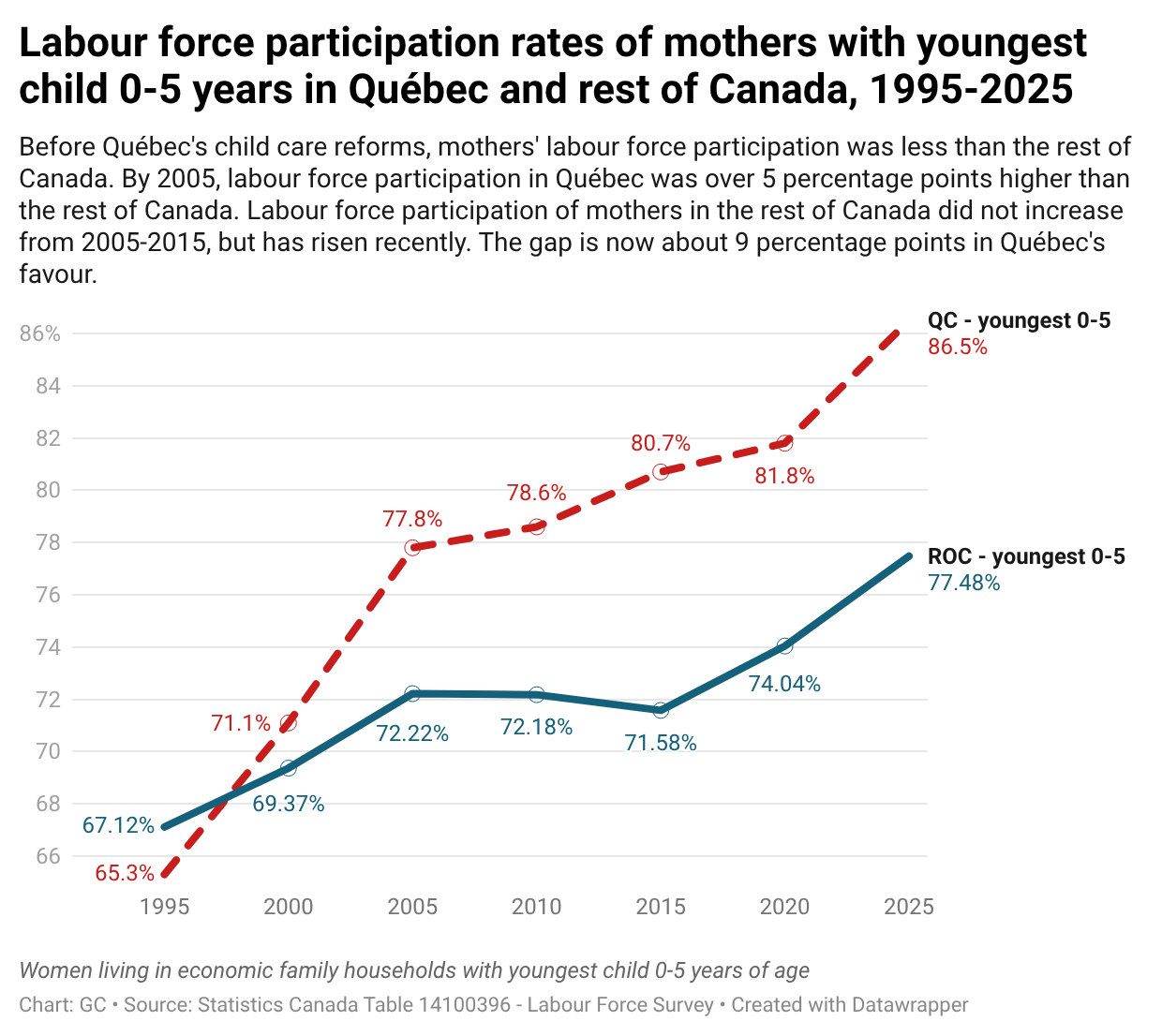
Have a good look at the three charts below. Every five years, they show labour force participation from 1995 (before the Québec child care reforms) to 2025. The first chart shows the rapid and continuing rise for mothers whose youngest child is 0-5 years of age in Québec (red dotted line). In the rest of Canada (blue line), labour force participation has risen, but much more slowly.
The big conclusion from the first chart is that there is lots of room for mothers in the rest of Canada who have children 0-5 to increase labour force participation – there’s a 9 percentage point gap. If the rest of Canada matches Québec’s participation, there would be 105,000 additional mothers with children 0-5 in Canada’s labour force.
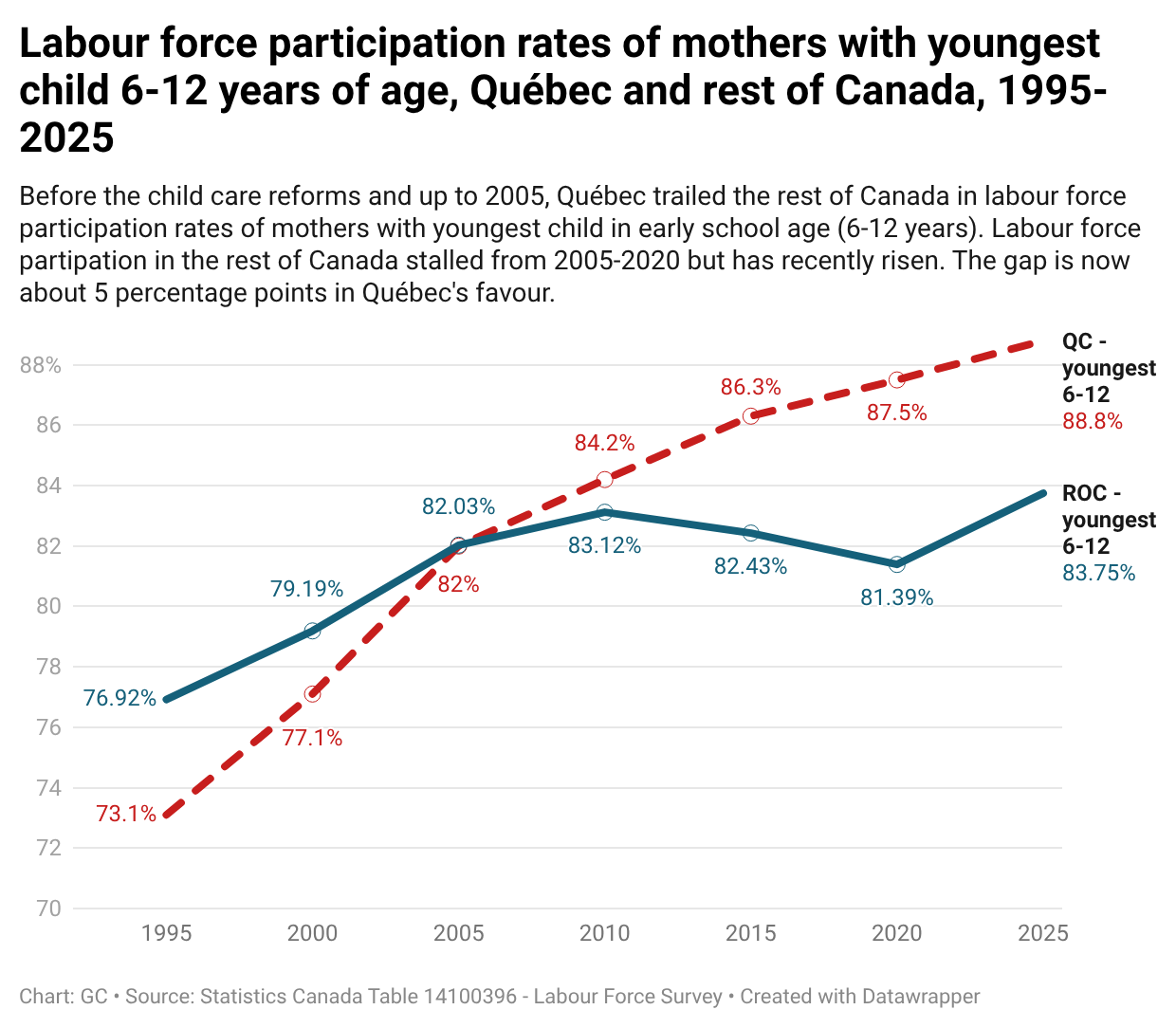
But, that’s not all. As the recent Baker, Gruber and Milligan study (2026) and others have shown, mothers affected by $5 a day child care tended to stay in the labour force for the long haul. We can see these effects in the next chart. It shows labour force participation in Québec and the rest of Canada again, but this time for mothers whose youngest child is 6-12 years of age.
In Québec, mothers who were exposed to affordable child care when their children were young stayed in the labour force, and each successive generation was more and more likely to remain attached to employment even when children were 6-12 years of age. In contrast, labour force attachment in the rest of Canada rose more slowly and not continuously. If behaviour in the rest of Canada matched Québec, there would be 54,000 additional mothers with youngest child 6-12 in the labour force.
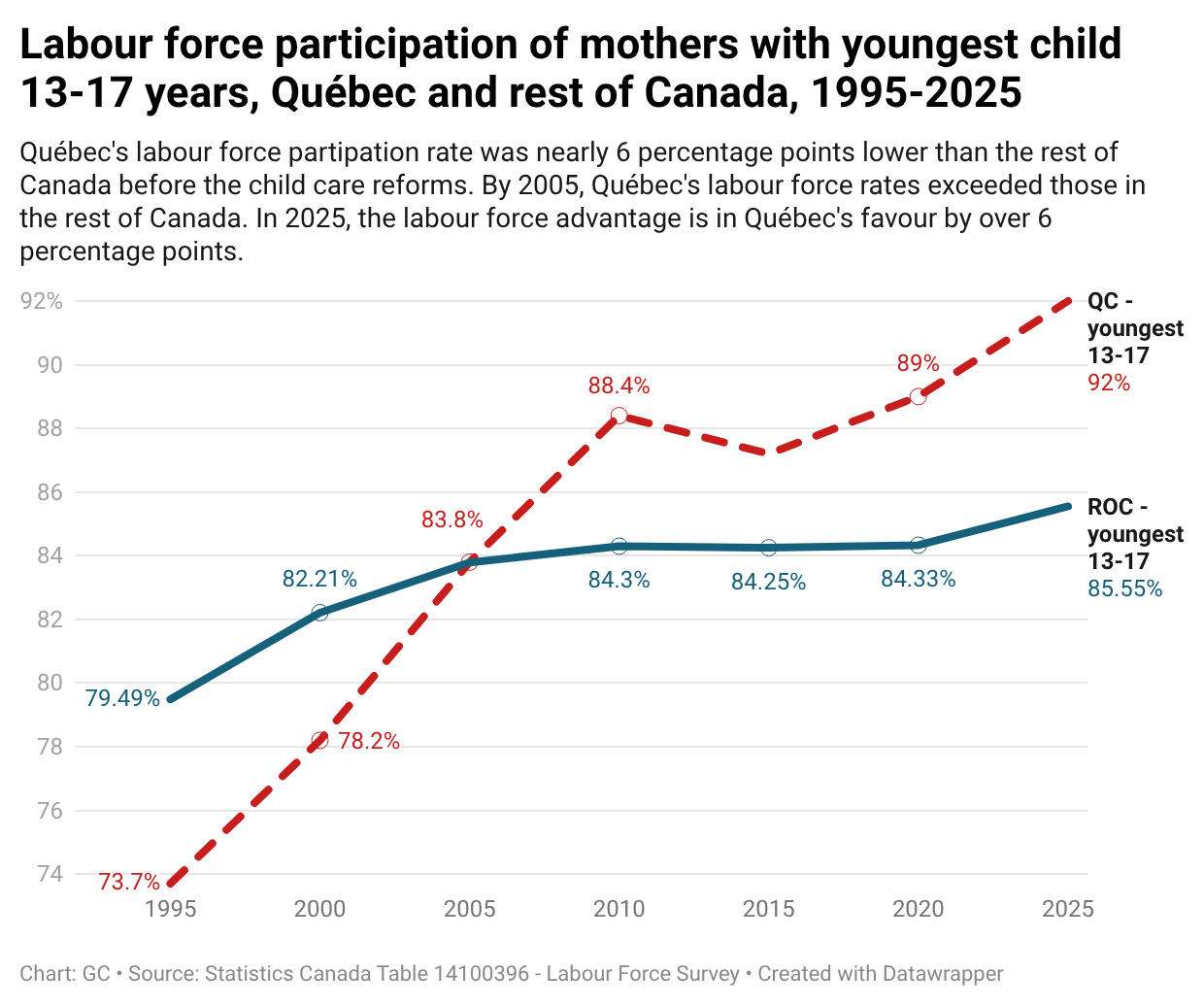
The same story is repeated for families with youngest child 13-17 years of age. If behaviour in the rest of Canada matched Québec, there would be 45,000 additional mothers in the labour force with youngest child 13-17 years of age.
So, a conservative estimate of the potential changes in labour force behaviour of mothers each year in the rest of Canada outside Québec would sum together these additions to the labour force – 105,000 + 54,000 + 45,000 = 204,000 extra mothers boosting up Canada’s supply of labour.
I say this is conservative because I haven’t taken into account hours of work. Baker, Gruber and Milligan found that most of the new employment was full-time rather than part-time. Nor have I looked at any labour force impacts after children turn 18. And I haven’t taken into account the important economic boost from changes in mothers’ earnings that Baker, Gruber and Milligan found.
The key to Québec’s success was the rapid expansion of child care capacity after 1997 so most families with young children could benefit. Will we learn this lesson in the rest of Canada? Yes, if we deliver on the promise of the Canada-Wide Early Learning and Child Care program to provide affordable and available child care to all children who want and need it, the rest of Canada can replicate Québec’s labour force success.